

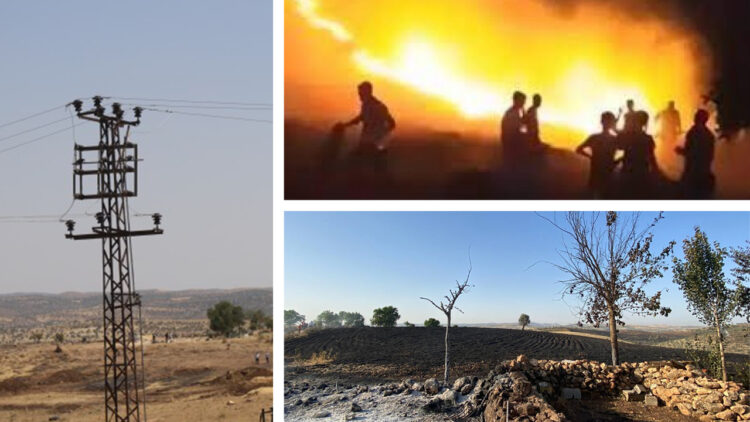
A preliminary report by the Diyarbakır Chief Prosecutor confirms that the fire between Diyarbakır (Amed) and Mardin (Mêrdîn), which resulted in 15 deaths and the destruction of 1,490 hectares of land, was caused by electrical faults rather than stubble burning by villagers.
Eyewitness accounts and a report by the Chamber of Electrical Engineers had already indicated that the fire, which broke out on 20 June, originated from electrical lines. These findings are now corroborated by the prosecutor’s preliminary report.
The prosecutor’s investigation involved testimonies from villagers and eyewitnesses, leading to the conclusion that the fire was electrical in origin. “The evidence points to electrical faults as the cause,” the report states. A detailed report will be prepared in the coming days after consultations with relevant institutions.
The Diyarbakır Chief Prosecutor’s report challenges initial statements from official sources that blamed the fire on villagers’ stubble burning. The investigation’s findings underscore the negligence of the state-owned electricity distribution company, Dicle Elektrik Dağıtım A.Ş. (DEDAŞ).
The 1,490 hectare fire killed a total of 924 livestock. In Diyarbakır’s Çınar district alone, 790 hectares of farmland were destroyed, including 111 hectares of unharvested wheat. Additionally, a tractor and 14 irrigation facilities were destroyed.
Residents of the worst-hit Kelekê village, where 10 citizens lost their lives in the fire, have expressed dismay over the delayed response and alleged obstruction by military personnel during rescue efforts. They reported that soldiers blocked access to the village roads and hindered attempts to rescue those trapped in the blaze.
According to a villager named Cahide Demir, both village exits were sealed off, preventing intervention as the fire took hold. She recounted chaotic scenes in which children and young adults were caught amid the flames, their cries for help echoing through the village. Despite desperate pleas, assistance did not arrive promptly.
Emine Demir, a village resident who lost 10 family members in the tragedy, lamented the lack of immediate helicopter support, which only arrived after the fire had subsided, describing it as too late to save lives. Leyla Demir added that even retrieving the bodies of their loved ones became a harrowing ordeal due to military restrictions on village access.
Further investigations are expected to provide more details on the exact failures within the electrical system and determine the full extent of DEDAŞ’s liability.
Meanwhile, Diyarbakır branch of the Union of Chambers of Turkish Engineers and Architects (TMMOB) released a preliminary technical inspection report suggesting that DEDAŞ’s repair activities in the affected areas on 21 June were an attempt to tamper with evidence. The TMMOB report emphasised that the fires were not caused by stubble burning but by poorly maintained electrical infrastructure.
The reports highlight a history of neglect by DEDAŞ in predominantly Kurdish areas, suggesting potential racial bias in the failure to maintain and repair the region’s electrical infrastructure adequately. Specifically, DEDAŞ was found responsible for the fire that occurred on 8 June 2023 in the rural Karabudak (Sîpyag) neighbourhood of Şınar (Xana Axpar) in Diyarbakır. Following this incident, the state-run company was held liable by the Diyarbakır Civil Court of the First Instance No.10 and forced to pay compensation to the affected Kurdish villagers.
“The same DEDAŞ system caused fires in the same area last year. Despite being held responsible, dozens of people died in this year’s fire. This was a foreseeable disaster, indicating possible intent rather than mere negligence,” said Ahmet İnan, General Secretary of the Diyarbakır Bar Association’s Urban and Environmental Law Commission, also pointing to a potential racial bias behind the criminal negligence.


