

Sütun 1
Sütun 2
Sütun 3
Medya News
Daily News
Breaking News
Subscribe
No Result
View All Result
  • Home
  • All News
  • Opinion
  • Kurdistan
  • Women
  • Politics
  • Human Rights
  • INTERVIEW
  • More
    • SPECIAL REPORTS
    • ECOLOGY
    • WORLD
    • AUDIO ARTICLES
    • JOURNALISM
    • ECONOMY
    • CULTURE & ART
    • LONG READS
    • NEWSLETTER
    • DAILY NEWS
MULTIMEDIA
PODCAST
LIVE BLOG
  • Home
  • All News
  • Opinion
  • Kurdistan
  • Women
  • Politics
  • Human Rights
  • INTERVIEW
  • More
    • SPECIAL REPORTS
    • ECOLOGY
    • WORLD
    • AUDIO ARTICLES
    • JOURNALISM
    • ECONOMY
    • CULTURE & ART
    • LONG READS
    • NEWSLETTER
    • DAILY NEWS
MULTIMEDIA
PODCAST
No Result
View All Result
Medya News

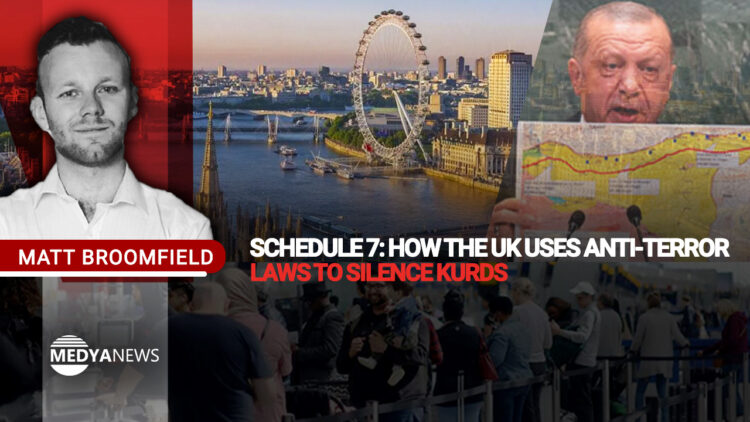
Schedule 7: How the UK uses anti-terror laws to silence Kurds

British anti-terror police found themselves in the headlines this week after using a controversial power to detain a French publisher at the British border and quiz him about his opposition to the French government. The case shone a spotlight on a little-known but widely-abused power, Schedule 7 of the Terror Act (2000), which equips British police with the ability to detain, search and interrogate anyone they claim is entering or leaving the country for reasons related to the commission of acts of terrorism – without needing to formally charge the individual in question, and without the right to silence.
8:59 am 17/11/2023
A A
Schedule 7: How the UK uses anti-terror laws to silence Kurds
Share post

Matt Broomfield

British anti-terror police found themselves in the headlines this week after using a controversial power to detain a French publisher at the British border and quiz him about his opposition to the French government. Ernest Moret, who was travelling to the UK for a book fair, has now been released on bail after refusing to surrender his laptop and phone passwords. The case shone a spotlight on a little-known but widely-abused power, Schedule 7 of the Terror Act (2000),

which equips British police with the ability to detain, search and interrogate anyone they claim is entering or leaving the country for reasons related to the commission of acts of terrorism – without needing to formally charge the individual in question, and without the right to silence.

Members of the UK Kurdish community are regularly detained and harassed while travelling to Europe for meetings, political events, and funerals

As might be expected, this power has been widely criticized by civil rights charities as open to abuse. And nor should it come as any surprise that the Kurdish community is singled out for harassment, detention and obstruction of travel using the power, further preventing their participation in legitimate diplomatic, political and journalistic activities linked to the Kurdish cause.

📌#AUDIOARTICLE| Matt Broomfield reports on the UK's use of anti-terror laws to disrupt the movement of Kurds travelling too Europe for meetings, political events and even funerals. https://t.co/tF8RrgnXtM pic.twitter.com/VjMqyuUZh7

— MedyaNews (@1MedyaNews) April 21, 2023

Civil rights campaigners argue that the power is excessive, and used disproportionately to target people from Muslim and minority ethnic backgrounds. Analysis by the organisation Cage has shown that of the 419,000 people stopped under Schedule 7 between 2009 and 2019, only 30 were convicted. This 0.007% conviction rate suggests the power is being used as a dragnet to target particular communities, subject individuals to harassment such as the forced removal of headscarves and interrogation about innocuous religions practices, and restrict freedom of movement and expression.

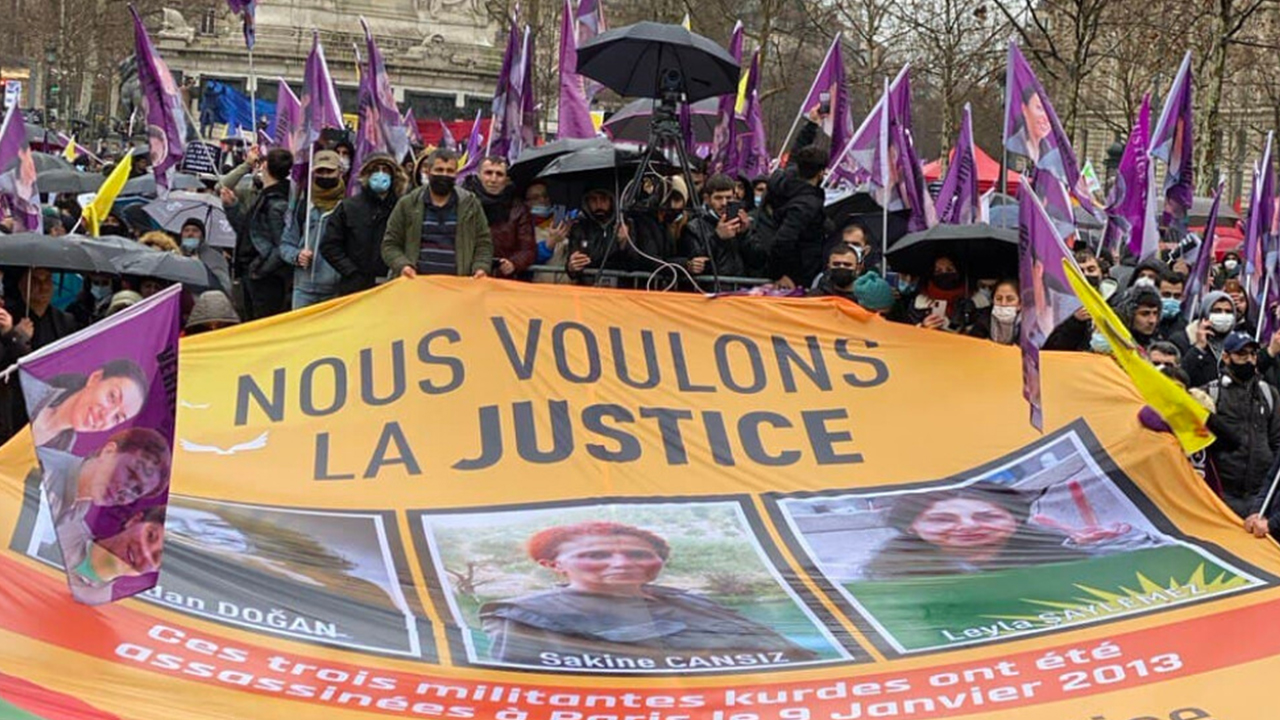
This generalized use of the power has dropped off steeply in recent years, with protracted public criticism meaning the police now favour other methods to gather information. But Schedule 7 is still regularly used to target Kurdish political representatives, activists, journalists and ordinary members of the diaspora. Recently, Kurdish community leaders and a journalist travelling to France to pay their respects and join peaceful protests following the murder of three Kurds in a terror attack on a community centre were detained under this power. Kurdish families have been detained en masse, and had their personal cash seized,

while travelling to Paris to attend the funeral of the victims of yet another triple murder of Kurds. Many prominent British-Kurdish political organizers expect to be stopped and interrogated each time they travel, whether to attend conferences or events in Europe, or simply when visiting their family in Kurdistan.

In a recent, landmark case, a member of umbrella political organisation the Kurdistan National Congress,

who was detained on arrival in the UK, won protections against the potentially-discriminatory use of Schedule 7, indicating the power should not be used on the basis of a legally-discriminatory approach to legitimate political beliefs. But as other recent stops on the UK-French border make clear, the power is still being used with little regard for the letter of the law to systematically harass Kurds and their supporters. The primary aims of these detentions therefore appear to be generalized information-gathering about the Kurdish community, and deterring Kurds from engaging in political activity of any sort.

The French publisher Moret’s own arrest was controversial because the British authorities appeared to be using this uniquely far-reaching power to do the French intelligence services’ dirty work for them, by investigating whether the publisher had been involved in anti-government – not terrorism, and certainly no concern of the British authorities, by any stretch of the imagination. “Perhaps most seriously, during his interrogation he was asked to name the ‘anti-government’ authors in the catalogue of the publishing house La Fabrique, for which he works,” said a statement from his employers. “None of these questions should be relevant to a British police officer.”

The same question hangs over the British police’s use of this power to target Kurds. Turkey has long demonstrated the ability to influence British security policy, with heavy-handed policing of Kurdish protests, raids on Kurdish homes and community centres, and aggression at the border all par for the course – and arrests of Kurdish activists often timed to coincide with Turkish diplomatic visits to, or trade deals with, the UK.
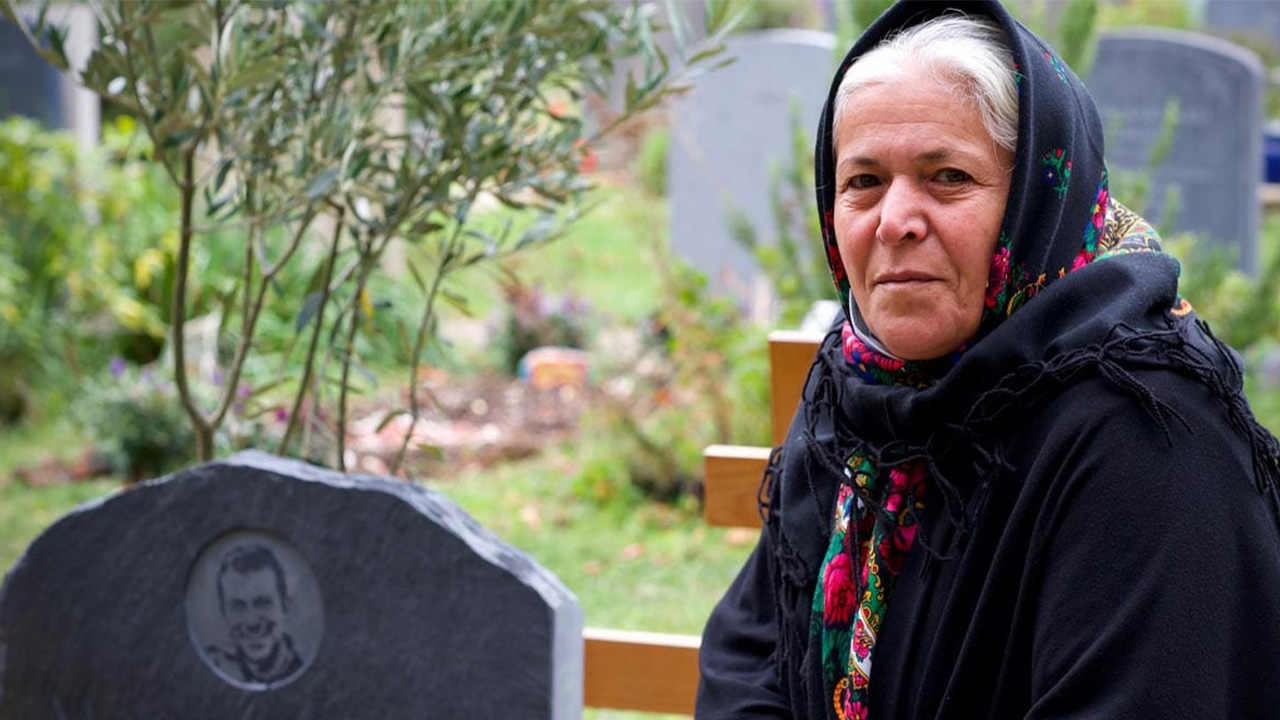
UK volunteers in the fight against ISIS have also faced persistent harassment and obstruction at the border

Notably, the UK has recently brought and subsequently dropped five separate cases against volunteers supporting the Kurdish-led Syrian Democratic Forces in their fight against ISIS and Turkish-backed Islamist groups, running up against the inconvenient fact the UK has never considered Syrian Kurdish groups to be terrorist and is itself allied with the SDF in the fight against ISIS. This repeated pattern suggests external, political pressure on the legal process, as judges repeatedly ask why these cases are being put forward in the first place.

When I myself was detained and questioned under this power on return from my work as a reporter in Syrian Kurdistan, the anti-terror police were clear that there was nothing illegal about travelling to or working in the region. These comments raised the question of why I should be detained and face restrictions when travelling in the first place. As is typical in such instances, the interviewing detective professed nominal sympathy for the ideals of women’s rights, democracy and rule of law being implemented in Kurdish-led North and East Syria. All communities deserve the right to equal treatment under the law – but all the more so when they are fighting for values the UK is supposed to share.

Matt Broomfield is a freelance journalist, poet and activist. He writes for VICE, Medya News, the New Statesman and the New Arab; his prose has been published by The Mays, Anti-Heroin Chic and Plenitude; and his poetry by the National Poetry Society, the Independent, and Bare Fiction. His work was displayed across London by Poetry on the Underground, and he is a Foyle Young Poet of the Year.


Share post
Tags: Trending

Related Posts

Daily News : 06 November 2024

Daily News : 06 November 2024

November 6, 2024
Daily News : 05 November 2024

Daily News : 05 November 2024

November 5, 2024
Daily News : 03 SEPTEMBER 2024

Daily News : 03 SEPTEMBER 2024

September 3, 2024
Fifty more detainees released under amnesty for internal peace in North and East Syria

Fifty more detainees released under amnesty for internal peace in North and East Syria

September 3, 2024
Uncle of missing child in Turkey arrested as case exposes broader child safety issues

Uncle of missing child in Turkey arrested as case exposes broader child safety issues

September 3, 2024
Turkey’s bid to join BRICS raises questions within NATO

Turkey’s bid to join BRICS raises questions within NATO

September 3, 2024

The news content on our website cannot be quoted without permission, even by citing the source. It cannot be copied or published elsewhere, contrary to the law or without permission.

Follow Medya News

Categories

  • All News
  • Politics
  • Human Rights
  • Opinion
  • Kurdistan
  • Human Rights
  • Interview
  • Women
  • Audio Articles
  • Special Report

Quick Menu

  • Daily News
  • Live Blog
  • Podcast
  • Videos
  • Breaking News

About

Impressum

About us

Privacy Policy

Welcome Back!

Login to your account below

Forgotten Password?

Retrieve your password

Please enter your username or email address to reset your password.

Log In
We use cookies on our website to give you the most relevant experience by remembering your preferences and repeat visits. By clicking “Accept All”, you consent to the use of ALL the cookies. However, you may visit "Cookie Settings" to provide a controlled consent.
Cookie SettingsAccept All
Manage consent

Privacy Overview

This website uses cookies to improve your experience while you navigate through the website. Out of these, the cookies that are categorized as necessary are stored on your browser as they are essential for the working of basic functionalities of the website. We also use third-party cookies that help us analyze and understand how you use this website. These cookies will be stored in your browser only with your consent. You also have the option to opt-out of these cookies. But opting out of some of these cookies may affect your browsing experience.
Necessary
Always Enabled
Necessary cookies are absolutely essential for the website to function properly. These cookies ensure basic functionalities and security features of the website, anonymously.
CookieDurationDescription
cookielawinfo-checkbox-analytics11 monthsThis cookie is set by GDPR Cookie Consent plugin. The cookie is used to store the user consent for the cookies in the category "Analytics".
cookielawinfo-checkbox-functional11 monthsThe cookie is set by GDPR cookie consent to record the user consent for the cookies in the category "Functional".
cookielawinfo-checkbox-necessary11 monthsThis cookie is set by GDPR Cookie Consent plugin. The cookies is used to store the user consent for the cookies in the category "Necessary".
cookielawinfo-checkbox-others11 monthsThis cookie is set by GDPR Cookie Consent plugin. The cookie is used to store the user consent for the cookies in the category "Other.
cookielawinfo-checkbox-performance11 monthsThis cookie is set by GDPR Cookie Consent plugin. The cookie is used to store the user consent for the cookies in the category "Performance".
viewed_cookie_policy11 monthsThe cookie is set by the GDPR Cookie Consent plugin and is used to store whether or not user has consented to the use of cookies. It does not store any personal data.
Functional
Functional cookies help to perform certain functionalities like sharing the content of the website on social media platforms, collect feedbacks, and other third-party features.
Performance
Performance cookies are used to understand and analyze the key performance indexes of the website which helps in delivering a better user experience for the visitors.
Analytics
Analytical cookies are used to understand how visitors interact with the website. These cookies help provide information on metrics the number of visitors, bounce rate, traffic source, etc.
Advertisement
Advertisement cookies are used to provide visitors with relevant ads and marketing campaigns. These cookies track visitors across websites and collect information to provide customized ads.
Others
Other uncategorized cookies are those that are being analyzed and have not been classified into a category as yet.
SAVE & ACCEPT

Add New Playlist

Contact

[contact-form-7 id=”18690″ title=”Contact form 1″]

[email-subscribers-form id=”1″]

No Result
View All Result
  • All News
  • Kurdistan
  • Women
  • Politics
  • Human Rights
  • Interview
  • Long Reads
  • World
  • Journalism
  • Ecology
  • Economy
  • Culture & Art
  • Daily News
  • Breaking News
  • Newsletter
  • Opinion
  • Authors
  • Podcast
  • LIVE BLOG

© 2020 Medyanews. All Rights Reserved