

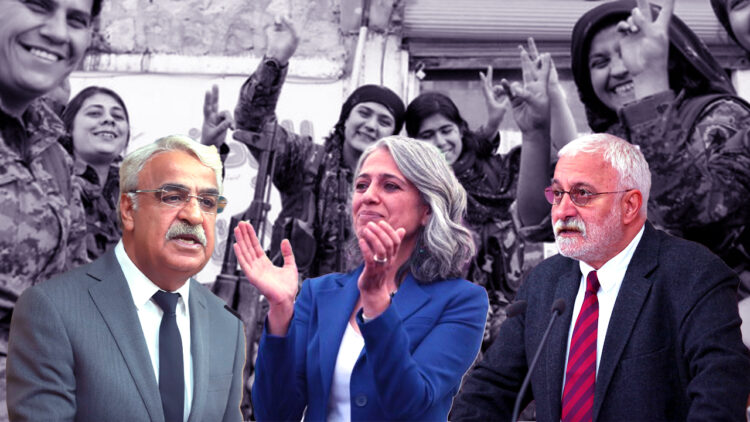
Leading members of the Peoples’ Equality and Democracy (DEM) Party and the Democratic Regions Party (DBP) have urged Turkey to embrace peaceful solutions to conflicts in North and East Syria (Rojava), during ongoing parliamentary budget discussions on Tuesday. They warned that escalating military actions risk destabilising the region, undermining coexistence among diverse communities, and perpetuating decades-long tensions.
Speaking in the Turkish Grand National Assembly, Saruhan Oluç and Mithat Sancar highlighted the urgency of dialogue, constitutional reforms, and regional partnerships. Oluç described Rojava as “a rose blooming in the desert,” imploring Turkey not to “wither it through conflict.”
Meanwhile, on Tuesday in Şanlıurfa (Riha), Çiğdem Kılıçgün Uçar, co-chair of the Democratic Regions Party (DBP), criticised Turkey’s foreign and domestic policies for exacerbating regional instability. “Rojava exemplifies resilience and coexistence amid adversity,” she said. “Targeting such a model undermines democratic values and erodes Turkey’s credibility as a regional power.”
Saruhan Oluç, DEM Party’s MP for Antalya, linked Turkey’s democratisation to resolving the Kurdish issue. “Turkey’s progress depends on addressing Kurdish aspirations,” he said. “Democratic reforms and peace efforts are intertwined; you cannot achieve one without the other.”
Oluç criticised Turkey’s current policies as counterproductive, calling instead for a Turkish-Kurdish alliance. “Such an alliance holds historical and regional significance,” he stated. “It could transform not only Turkey but also foster peace across Iraq, Syria, and Iran, where millions of Kurds reside.”
He emphasised the diverse cultural fabric of Rojava, home to Kurds, Arabs, Armenians, and others. “This is a society where different cultures coexist. Instead of policies that destroy, we need frameworks that protect and strengthen this unity,” he added, calling Turkey’s military actions in the region “misguided and destructive.”
Mithat Sancar, a DEM Party MP from Şanlıurfa, reinforced the message by stressing the necessity of recognising Kurdish rights in Rojava as a prerequisite for regional peace. “Ignoring these rights only obstructs progress,” he said. “It creates an impasse for any peace initiative.”
Sancar warned against military escalations, arguing that they deepen societal divisions and hinder Turkey’s own aspirations for stability. “Without addressing the legitimate rights of Rojava’s people, any dialogue on peace will fail to gain traction,” he cautioned.
In her Şanlıurfa address, Uçar called for an inclusive constitutional process to address the grievances of all ethnic groups. “Democracy cannot thrive where the rights of one group are systematically suppressed. Turkey must redefine its approach to governance and embrace its diversity,” she concluded.
Closing his address, Oluç urged decision-makers to reconsider Turkey’s trajectory in the region. “Rojava is not a threat; it is an opportunity,” he said. “It embodies a vision of coexistence and progress. Let us not destroy it but learn from it.”
The DEM Party’s remarks come as Turkey faces increasing scrutiny over its military interventions in Syria, with critics accusing the government of undermining stability and fuelling regional conflicts.
As the budget discussions continue, the party’s calls for dialogue, democratic reforms, and a Turkish-Kurdish alliance underscore their vision for a more inclusive and peaceful future.


