

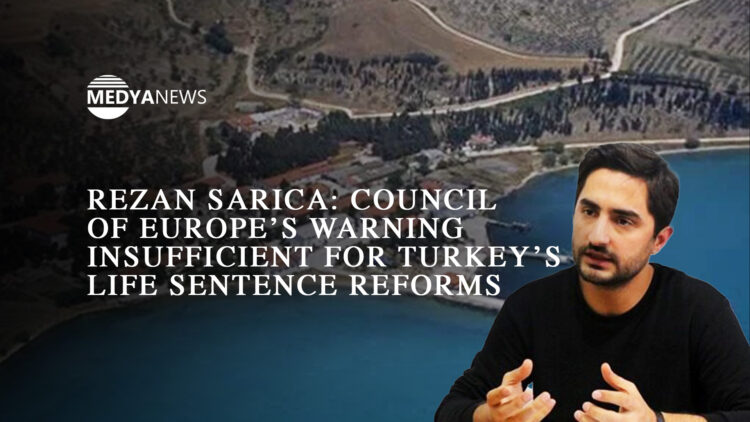
Lawyer Rezan Sarıca has warned that while the Council of Europe’s recent warning to Turkey over life sentence reforms is a positive step, it remains insufficient to address the deeper issues tied to aggravated life sentences. Sarıca, who represents Kurdish leader Abdullah Öcalan, stressed that the new developments fall short in addressing the realities faced by those affected, including Öcalan, who has been held in solitary confinement for 25 years.
During the Council’s meeting from 17-19 September, the Committee of Ministers called on Turkey to introduce a review mechanism for those serving aggravated life sentences. The committee warned that if Turkey fails to take action by September 2025, further measures may be implemented. However, Sarıca highlighted that this step is “positive but far from sufficient considering the reality at İmralı,” referring to the prison where Öcalan is held.
Sarıca noted that Turkey’s lack of compliance with the European Court of Human Rights (ECtHR) ruling from 2014, which deemed the country’s life sentence laws a violation of the Right to Hope, has left thousands of prisoners in limbo. “The failure to reform this issue, which affects so many, is deeply concerning,” he added, pointing out that Turkey’s inaction affects not just Öcalan, but also thousands of families.
Sarıca criticised the slow pace of the Council’s process, explaining that the ongoing delays have allowed Turkey to avoid making meaningful progress. “While this is a new phase, and the September 2025 meeting is set, the fact that it has taken over a decade without real action shows how slow the process has been,” he said. According to Sarıca, the Council’s handling of the case contrasts with its own rulings, which found Turkey’s treatment of Öcalan and other prisoners to be in violation of human rights.
“The Council’s delay only prolongs the torture,” Sarıca stated, adding that the current situation allows Turkey to “continue its violations with impunity.” OcalanVigil, a campaign advocating for Öcalan’s release, echoed these concerns, criticising the Council for repeatedly postponing action.
Sarıca urged the Council to adopt a more active monitoring approach and implement faster, more effective measures to bring Turkey into compliance with international human rights standards.
While the Council’s decision to place the issue on the agenda for September 2025 is a significant step, Sarıca remains sceptical about the overall progress. “The next steps must come much sooner,” he concluded.
In addition to Rezan Sarıca’s remarks, the Kurdistan Communities Union (KCK) also criticised the Council of Europe’s approach, calling it “insufficient” in addressing the ongoing isolation of Abdullah Öcalan. In a statement released on 21 September, the KCK condemned the Committee of Ministers for giving Turkey a one-year deadline to implement the Right to Hope law, arguing that this leniency effectively legitimises the Turkish state’s policies of “torture and genocide” in İmralı Prison.
The KCK asserted that Öcalan’s isolation is part of a broader strategy of Kurdish genocide, which is being perpetuated with international support. They further accused European institutions, including the Council, of failing to uphold their responsibilities by remaining passive in the face of the Turkish state’s flagrant human rights violations. The KCK urged all human rights organisations and legal experts to take immediate action and intensify efforts for Öcalan’s physical freedom, describing his treatment as a “crime against humanity”.


