

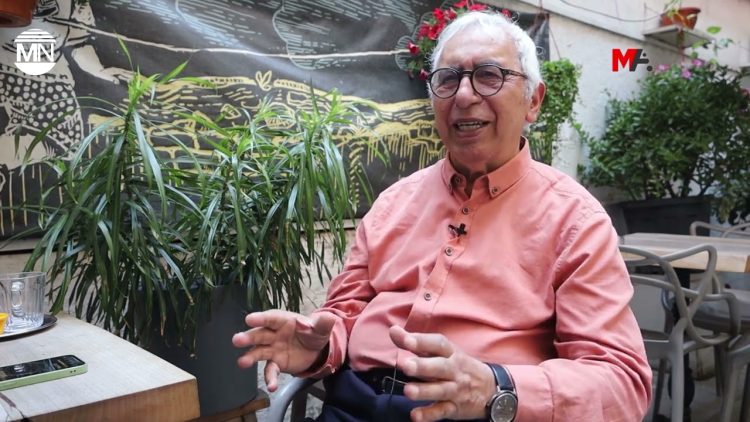
Journalist Oral Çalışlar has said that the Kurdish issue remains unresolved because Kurds are still viewed as Turks. He pointed out that acknowledging the Kurds as Kurds would pave the way for a solution, indicating Turkey’s parliament as the key to progress.
The Kurdistan Workers’ Party (PKK) held its 12th Congress from 5-7 May, where it made the decision to end its activities, following Kurdish leader Abdullah Öcalan’s call for “Peace and Democratic Society” made by on 27 February. The organisation’s decision has opened the door to a new era for the Kurds and Turkey. As calls grow for the establishment of a parliamentary commission to address the Kurdish issue and advance the democratisation of the country, it is expected that a new judicial reform package will be presented to the parliament soon.
Veteran Turkish journalist and author Oral Çalışlar spoke to the Mezopotamya Agency (MA) on Saturday about Öcalan’s call for peace and the developments that followed.
The PKK held a congress and announced it was ending its activities. How do you view this decision?
We’re talking about a 50-year period. Their first armed action was the 1984 attack on the police station of Eruh [in Siirt, southeast Turkey]. That had a shocking impact. It was a form of uprising Turkey wasn’t used to. Yes, Turkey had seen the 1968 movement, with young people heading to the mountains [to become fighters], but this was different. Directly attacking a town’s central police station went beyond bold. In 1997, they took a group of us journalists, including Fatih Altaylı, Fehmi Koru, Abdurrahman Dilipak, Enis Berberoğlu, Gülay Göktürk and myself to Hakkari (Colemêrg), where they briefed us. Travelling by road to the villages wasn’t possible as the PKK was blocking the routes, but we could go to villages by helicopter. Village guards [state-paid militias] also briefed us. But when one of them said, “These are children of Armenians,” all of us journalists stood up and said, “We’re not listening to this”. That kind of talk took things to a completely different level. This “children of Armenians” rhetoric was still being used even in 1997. But there was no solution to any of this. Forty-one years have passed since then. Over those years, various governments have been and gone, all crying, “We’ve dug them out by the roots, we’ve finished them, Struggle with Terrorism”. None of them succeeded.
Why do you think this “digging them out by the roots” never happened?
Because this is a sociological and societal issue. It’s not something that can be stopped with military measures. As Öcalan said in his call for peace, the time for weapons is over. There’s nothing more Kurds can achieve through armed struggle. Because now, there are opportunities legal political action, for you as much as for me. What’s more, despite the closing down of and the pressure brought to bear on the parties whose tradition the Equality and Democracy (DEM) Party is following, they have maintained their presence in the legal sphere. By holding their ground, they have become a political force. The unresolved Kurdish issue has become a major obstacle to Turkey’s progress. Turkey has made several attempts to move towards democracy. The Justice and Development (AK) Party, [former Prime Minister Bülent] Ecevit and [former Prime Minister and President Süleyman] Demirel all tried. But each time, they stumbled on the Kurdish issue. Governments have tended towards fighting terrorism rather than advancing democracy. This is no longer something that can be resolved with weapons. It is now widely recognised as a sociological, societal and political matter. When we discuss how to solve it, we conclude that the place for that is parliament.
Abdullah Öcalan and the PKK also point to parliament as the solution. Why is parliament so important?
The current parliament has the highest level of representation in Turkey’s history. It represents 93% of the vote. Only 7% of Turkey’s voters are unrepresented, which is a very high figure by global parliamentary standards. This makes it one of the most representative parliaments in the world. In this parliament, both the [left-wing] Turkish Workers’ Party and the [far-right] Nationalist Movement Party [MHP] are saying, “We’re ready to join such a commission”. With such strong public support behind this process, we need to move forward through parliament. What other legitimate platform could there be? The key is societal legitimacy, and the ground for that is parliament.
What sets this process apart from previous attempts at a solution, none of which succeeded?
I think [MHP Leader Devlet] Bahçeli explains it brilliantly. He says, “The Turkish nation can only gain global acceptance through peace with the Kurds.” Bahçeli sees this as a strategic move. He views it from the perspective of Turkishness. In no way is he abandoning nationalism. He argues that for the Turkish identity to thrive and stand tall as a global identity, it is essential to reconcile with the Kurds today. The state is working towards that. Whether it is sincere or not is not the point. What matters is that Turkey crowns itself with democracy. When democracy comes under strain in semi-developed countries like Turkey, the consequences can be overwhelming. We want a European-style democracy, one with freedom of thought and expression. We want an end to both state and opposition violence. Leaders who come through elections should leave through elections. Fair elections should be held. That’s what both Kurds and Turks want.
“The solution lies in recognising Kurds as Kurds, not as Turks. We are in an era of resolution. The international climate is also conducive to this solution.”
So far, successive governments have never accepted this equality. Instead, they’ve always said, “Kurds are Turks.” This mindset has prevented a resolution. The solution lies in recognising Kurds as Kurds, not as Turks. Secondly, in this era, the nation-state mentality has gradually been weakening. Within nation-states, ethnic and sectarian issues have been resolved. How many countries with civil wars or guerrilla conflicts have found solutions in the last decade? Colombia, Indonesia, South Africa, Ireland, Spain—all have resolved these issues as part of their democratisation. We’re part of that same process. We’re living through an era of resolution, and the international climate supports this.
There’s a report on the Kurds by Abdülhalik Renda, one of the Republic’s founding figures. The prime minister of the time, İsmet İnönü, sent Renda to villages in the regions of unrest to prepare a report. Renda went, compiled the report, and said, “Turkish men are speaking Kurdish. Kurdish has become so dominant in the region that Turkish is being forgotten.” At the end of his report, he said, “This land is too small for two nations, it is just enough for one.” That was the conclusion they arrived at. This report is 100 years old. I see this mindset in the state for the last hundred years – the idea that “This country belongs only to Turks.” We don’t accept anyone else. If Kurds are to exist, they must be Turks. We’ve held this logic for 100 years. There’s no need even to debate the cost of it any more. But now Devlet Bahçeli is saying, “Turks and Kurds are one,” meaning “We are equal.” It’s fascinating to see how this paradigm has shifted.
When you mention the international climate being conducive, are you referring to support from international states?
They want this issue resolved. An region of armed conflict benefits no one, including the major powers. Maintaining troops, firing weapons and spilling blood creates unrest in the region and undermines investments by everyone involved. Iraqi Kurdistan is a region rich in oil, and everyone wants a share of that wealth. Kurds also want to develop the opportunities this brings, which is every country’s right. In recent times, the US hasn’t been heavily involved in the region. Its main focus has been supporting Israel, and that continues. Apart from that, there’s a relationship between the Kurds and Israel, but this solidarity doesn’t require hostility with Turkey or other countries in the region.
Öcalan had already begun considering an end to the armed struggle in the early 1990s, and he made statements to that effect back then. As one of the journalists who met with him in 1993, what can you say about where Öcalan stood on this issue?
I first met Öcalan in 1993 in [Lebanon’s] Bekaa Valley. I asked him, “Do you want an independent Kurdistan?” He replied, “Am I mad? Why would I want that? Am I going to leave Ankara, Istanbul and Izmir to you? There are millions of Kurds in those cities. Those cities belong to Kurds too. Separation isn’t on my mind. We’re part of Turkey, and we’ll stay that way.” Then I asked Öcalan, “If America cracks down on Syria and forces you out of here, do you have a plan for that?” He said, “I trust the Turks and the Kurds. What America does doesn’t concern me.” During that first visit, Öcalan said to me, “Stay here. I want to have a proper discussion with you. I’m studying Alevism, both its history and its present, and I know you’ve written books on it. I’d like to discuss the prophet Ali with you.” I replied, “I can’t stay now; I’ve got plans. Let’s talk next time I come.”
When was your next visit?
My second visit was also in 1993, this time in the Bar Elias Valley [also in Lebanon]. I went to the house they showed me. [PKK founder member] Cemil Bayık greeted me there—I knew him from Ankara. Then Apo [Öcalan] arrived. We talked until the early hours. Öcalan brought out roasted aubergine, saying, “I’m fond of this, let me treat you.” We had roasted aubergine for breakfast. Then we went to a press conference. I was nervous and said to Öcalan, “We’re heading out like this, but what if they drop a bomb?” He replied, “Don’t worry, it’s all been secured. I wouldn’t set out without guarantees.” Öcalan was searching for an answer to the question “Will the Turkish state recognise the legitimacy, existence, language and future of Kurds or not?”Another journalist had visited before us. Öcalan had thought this journalist was from the MIT [National Intelligence Agency of Turkey] and got his hopes up. When he found out the journalist wasn’t from MIT, he said, “Oh dear.” It really upset him that the journalist wasn’t an MIT agent.
Why was he upset?
It was clear Öcalan was making a special effort to resolve the issue. When he thought someone from MIT had come, he thought the state was reaching out to engage.
There’s a group that opposes this process, and we’ve seen them using aggressive language in the media. How might this approach affect the process?
“Özgür Özel persists in supporting the process despite everything. That’s incredibly valuable. One of the main reasons the first peace process failed was the lack of support from the CHP.”
Those using that kind of language have become very marginalised. They used to be much stronger. Why are they marginalised now? Nearly 90% of the parties with groups in the parliament have supported this process from the start. The most critical party in this was the Republican People’s Party (CHP). Despite all the attacks he’s faced, [CHP Leader] Özgür Özel keeps saying, “I support this process; I’m for peace.” He’s been targeted with provocative attacks, and his party has been undermined through the courts. Yet he persists in supporting the process. That’s incredibly valuable, and we need to appreciate it. One of the main reasons the first peace process failed was the lack of support from the CHP. When the CHP came on board, the atmosphere changed dramatically. The opposition wing within the CHP is very influential in the media. Some commentators on Halk TV and Sözcü TV are fiercely against this process. They have influence, but the CHP has managed to rise above them. The CHP has a broader perspective.
There is a prevailing view that the AKP would like to keep the CHP out of this process. Do you think this is true?
The actions they are taking indicate [the intent to] exclude them. They talk about making peace, but then the home of the [CHP Mayor of İstanbul Ekrem] İmamoğlu is raided at night, and he is thrown in jail. The question of whether the government wants to include the CHP in this process is crucial. If you were to ask the CHP, they’d say they want to be involved. But the pressures they are under are making things difficult for them and for the process itself. Özgür Özel’s role and presence right now are incredibly important, and we need to value that. The so-called “White Turks”*—a significant portion of the Turkish population—are gathered around that party. They’re an important part of Turkey, and you can’t achieve anything by completely sidelining them. Indeed, one of the main reasons the first peace process failed was the lack of support from the CHP.
Everyone should support the process, no matter where they stand. What harm is there in supporting it? It is enough not to obstruct it. From this point of view, dialogue between the parties is vital. The fact that two opposing poles like the [pro-Kurdish] DEM Party and the [ultra-nationalist] MHP are working together to resolve this is a huge advantage. This advantage needs to be backed. The atmosphere has changed dramatically with the support of the CHP. And then there’s the Bahçeli factor, of course. All this makes me hopeful.
What gives you hope?
For one thing, it is no longer possible for the PKK to return to arms. And the Turkish state no longer has that intention. Secondly, this issue will be resolved internally, and to a large extent, it already is being resolved. The fact that the DEM Party and the MHP are joining hands and saying, “We’ll sort this out,” essentially means the resolution of the issue has started. It doesn’t get bigger than that. In the past, we might not even have dared to discuss or publish most of what we’re talking about now. Now we’re speaking freely, and that’s partly thanks to this process. The question “Is Turkey changing?” is answered by the very fact that we’re holding this interview. We’re criticising the past.
For example, MHP members used to threaten me in all sorts of ways in the past. Now, I’m on friendly terms with those same people, chatting on the phone. Leading MHP figures call me, saying, “How’s the process going, Oral Bey? Is something holding it up?” They call me, I call them. Why am I doing this? Or rather, why are we doing this? Because we want a resolution. We want it sorted. If it’s to be resolved with the MHP, then let it be resolved with the MHP or with whomever it takes. It doesn’t matter who’s involved; it’s the intention that matters.
In his latest meeting with the DEM Party delegation, Öcalan stressed the need for “a new social contract”. How do you interpret this message?
A new social contract means a new constitution. But will this constitution be what [Turkish President Recep] Tayyip Erdoğan expects, giving him the chance to be elected president five more times? Or will it truly be a constitution based on equality and brotherhood among peoples? That’s the decision to be made. It’s not an easy one. There’s an opportunity for peace in Turkey. We can achieve peace to some extent, but strengthening democracy is not so straightforward.
There have been calls for Öcalan to meet with journalists, and some journalists have applied for a meeting. If you were given the opportunity, would you want to meet Öcalan?
Of course I would. There’s a idea developing that a couple of journalists should go. I haven’t applied yet. Some people told me, “You should apply.” I haven’t decided yet. But if they were to call me, I’d go running. I’d sit and talk. What’s the big deal? We could even talk general chit-chat, something light-hearted to make the conversation more colourful. Not everything has to be political.
* “White Turks” is a sociocultural label used to describe a privileged, urban, secular, western-oriented elite class with generally liberal views but retaining Kemalist tendencies.
Interview by Mezopotamya Agency’s Melik Çelik, English translation by MedyaNews


