

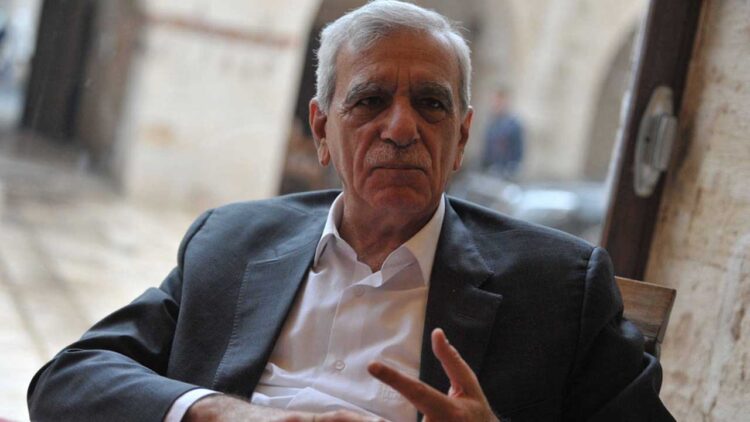
Ahmet Türk, a veteran Kurdish politician and a leading figure in Turkey’s pro-Kurdish movement, has urged caution in response to recent gestures from the Turkish government that have sparked discussions about a potential new peace process in the Kurdish issue. Speaking to the daily Sözcü on 11 October, Türk emphasised the need for practical steps and a democratic constitution, advising against either underestimating or exaggerating recent political signals.
Türk’s comments come after the Nationalist Movement Party (MHP) leader Devlet Bahçeli offered a symbolic handshake with pro-Kurdish Peoples’ Equality and Democracy (DEM) Party co-chair Tuncer Bakırhan during the opening of the Turkish Parliament on 1 October. Bahçeli’s gesture, along with statements from President Recep Tayyip Erdoğan supporting dialogue, has led some to speculate about a possible renewal of peace efforts between the Turkish state and the Kurdish movement. However, Türk was measured in his response, saying, “We should neither underestimate nor overstate these gestures.”
Ahmet Türk, currently mayor of Mardin (Mêrdîn) and a prominent leader in the DEM Party, has a long history in Kurdish politics. He played a significant role in Turkey’s previous peace process, which took place between 2013 and 2015. During that period, Türk was involved in efforts to negotiate a peaceful resolution between the Turkish government and the Kurdistan Workers’ Party (PKK), led by Abdullah Öcalan, who remains imprisoned. The peace process aimed to end decades of armed conflict, but it collapsed in 2015, leading to a resurgence of violence.
Reflecting on the importance of addressing the Kurdish issue, Türk highlighted that a key obstacle remains the lack of a genuine understanding of Kurdish rights. “If you cannot internalise the fact that Kurds are a people with rights, you won’t solve anything,” he stated. Türk also emphasised that societal preparation, including through the media, is necessary for meaningful progress. “You cannot resolve the issue with rhetoric alone; the whole society must be prepared,” he added.
While hopeful of the possibility of a reopening of dialogue, Türk was careful not to project overly optimistic outcomes. He noted that while there have been recent gestures from the Turkish government, it remains uncertain whether these will translate into substantive changes. “We don’t know. Time will tell,” he said, reflecting the uncertainty surrounding the potential for a new peace process.
Furthermore, Türk called for Turkey to engage diplomatically with the Kurdish-led Autonomous Administration of North and East Syria (the region commonly known as Rojava). He stressed that Rojava does not pose a threat to Turkey and advocated for steps to be taken towards recognition of the autonomy of the region. “Recognising Rojava’s autonomy and fostering dialogue would lead to better security for both sides,” he argued.


