

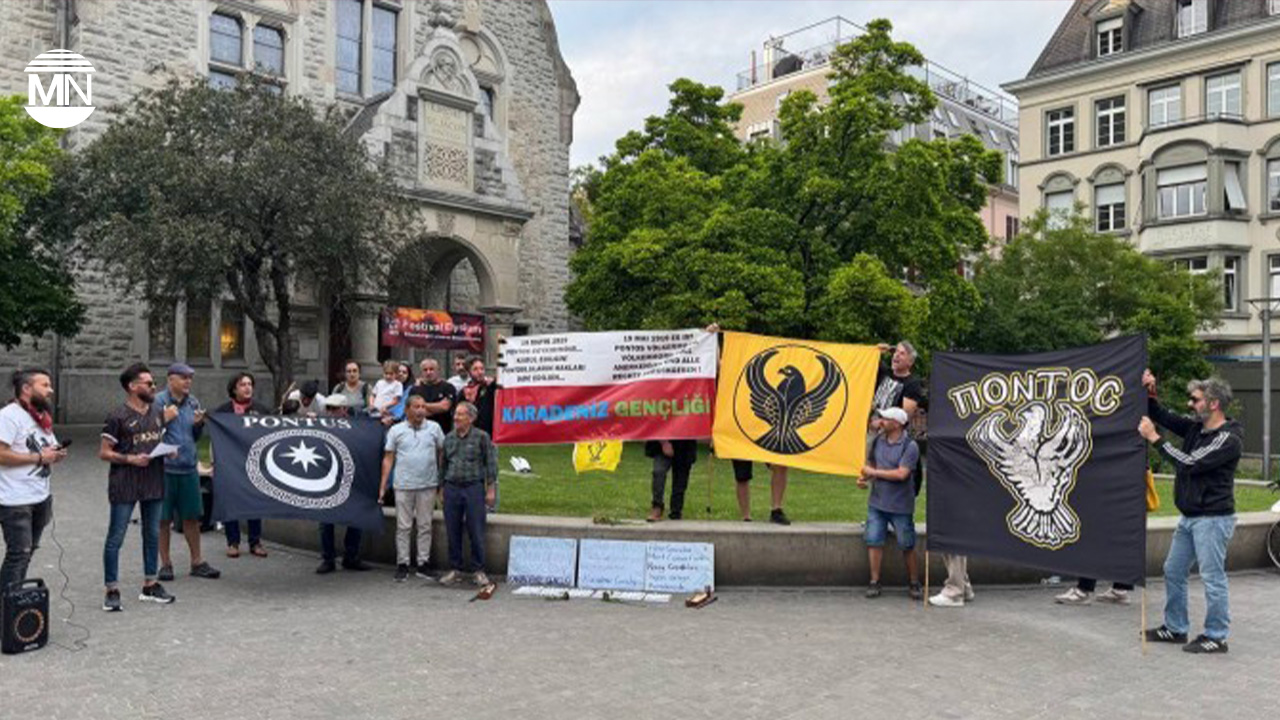
A group of young Pontic Greeks gathered in Zurich on Monday to commemorate what they describe as the genocide of their ancestors during the final years of the Ottoman Empire. The event was held on 19 May, the day Mustafa Kemal Atatürk landed in Samsun in 1919, launching the “Turkish War of Independence”. For Pontic Greeks, this date also marks the beginning of a campaign of persecution, deportation, and mass killings that aimed to erase their community from its historic homeland along the Black Sea.
The group, calling themselves the “Black Sea Youth”, held a public demonstration and read out statements in German, Greek, and Turkish. They unfurled banners reading “19 May 1919 is the Pontic Genocide. Recognise it, return the rights of the Pontic people,” and carried flags bearing the symbol of Pontus, a historical region along the Black Sea coast.
“This day is seen by some as a beginning,” a speaker said during the event. “But for us, it marks the beginning of extinction.”
Between 1914 and 1923, Pontic Greek communities in the Ottoman Empire faced mass killings, forced deportations, and assimilation policies. The group commemorated what they said was the extermination of 353,000 Pontic Greeks and the forced exile of more than 1.2 million people.
“Before the establishment of the Aegean Republic, on the orders of Mustafa Kemal, a massacre was carried out by Topal Osman and Nurettin Pashas,” one speaker said. “It was a massacre. In this massacre, we lost 353,000 people from the true Black Sea region.”
They recalled women like Eleni Çavuş, whom they described as a symbol of resistance. “Eleni is the name of a non-violent struggle for existence,” said a speaker. “While her people were being massacred, she stood firm, remembering, not allowing forgetfulness.”
The youth group declared that history has often silenced the songs, voices, and stories of the Pontic people. “The songs of Pontus may have been silenced,” one participant said. “But we sing them again. The name of Eleni Çavuş may have been shadowed. But we bring it again into the light.”
Their call included a demand for official recognition of the Pontic Greek genocide and the restoration of rights for displaced descendants. “This destruction was neither collateral damage, nor a historical necessity,” one statement said. “It was an extermination. And it happened on these lands.”
The event concluded with traditional Black Sea dancing (horon), performed to the sound of the kemenche, a traditional bowed string instrument, as a symbolic act of cultural survival.


