

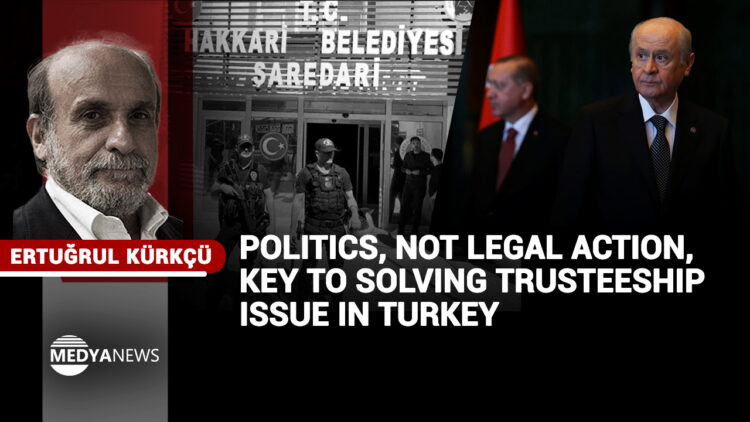
Ertuğrul Kürkçü
The problem of trustees cannot be solved by expecting the AKP-MHP government to renounce its tyrannical powers granted by the corrupt constitutional regime out of respect for ‘democracy’, nor by appealing to the Constitutional Court, the Council of State, or the European Court of Human Rights. It is evident that it is futile to expect a government that has directly integrated the judiciary with its own sovereignty to be brought into line through judicial means on fundamental issues.
The appointment of a trustee to Hakkari was met with a strong initial reaction from the general democratic public. Especially the main opposition party strongly criticised the trustee attack. In a statement made by the CHP delegation in Hakkari, they said, “The appointment of a trustee is an operation to seize the municipality by ignoring the will of the people of Hakkari.”
There is no doubt that this stance has strengthened solidarity on the front of the forces of democracy within the context of the current political balance. However, we cannot overlook that this approach leaves out two significant conflict dynamics in the historical and strategic context.
Firstly, there is the boundless aggression stemming from the fact that, over the past 20 years, the Kurdish people, having become politically aware of their identity and rights, have reinforced their claim to identity by reflecting their demands for self-determination at the level of local administrations, thereby presenting the central state with a challenge it does not know how to counter.
Especially since the autumn of 2015, when Ankara, with the consent of the main opposition, ended the process of resolving the Kurdish issue and started to implement ‘rebellion suppression’ measures by seizing HDP/DEM municipalities and attempting to transform Kurdish local administrations into military/administrative colonies, it has viewed the struggle for local administrations not as a political process but as a ‘covert war’. This perception, which reads local administrations as fortifications and Kurdish municipal governance as the enemy, turns the arbitrary, extrajudicial ruling powers granted to central governments by the current Constitution into tools of this illegitimate and dirty war, using them to the fullest extent.
To the extent that the main opposition approaches the problem outside of this specific conflict context, it conceals the logic behind the regime’s trustee policy. Thus, it becomes silent in the face of the reality that the impasse of the Kurdish issue is perpetuated within the scope of ‘rebellion suppression’ practices. By avoiding confronting the colonial mentality underlying the ‘collapse operation’ against Kurdish municipalities, and by deferring the political issue to the law without surrounding the government with genuine political questions, it ultimately contributes to weakening the just cause.
Secondly, the main opposition does not approach the trustee appointments in terms of the constitutional unlawfulness of the regime’s absolute guardianship authority to dismiss elected local administrations. Instead of objecting to the dismissals themselves, it criticises the arbitrariness of Erdoğan’s administration in replacing the dismissed mayors or organs. CHP Deputy Chair Zeliha Aksaz Şahbaz said in a statement on behalf of her party in Hakkari:
“Removing the mayor from office can happen in all municipalities; however, the democratic way is for the deputy mayor or mayor to be elected by the municipal council.”
The structural crisis currently manifesting through the government’s appointment of trustees to Kurdish municipalities is inherently present in the design of Article 27 related to local administrations in the current Constitution of 12 September [1980 post-coup military regime]:
“Local administrations are […] public legal entities. […] The resolution of objections regarding the qualification of elected organs of local administrations and their loss of qualification is carried out by judicial means. However, for a crime related to their duties, the Minister of the Interior may temporarily suspend local administration organs or their members, who are under investigation or prosecution, as a precaution until a definitive ruling is made.”
The illegality of appointing AKP-affiliated Governors to replace dismissed DEM Party mayors is evident. However, there exists the authority to arbitrarily remove elected mayors before this. By not confronting the extrajudicial nature of this constitutional provision, the main opposition implies that they would not refrain from exercising this guardianship themselves when in power, thus not criticising the absolute guardianship of the centre over local authorities as recognised by the Constitution. They also send a message that they share the same ground with the regime’s central powers regarding the democratic political solution to the Kurdish issue and the autonomy of local administrations, or that they will not enter into conflict with the centre for this reason.
In Turkey—and consequently in Kurdistan—municipal organisations, or more broadly, local administrations, are not naturally and spontaneously formed social institutions with a historical background. Local administrations entered the social imagination as democratic and autonomous decentralised governance bodies over the past 30-40 years, primarily due to certain regulations within European legislation becoming a public discussion topic following Turkey’s application for European Union membership.
However, Article 126 of the Constitution unmistakably records that the relationship between local administrations and the central government in Turkey is fundamentally one of guardianship:
“The central administration has administrative tutelage over local administrations within the principles and procedures specified in the law.”
The underlying concern of the administrative, financial, and judicial control networks surrounding municipalities is the fear that the autonomy granted to local administrations will lead to a tendency to share the sovereignty monopoly with the central government and take over the powers of the centre. In other words, these control networks are designed as a precaution against the risk of local administrations, as self-governing bodies, equating with the areas and levels of sovereignty considered to be under the central administration’s monopoly.
In this context, the issue of trustees derived from the central state’s claim of ‘authority/sovereignty’, which instrumentalises local administrations to the extent of ultimately reducing them to colonies of Ankara, clearly demonstrates that the trustee problem is essentially not just a local administration issue but a regime issue that reveals itself on the local administration level.
It is evident that this problem cannot be solved by expecting the AKP-MHP government’s corrupt constitutional regime to renounce its tyrannical powers granted by respect for ‘democracy’, nor by appealing to the Constitutional Court, the Council of State, or the European Court of Human Rights. It is futile to expect a government that has directly integrated the judiciary with its own sovereignty to be brought into line through judicial means on fundamental issues.
However, with democracy struggles sustained by the interplay of two dynamics, it is possible to establish a new balance in favour of local administrations and against the central state in the medium term.
Firstly, without denying the “right of the Kurdish nation to self-determination”, it is necessary to lead a public enlightenment campaign that exposes the irrationality of the paranoia of ‘division’ injected into society by the sovereign state and the war guided by this paranoia. This campaign should also highlight that expanding local autonomy will counter the waste and domination of the central state, returning as a dynamic of freedom and prosperity for the entire country. Alongside this, it should pave the way for social opposition forces to rise to a common democratic change strategy centered on peace.
Secondly, it is essential to initiate criticism, discussion, and campaigns for implementing the European Charter of Local Self-Government at both central government and local administration levels, despite the fact that AKP and CHP, while not fully implementing it, also do not theoretically or politically deny it. This includes campaigning for the amendment of Article 27 of the Constitution. Turkey has signed the European Charter of Local Self-Government with some reservations. The Charter calls on signatory states to reduce the central government’s role based on the democratic constitutional and legal framework within which an autonomous local government institution should operate, and to minimise the central government’s control over local administrations. It is possible for Turkey to lift all its reservations with a single signature.
Thirdly, the DEM administrations currently in office in Kurdistan municipalities should promptly undertake transformative actions in areas such as ‘municipal services in the mother tongue’, ‘people’s municipalities’, and ‘women’s municipalities’, making municipalities more transparent, and evaluating employment and investment opportunities fairly. In short, they should run a strong and continuous campaign of explanation, propaganda, and public relations to show those who say “do it and we’ll see” what they have done and can do without missing any opportunity.
The lawless AKP-MHP regime has been continuously losing power, prestige, and influence since the blow it received in the 31 March local elections. It lacks any achievement to offer society or any dream to build. A rational, consistent, and pluralistic resistance firmly adhering to democratic and social liberation goals will show that the trustee in Hakkari is the first and last trustee. Trustees will leave, and the people will successfully complete their march towards self-governance through local and central administration bodies.
Ertuğrul Kürkçü is the current Honorary President of the Peoples’ Democratic Party (HDP) and Honorary Associate of the Parliamentary Assembly of the Council of Europe (PACE). He spent 14 years as a prisoner between 1972-1986 for his political activism in Turkey. He is also member of Progressive International Council.


