

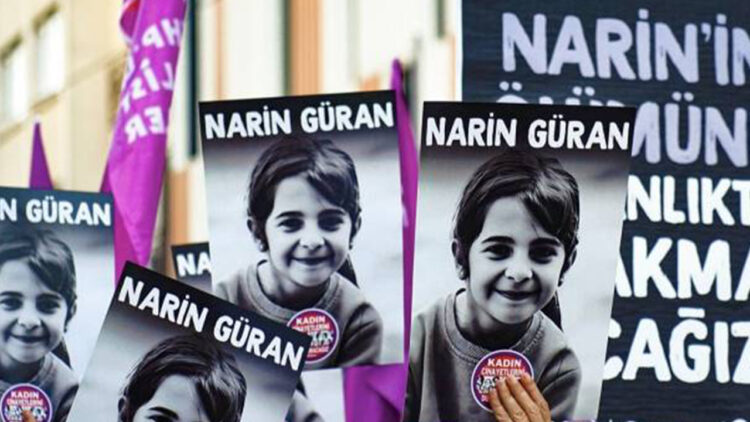
The murder of 8-year-old Narin Güran, whose body was discovered on 9 September after she went missing on 21 August, has drawn significant attention from women politicians and human rights activists, who have framed it as a political issue on several fronts.
Tülay Hatimoğulları, co-chair of the Peoples’ Equality and Democracy (DEM) Party, stressed that Narin’s murder reveals several political layers: violence rooted in patriarchy, the dismantling of protective legislation by the ruling Justice and Development Party (AKP), and the specific context of the Tavşantepe (Çuli) neighbourhood where the tragic event took place.
“We have to understand that there are thousands of Narins in Turkey. Thousands of children who cannot even tell their closest relatives about the violence they have suffered,” said Hatimoğulları.
Hatimoğulları also highlighted how the political nature of the murder is intertwined with Tavşantepe’s links to ruling politicians and the support for covering up the crime. “If it had been an ordinary murder, it would not have received such support (for the cover-up),” she said.
Hatimoğulları drew a striking parallel with the Susurluk scandal, a 1996 political debacle that exposed links between the state, the police, and the mafia in Turkey, revealing that many Kurdish activists and politicians had been murdered by a state-linked paramilitary organisation. “The Tavşantepe murder has exposed the intertwining of militaristic forces, paramilitary groups, and the state,” she noted.
Human rights activist and lawyer Eren Keskin also emphasised the political dimensions of Narin’s murder, saying that it reflected deep-rooted violence against women and children, as well as systemic problems. “Narin Güran is neither the first nor the last child to be murdered because of these deeply rooted values,” she said.
Keskin pointed to the murky links between high state officials and local perpetrators, noting how these connections contribute to protecting perpetrators and perpetuating violence. “The real problem is the entrenched, internalised perceptions that drive such violence,” she stressed.
Both Keskin and Hatimoğulları criticised the ruling AKP for repealing protective legislation such as the Istanbul Convention, which they argued has shielded perpetrators and exacerbated the crisis. The Istanbul Convention on violence against women contained measures protecting against sexual harrassment, femicide and domestic abuse. Turkish President Recep Tayyip Erdoğan withdrew Turkey from the convention by presidential decree in 2021. The AKP and Erdoğan have faced legal challenges, which state that their withdrawal from the Convention was unlawful.


