

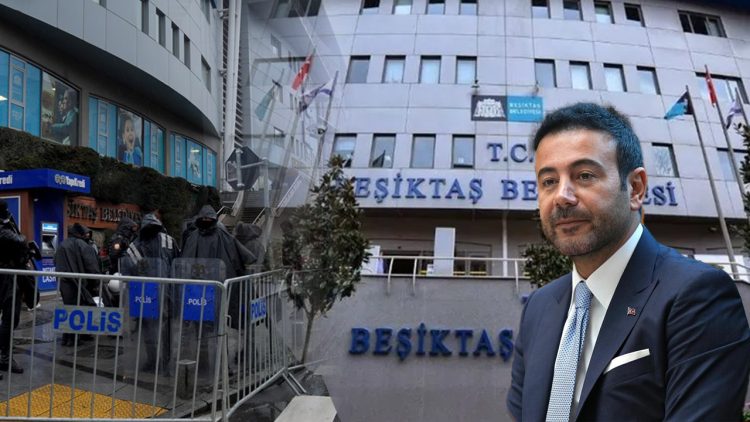
Turkish police conducted a dawn raid on the Beşiktaş Municipality in Istanbul on 13 January, causing a sharp escalation of tension between Turkey’s ruling Justice and Development Party (AKP) and the main opposition Republican People’s Party (CHP). The operation, which resulted in the detention of Mayor Rıza Akpolat and eight others, has drawn fierce criticism from the CHP, which condemned the move as an attack on democracy.
Akpolat faces allegations of “membership of a criminal organisation”, “collusive tendering”, and “unlawful enrichment,” according to the Office of Istanbul Chief Public Prosecutor. CHP officials, however, view the raid as politically motivated. “This is not justice – it is the ruling party’s weapon to undermine our electoral victories,” said CHP General Vice Chair Gökhan Zeybek.
During a press conference, the CHP’s Istanbul Branch Chair Özgür Çelik criticised the dawn operation, which involved hundreds of police officers and dozens of police vehicles surrounding the municipality. “Such actions aim to damage the integrity and reputation of our elected officials,” Çelik said, adding that Mayor Akpolat’s detention could have been addressed through due process rather than via an aggressive dawn raid.
Zeybek accused the AKP of using public prosecutors and civil servants as tools to target opposition. “Since 31 March, the AKP has turned into the party of the state, targeting CHP municipalities through judicial and bureaucratic means. This is an insult to the will of the nation,” he remarked.
Beşiktaş, a prominent district in Istanbul and a major cultural and commercial hub, is one of 31 districts under the administration of Istanbul Metropolitan Municipality. The city itself is led by the CHP’s Ekrem İmamoğlu, who made history by defeating the AKP in the 2019 local elections, victory marking the first time in over two decades that the AKP had lost Istanbul – a significant political loss, and a symbolic one. The CHP further solidified its position as the leading party in Turkey during the 2024 local elections.
Turkey’s AKP, under the leadership of President Recep Tayyip Erdoğan, has faced widespread accusations of consolidating power by undermining democratic institutions. Since 2016, the government has replaced elected mayors with state-appointed trustees in seven municipalities, most of which were led by Kurdish mayors. This includes Esenyurt in Istanbul and Akdeniz in Mersin. This policy has been widely criticised as a tactic to silence opposition voices and undermine democratic progress.
Related Articles:
DEM Party: ‘Replacing elected officials with trustees is a political putsch’

Turkey’s Kurdish protests spotlight opposition unity against trustee appointments

Political backlash as Turkish government deposes elected DEM Party mayors
The raid is also viewed as part of a wider effort to suppress a “city consensus” between the CHP and the pro-Kurdish Peoples’ Equality and Democracy (DEM) Party. This coalition was instrumental in the CHP’s victories in key municipalities, including Istanbul. Critics argue that the AKP seeks to delegitimise this alliance to maintain its grip on power.
CHP Leader Özgür Özel held a remote emergency meeting to strategise a response, while İmamoğlu met with Özel at the CHP’s headquarters. Protest rallies are planned nationwide, stressing the party’s resolve to resist what they term as “trusteeship policies” and an assault on local democracy.
“Turkey must rid itself of these dawn raids,” Çelik said. “This is not just an attack on the CHP – it is an attack on the democratic fabric of our nation.” The opposition vowed to fight the government’s authoritarian practices in courtrooms and on the streets, reaffirming their commitment to democracy and the rule of law.
Observers note that these tactics may escalate ahead of Turkey’s next general election, expected in 2028. As tensions rise, the CHP’s message is clear: “We stand with our mayors, our voters, and the principles of democracy.”


