

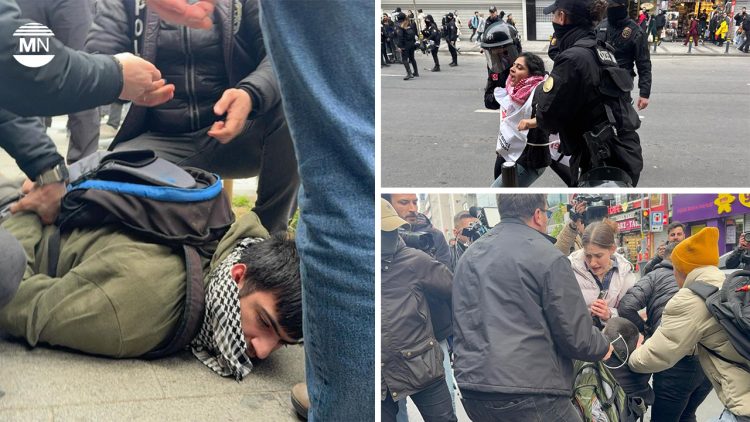
Hundreds of people were detained by Turkish police on 1 May as they attempted to march to Taksim Square in central İstanbul, defying a government ban on gatherings in the symbolic location.
Groups began gathering from early morning in the Şişli and Mecidiyeköy districts following a call by the 1 May Taksim Organising Committee, a coalition of over 40 trade unions, youth groups and leftist organisations. Protesters chanted slogans and carried banners declaring “Taksim belongs to the people” as they moved through side streets toward the square.
Police responded with large-scale interventions. According to the İstanbul branch of the Progressive Lawyers Association (ÇHD), 300 people had been detained by midday, including at least nine lawyers and multiple university students. Images and eyewitness accounts described individuals being forcibly dragged, handcuffed or surrounded by police vehicles.
Taksim Square has been a central site for May Day demonstrations in Turkey since the 1970s. However, since a deadly incident in 1977 and increasing state restrictions in recent decades, authorities have repeatedly banned access to the square on 1 May, citing security concerns. Despite rulings by both the European Court of Human Rights (in 2017) and Turkey’s Constitutional Court (in 2023) affirming the right to demonstrate in Taksim on May Day, the bans have continued.
In the lead-up to this year’s events, police conducted operations on 29 and 30 April, detaining activists and committee members involved in the call to gather in Şişli. On May Day itself, police sealed off entrances to Taksim from as early as 5 a.m. and surrounded key protest points with barricades. Access to Şişli’s main square was heavily restricted, with workers asked to show proof of employment to pass through.
Among those detained were members of trade unions, such as DİSK/Enerji-Sen, and organisations including the Özgür Dayanışma (Free Solidarity) group. The secretary for women’s affairs from Education Union Branch No. 7, Eren Ertin, was also taken into custody.
Media coverage was also obstructed. Reporters were pushed away from protest areas, and a journalist from the independent outlet Bianet was prevented from filming detentions. The Turkish Journalists’ Union has repeatedly condemned such restrictions as violations of press freedom.
Meanwhile, in the Kadıköy district on İstanbul’s Asian side, an authorised May Day rally proceeded under tight police control. Thousands gathered at the event, which was supported by major trade unions including the Confederation of Progressive Trade Unions (DİSK), the Confederation of Public Workers’ Unions (KESK), the Union of Chambers of Turkish Engineers and Architects (TMMOB), and the Turkish Medical Association (TTB). Protesters there highlighted labour rights, gender equality and democratic reforms. Some placards read “Do not touch my severance pay” and “Decent work, dignified life”.
Though Kadıköy saw no mass detentions, authorities blocked some banners considered ‘politically sensitive’. Police also maintained a heavy presence throughout the district, erecting checkpoints and barriers from the night before.
Despite repeated legal rulings affirming the right to protest in Taksim, Turkey’s interior ministry has continued to enforce a blanket ban on gatherings there every 1 May. Critics argue this approach violates both domestic and international legal standards on freedom of assembly.


