Iida Käyhkö
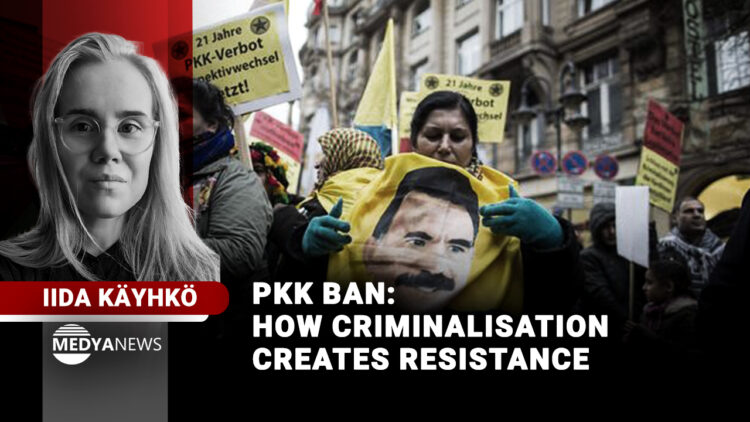
2024 marks 31 years since the Kurdistan Workers’ Party (PKK) was designated a terrorist organisation in Germany, in 1993. This example would eventually be followed by the United States and by the European Union, which designated the PKK in 1997 and 2002, respectively. As a result, the movement has been targeted by heavy-handed methods of state repression ever since.
The broader movement spearheaded by the PKK and collectively known as the Kurdistan Freedom Movement has been shaped throughout its existence by the repression, criminalisation, and counterinsurgency strategies pursued not only by the Turkish state, its main political opponent, but by the international state system as a whole. Prison resistance, exile, underground organising, and strategies to avoid surveillance and state violence have been unavoidable experiences for many Kurdish people and their allies.
The movement’s history and present cannot be understood without a clear view of this context of criminalisation. But perhaps more importantly, seeing how counter-terrorism has been deployed as a legal and physical weapon against the Kurdish struggle is crucial for understanding the broader, state-led system of global policing and militarism.
A brief history of criminalisation
Although all European states are involved in criminalising the Kurdish movement to some degree, Germany continues to lead the way. The most significant reason for this is the degree of organisation and prominence of the Kurdish movement in Germany, which has the largest Kurdish population of any European country. But just as importantly, Germany has for decades been a close economic and diplomatic ally of the Turkish state, particularly in providing weapons and military equipment — equipment deployed with deadly consequences by the Turkish state in Kurdistan. Having fled the war waged using German weaponry, many Kurds arrived in Europe expecting to experience greater political freedoms than back home. Instead, they were subjected to criminalisation, a process in which the German state plays a leading role, in collaboration with the Turkish state.
Criminalisation is demanded by Turkey and delivered by Germany: it is the grease that keeps diplomacy running smoothly. Each state visit and trade deal negotiation is followed by a new wave of raids, arrests, and prosecutions. This is despite Germany’s stated support for the Kurdish movement in the fight against ISIS, and the adoption of the slogan ‘Jin, Jiyan, Azadî’ or ‘Women, Life, Freedom’ by prominent German politicians — a slogan born out of the struggle of Kurdish women in the PKK. These surface-level gestures belie a deep economic and ideological commitment to supporting the Turkish state in its imperialist and genocidal projects across the region.
The PKK ban, enshrined in German law on 26 November 1993, was a result of Turkish lobbying efforts. The Turkish prime minister’s diplomatic visit in September of that same year put criminalisation at the heart of Germany-Turkey relations. Later that same year, Turkish military forces carried out a massacre in a small town in Kurdistan, using German weapons to kill at least 30 civilians. Mass protests erupted, with 59 Turkish organisations and companies attacked across Germany by protesters. This became a pretext for the ban, which had already been decided on as a diplomatic necessity.
Kurdish life and politics under threat
The ban transformed the political conditions faced by those organising as part of the Kurdish struggle in Europe. The effects of criminalisation are serious. In Europe, Kurdish communities endure different forms of insecurity: precarious immigration status, impoverishment, and racism are common experiences among the Kurdish diaspora. Repression adds another layer of fear. It amplifies existing concerns over employment opportunities and visa status, with criminalisation making it hard for many to pass security clearances for work, or to gain a more secure immigration status. The PKK ban creates the pretext for the targeting of Kurdish life as a whole: every cultural and political expression of Kurdishness is a target for the state, with devastating consequences for individuals and communities.
The ripple effect of criminalisation has targeted Kurdish diaspora communities and Kurdish political expression in Europe through surveillance, raids, the closing down of organisations, arrests, prosecutions, the seizing of money and possessions from individuals and organisations, violent policing of demonstrations, and many more repercussions ranging from frustrating to life-altering. These methods are used against anyone perceived to be a sympathiser — that is, anyone involved in community organising or political mobilisation, and even people attending demonstrations or events, or merely posting supportive messages on social media. Also targeted are Kurdish student organisations, community centres, and charitable entities.
In addition, the secretive nature of intelligence operations raises many questions in terms of the misinformation, disinformation, and rumours circulated about the movement, leading to misrepresentation of its ideology and aims in mainstream media and discourse.
‘Terrorism’ as a tool for the state system
This ongoing criminalisation is the result of a state strategy of counterinsurgency: placing the PKK into a ‘terrorist’ legal category gives states and international coalitions the self-authorisation to use the broadest possible powers to repress anyone even vaguely connected to or sympathetic towards the Kurdish freedom struggle, regardless of their level of political activity.
Whether or not the PKK should be considered a terrorist organisation, and whether or not its actions meet a definition of terrorism, are questions that become almost absurd once we examine the context in which states deploy the word terrorism. It is most commonly used to describe the actions of insurgent, non-state political groups. This is a definition created by and benefiting the existing state system — a system which itself commits acts of violence and harm to humanity, at an enormous cost to life, while rarely being considered as a terrorist actor.
The so-called “war on terror” — the dominant security narrative and directive we have been living under for more than two decades — has given states the opportunity to expand the definitions of terrorism to great lengths. While the popular understanding of terrorism involves direct, physical violence targeted at civilians, many people are now prosecuted as terrorists for holding flags, organising meetings, or speaking in public. These prosecutions depend on the political associations of the groups or individuals involved, not the real-term harm caused by their actions. Usually, these groups are insurgent movements engaged in armed struggle or political mobilisation against states and capital. Crucially, counterterrorism polices not only organised political action, but also speech and thought — in blatant contravention of the stated liberal values held by the states most keenly pursuing the “war on terror” project.
Criminalisation in a shifting geopolitical landscape
The Turkish state makes demands for more criminalisation at every opportunity. As tens of thousands of journalists and political prisoners are held in Turkish prisons under terrorism charges — for offences such as downloading a secure messaging application, using the word “Kurdistan” in a public speech, or being elected mayor via popular, democratic vote — the aim of the Turkish state is to create a global environment of criminalisation.
The full-scale Russian invasion of Ukraine, the subsequent expansion of NATO, and the greater reliance of European military and political power on the cooperation of the Turkish state, have led to heightened repression across Europe. As the Turkish state asserts its geostrategic importance, it presents growing demands to its NATO allies. In 2022, Sweden infamously altered its constitution to strengthen its counter-terrorism law, in order to gain Turkey’s approval to join NATO. Meanwhile, the extradition of Kurdish people to Turkey from European countries is on the rise.
This occurs despite the German state’s stated commitments to “feminist foreign policy” — a smokescreen for the capitalist and militarist drive behind Germany’s geopolitical position. As Hêlîn Dirik asks, how could the foreign policy of a capitalist, imperialist state such as Germany ever be feminist? It is an absurd contradiction, made all the more blatant by continued weapons sales to the Turkish state, and the continued persecution of the Kurdish movement within Germany.
The future of repression
Although the economic and diplomatic reasoning behind the continued repression of the Kurdistan Freedom Movement is clear, it is also necessary to place this repression into an ideological context. The Kurdish movement is an anti-capitalist, anti-patriarchal struggle for a world built on the principles of a non-state system of direct democracy. This broad social transformation, the fruits of which can be seen across Kurdistan, is a dream held close by many people across the world — and feared by hegemonic powers.
As a broad social movement connected to a party waging armed struggle against the second-largest NATO army, the threat presented by the Kurdish movement to the global state-led, capitalist system is immense. Over the last thirteen months, we have seen how the resistance of the Palestinian people has reanimated a practice of internationalism, and how the solidarity of peoples in the imperial core has challenged the militarist and capitalist powers of major European states. The Kurdistan Freedom Movement is one of the largest political movements in Europe, with close links to a range of left-wing, feminist and climate struggles. It is capable of mobilising thousands to the streets on short notice in cities across Western and Northern Europe. This makes it a significant threat to states and capital, especially in Europe.
Europe is where the spoils of empire come home. It is where industries, from banking to technology, continue to reap the greatest benefits from imperial war. It is home to the states that have created the current world order, and that continue to wage war on humanity. The upending of the imperial system depends on uprisings in the imperial core. This threat is what continued repression attempts to destroy: the power of organised resistance. The Kurdistan Freedom Movement, as one of the last remaining mass armed struggles against imperialism, is one of the greatest threats to the global state capitalist system.
For these reasons, we can expect to see greater investment in the technologies, methods and legal frameworks that enable repression of this movement. As geopolitical discussions are dominated by the struggle for power between imperial states, the established momentum of counter-terrorism will keep criminalisation going behind the scenes. As repression continues to target an ever-greater number of people on increasingly more tenuous grounds, we can expect to see resistance to it grow in similar measure. By criminalising struggles against the powers of colonial and capitalist domination, the state system is making its greatest fear — organised resistance — come true.
Iida Käyhkö is a PhD candidate at the Information Security Group at Royal Holloway, University of London. Her doctoral research concerns experiences of insecurity and criminalisation among the UK’s Kurdish community, as well as counterterrorism as an extension of colonial counterinsurgency. Her writing on questions of feminism and security has been published by the Guardian, Hope Not Hate, Novara Media and ROAR Magazine.