

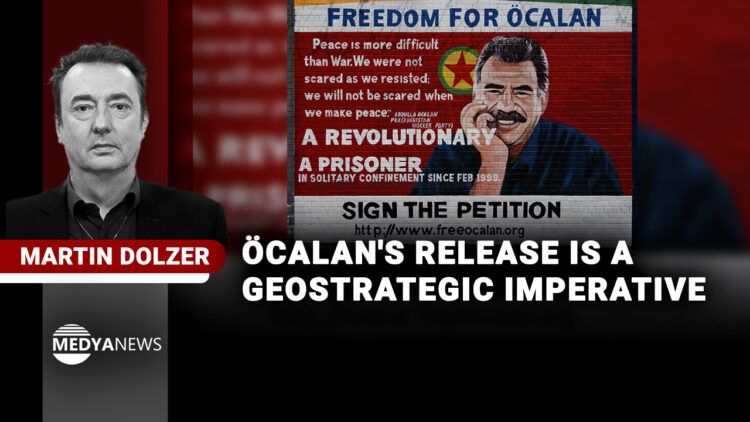
Martin Dolzer
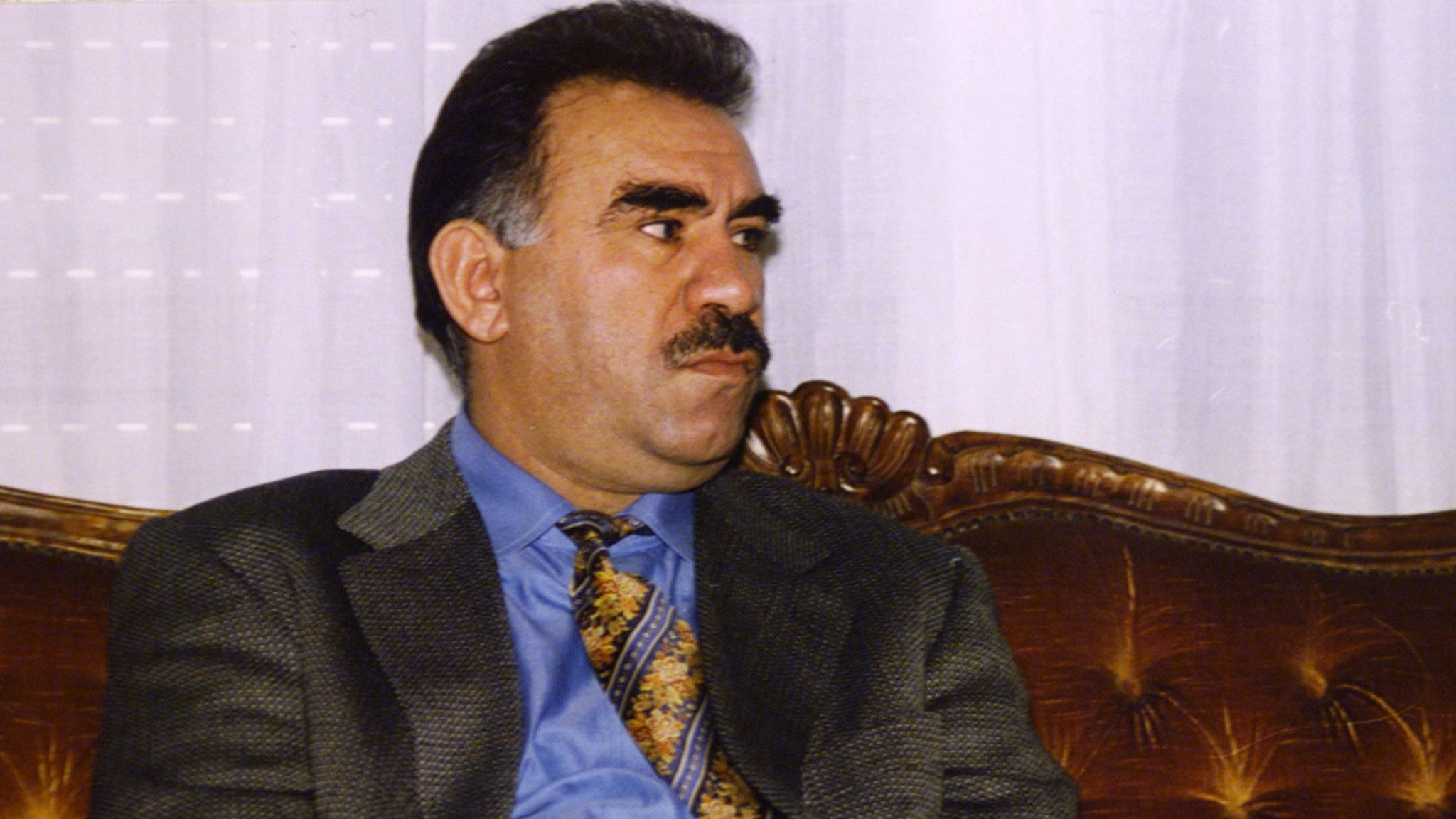
On 9 October 1998, Abdullah Öcalan was expelled from Syria under the so-called Adana Agreement, after Turkey threatened the government in Damascus with war. Öcalan then travelled to Greece and Russia via Cyprus. Russia’s parliament granted him political asylum, but the government at the time had other ideas. After a long odyssey that took him through several European states seeking asylum – including a brief detention in Italy due to an international arrest warrant issued by Germany – Abdullah Öcalan was kidnapped on 15 February 1999 on his way to Nairobi airport from the Greek ambassador’s residence in the capital of Kenya. He was taken to Turkey tied up on a Turkish businessman’s plane.
Today we know that the kidnapping was a joint effort by the secret services of Turkey, the United States (US), and Israel. Since the Kenyan authorities did not consent to it, this act of piracy constitutes a serious violation of Kenya’s territorial integrity and sovereignty, and is therefore illegal under international law. This in itself raises grave concerns about Öcalan’s show trial, which then took place in Turkey, and the sentencing his hijackers decided on.
Looking back, the whole thing appears to be a deliberate conspiracy in which many NATO countries trampled on international law, national legislation, and human rights. The likely motivation for their thuggishness is that the governments of these neoliberal-capitalist societies considered a self-determined movement and peace in the Middle East to be more dangerous for their own geostrategic interests than unjust regimes, such as the Turkish government. On this basis, the governments were at that time already quite indifferent to their own observance of human rights and international law, except when these served to justify their own acts of war, such as in Yugoslavia, Iraq, Libya or Syria.
No state wanted to grant asylum to Abdullah Öcalan who, as a political refugee, had a clear right to sanctuary. No government wanted to seriously engage with the Kurdish question, or hear his message of a democratic confederalism in the Middle East. Nor did they want to give him the opportunity to defend himself before an international tribunal, fearing that this would make public the truth of their NATO ally Turkey’s decades-long machinery of oppression and destruction. The governments did not care at all that the European Court of Human Rights (ECHR) had already certified serious deficiencies in the Turkish rule of law and the judiciary on numerous occasions, rejecting it for violating European standards.
Pressure from the US government played no small part in the European Union’s (EU) denial of its own legal traditions and asylum protocols, as Europe’s central governments joined Turkey in pressuring Syria to expel Öcalan. It is important to mention in this context that the German government was especially invested in Öcalan’s sentencing. For Germany, this represented the solution to a political dilemma: it had contributed political and military support to the escalation of this war that has left more than 50,000 dead to date and displaced more than 5 million people. Germany had however also turned a blind eye to the widespread devastation and destruction in Kurdistan, and the serious human rights violations and war crimes of the Turkish army.
After Abdullah Öcalan’s imprisonment on the prison island of İmrali, the politician developed the concept of Democratic Confederalism in his defence writings, as a peaceful way to structure society in the Middle East. On the basis of this, the people of the Middle East could live together peacefully and pursue self-determination through grassroots democracy. This concept includes the respectful coexistence of all religious and population groups and equal rights for women, as well as the peaceful settlement of the conflict between the Turkish state and the Kurdistan Workers’ Party (PKK).
After World War I, arbitrarily-drawn colonial borders resulted in repeated conflict. After the collapse of the real socialist states in 1989/90 and the reorganisation of the global balance of power at the turn of the century, such democratic arrangements would also have been possible in the Middle East at the time. However, this was not what the US and EU governments wanted. The US pursued the exact opposite approach, with the so-called ‘Greater Middle East Project’; and the EU states with their own similar ideas.
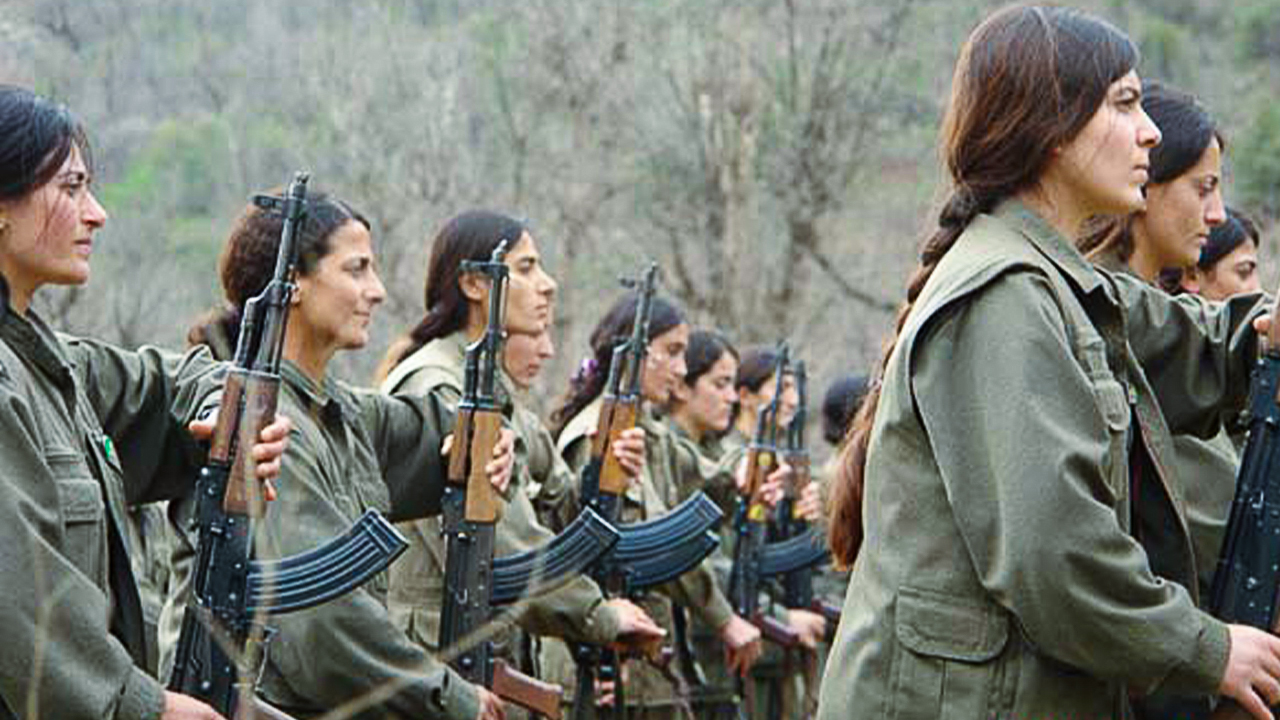
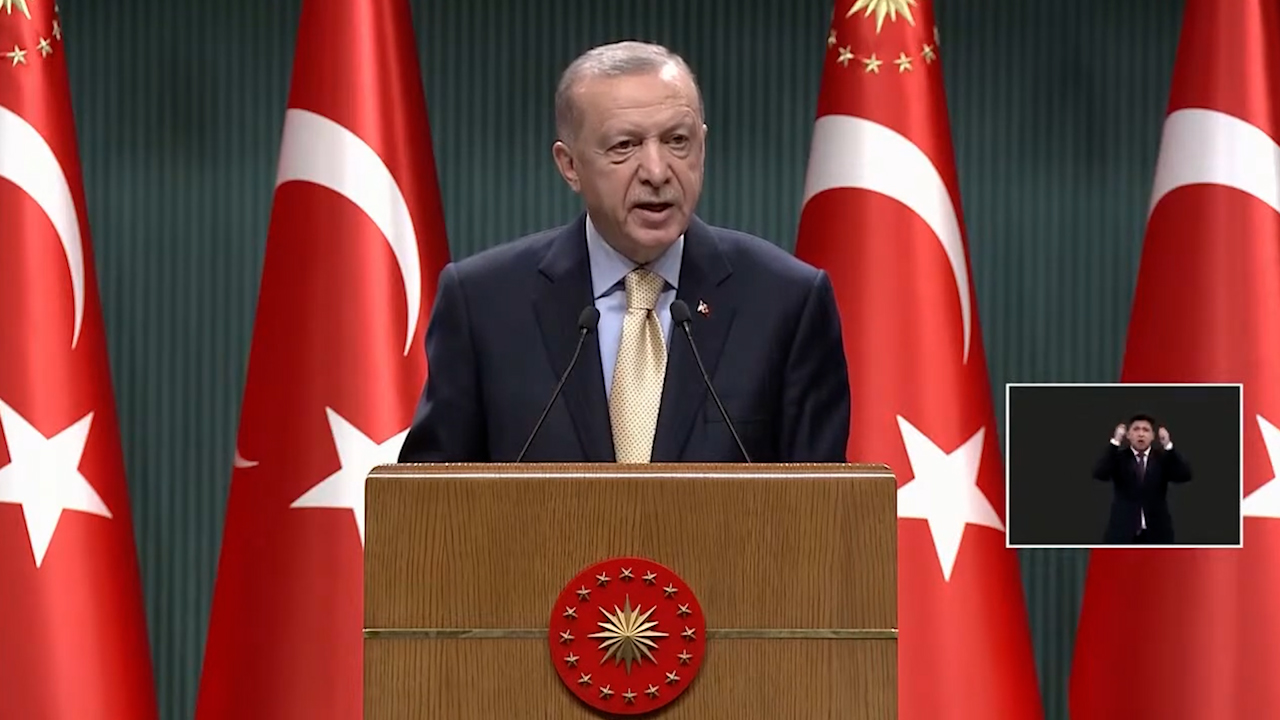
This involved a renewed splitting of the region – of Iraq, Libya, Syria, and Iran – into even smaller units along cultural, religious and tribal lines of division. To implement this, cooperation with the increasingly authoritarian Erdoğan regime was preferred, despite having full knowledge of Erdoğan’s neo-Ottoman project and his cooperation with ISIS and other Islamist actors. This preference has not shifted despite the use of chemical weapons in northern Iraq, the ethnic cleansing in Afrin, and the torture practices used in Turkish police stations and prisons. Nor have the arrests of more than 30,000 political prisoners; massacres in Cizre, Nusaybin and Diyarbakir Sur; and the unacceptable absolute isolation of Abdullah Öcalan for two and a half years now shaken the US government’s and EU’s alliance with Erdoğan.
All attempts by Abdullah Öcalan to reach a peaceful solution in Turkey and the Middle East through serious negotiations with the Erdoğan regime between 2005 and 2015 were ended by the Turkish government. This is despite several hopeful phases involving talks with the PKK, for example in Oslo. In most cases, Öcalan’s peace initiatives were ended by the Erdoğan regime after elections, or when it became clear that the Kurds had continued to vote for the HDP and not for the AKP.
It is not only the case that in the Federal Republic of Germany and other European states Erdoğan’s policy of extermination is only tolerated or militarily supported – in addition, politically active Kurds are criminalised and imprisoned in several EU states and, moreover, more and more politically persecuted people have recently been extradited to Turkey.
On the anniversary of the conspiracy to silence him, it must be said that it is time to lift Abdullah Öcalan’s absolute isolation. It is time to release Abdullah Öcalan. He can play a decisive role in peaceful developments in Turkey and throughout Middle East. Not only must Turkey act on this, but the US government, the governments of EU states, and the Russian government must also act. Just as the original conspiracy to imprison Öcalan was a joint effort of many Western NATO countries for geostrategic reasons, peaceful developments in the Middle East and worldwide today require the intervention or restraint of NATO countries and the BRICS (Brazil, Russia, India, China, and South Africa).
If NATO countries, including Turkey, do not perceive the fact that the world is reordering itself and they themselves have become too static – like Rome before the fall – this arrogance will lead to a dead end, or to their downfall.
In his defence writings, Abdullah Öcalan did not give up on recognition of the Kurdish identity, of his people’s right to self-determination with all its cultural, political and economic consequences: a dignified existence within a common federation of states. He stated that the only way to achieve this is through the thorough democratisation of all the institutions of society. He has named the central inadequacies of the political system in Turkey, the ominous dominance of the military apparatus, the coarsely knit web of political corruption, the absence of rule of law, and the weaknesses of its anti-democratic state. However, his analysis goes beyond Turkish borders, encompassing Kurdish existence in Iran, Iraq and Syria; and applies to a large extent to Europe and the US as well – with the difference, of course, that developed, large-scale industries and over-individualised societies prevail there.
The policy of military and political support for the Turkish war has undoubtedly rolled back democratisation in Turkey. Security and military cooperation with Turkey must be ended, the PKK must be removed from terror lists worldwide, and Abdullah Öcalan must be released. However, appealing to the relevant governments will not be enough to achieve this. In order to end the prevailing Third World War, the left and humanist actors in Europe and worldwide must organise themselves beyond powerlessness and impotent, systemic division and bring about a change in their own social formations.
*Martin Dolzer is a journalist and former German parliamentarian, and has written for Junge Welt and Neues Deutschland. He is the author of ‘The Turkish-Kurdish Conflict. Human rights, peace, democracy in a European country?’


