

The United Nations Relief and Works Agency for Palestine Refugees (UNRWA) is close to breaking point as it struggles to cope with donor funding freezes, Israeli pressure to dismantle it and rising humanitarian demands, the agency’s chief, Philippe Lazzarini, said on Thursday.
The agency is struggling financially due to a significant cut in funding following accusations by Israel that have led several countries, including the United States, Britain, Germany and Japan, to suspend their financial support. This suspension represents a loss of $438 million, more than half of the agency’s expected budget for the year.
Established in 1949 after the founding of Israel, UNRWA operates in the occupied Palestinian territories, Lebanon, Jordan and Syria and employs some 30,000 people. In response to earlier Israeli allegations of UNRWA staff involvement in attacks against Israel, the UN has dismissed the staff allegedly involved and is conducting an investigation to maintain impartiality in the Israeli-Palestinian conflict.
Meanwhile, the head of Médecins Sans Frontières (MSF), Christopher Lockyear, criticised the systematic damage to Gaza’s health infrastructure and the role of the United States in blocking ceasefire negotiations at the UN Security Council. On 20 February, the US vetoed a Security Council resolution calling for an immediate ceasefire in Gaza, its third such veto.
“We are appalled by the willingness of the United States to use its powers as a permanent council member to obstruct efforts to adopt the most evident of resolutions, one demanding an immediate and sustained ceasefire,” said Lockyear.
“The humanitarian response in Gaza today is an illusion. A convenient illusion that perpetuates a narrative that this war is being waged in line with international laws,” he added.
Israeli military action has resulted in significant civilian deaths, with reports of up to 29,500 Palestinian casualties since 7 October. Research by the London School of Hygiene and Tropical Medicine and the Johns Hopkins Centre for Humanitarian Health warns of further deaths due to deteriorating living conditions, even if a ceasefire is declared immediately.
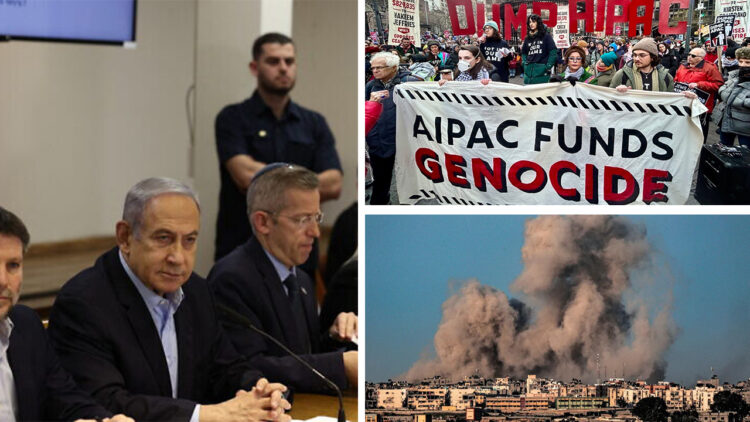
Global outcry over the conflict continues, with protests in New York and California criticising the policies of the American Israel Public Affairs Committee (AIPAC) and US President Joe Biden, calling for a swift end to hostilities and questioning US support for Israel.
In parallel, Israeli Prime Minister Benjamin Netanyahu has proposed a post-conflict governance strategy for Gaza, the Times of Israel reported. The plan includes the appointment of local officials with no links to organisations designated as supporting ‘terrorism’, Israel’s full operational capability in Gaza and the establishment of a security buffer zone along the border. It also calls for the “complete demilitarisation” of Gaza beyond the needs of public security and excludes the Palestinian Authority from any future governmental role.
This stance reaffirms Netanyahu’s position on excluding the Palestinian Authority from Gaza’s post-conflict administration. In contrast, EU foreign policy chief Josep Borrell emphasised at the G20 summit in Brazil that Israel cannot single-handedly prevent the establishment of a Palestinian state.


