

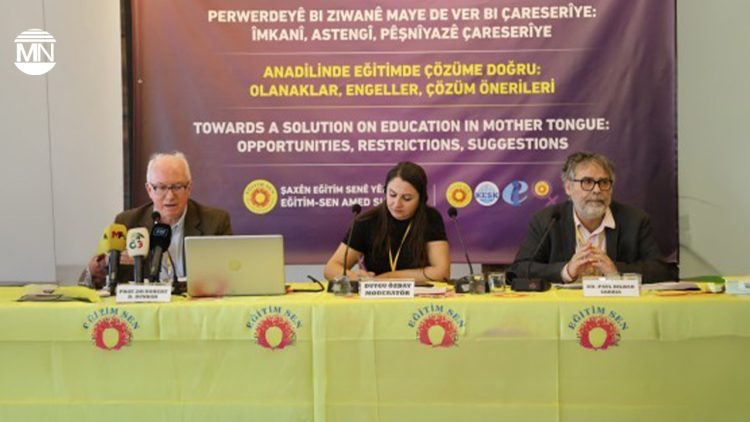
A workshop titled “Towards solutions in mother-tongue education: Opportunities, obstacles, suggestions” has been held in Turkey’s Diyarbakır (Amed) to advocate for the protection of Kurdish and Syriac language rights through education and legal reforms.
The event was held by Turkey’s Education and Science Workers’ Union (Eğitim Sen) and gathered together academics, lawyers, linguists and representatives from the pro-Kurdish Peoples’ Equality and Democracy (DEM) Party.
Cemile Turhallı, a spokesperson for the DEM Party’s Language, Culture and Arts Commission, delivered a speech in Kurmancî (Kurmanji – the dialect of Kurdish most used within the borders of Turkey). “The right to mother-tongue education is not just a political issue—it’s tied to life, health, education and protection from mistreatment,” she said. “Societies that fail to achieve linguistic peace cannot build internal harmony.” Turhallı called for an end to the definition of citizenship restricted to ethnic exclusivity, saying the basis of citizenship of the Republic of Turkey should instead be based on equality, and urged amendments to discriminatory constitutional clauses, such as Articles 3, 4, 42 and 66.*
Boğaziçi University Professor of Educational Sciences Fatma Gök addressed the impact of monolingual education policies, describing them as tools of cultural suppression. “The production of knowledge in Turkey has been rooted in Turkification, yet Kurdish communities have resisted relentless efforts at assimilation,” she explained. Gök equated linguistic suppression to cultural genocide, driven by prohibitions and forced abandonment of native languages.
Writer Dilawer Zeraq argued that assimilation targets consciousness rather than language itself. “Language is shaped by consciousness—when that’s eroded, assimilation takes hold,” he said. Zeraq stressed the need for community-driven systems outside state control, noting, “Despite 20 years of efforts, we haven’t fully succeeded. To counter assimilation, we must first build our own structures.”
Linguists Sami Tan and Mehemed Tayfun (more commonly known by his pen-name of Malmîsanij) focused on the neglect of the Kurmancî dialect, warning that the survival of a language depends on its recognised status. “Language work should not be confined to conference halls—it must reach every street and neighbourhood,” Tan urged, advocating for grassroots revitalisation. Evgil Türker, president of the Syriac Associations Federation (SÜDEF), highlighted the ancient heritage of Syriac in the Middle East, lamenting its exclusion from Turkish schools. “Blocking mother-tongue education is cultural genocide,” he warned, citing an application to open a Syriac school, unanswered since 2013.
The third session of the workshop featured international perspectives. Professor Robert Dunbar from the University of Edinburgh shared lessons from Northern Ireland, Scotland and Canada, where languages like Irish and French were revived through education reforms. “In Ireland, grassroots efforts by families led to Irish-medium schools,” he noted. Dr Paul Bilbao Sarría, from Spain’s Basque Autonomous Region, described the resurgence of the Basque language, saying, “A language doesn’t vanish on its own—it is suppressed. Recognition and education are key to revival.” Both speakers underlined the role of multilingualism in fostering social peace and equal citizenship.
The event also addressed practical challenges. Malmîsanij noted the scarcity of media in the Kurmanji dialect, such as television channels, while Tan called for the mapping of Kurdish dialects to ensure their daily use. Türker pointed to Syriac education models in northern Syria and Iraq as examples Turkey could follow, criticising the state’s failure to implement existing laws on minority languages.
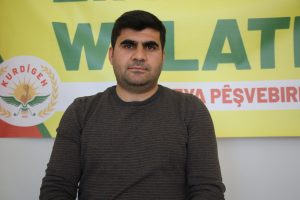
Meanwhile, in Van (Wan), Mesut Kertiş, co-chair of the Association for the Advancement of Culture and Language (KURDÎGEH), reinforced the demands of the workshop in Diyarbakır, pressing the Turkish state to grant official status to Kurdish. Forty-six days after Kurdish leader Abdullah Öcalan’s call for peace and democratic reform issued from İmralı Prison on 27 February, Kertiş noted growing public support but no tangible action from the authorities. “The state must act swiftly—a vital step is recognising Kurdish in education, healthcare and academia,” he said on Sunday, highlighting the cultural richness of the language and the need for legal protections to end its suppression.
Kertiş’s remarks echo the workshop’s push to revise constitutional provisions which mandate Turkish as the sole official language and ban mother-tongue education in Kurdish. He criticised the closure of Kurdish institutions under “terrorism” allegations, saying, “Schools and cultural venues are repeatedly targeted, stripping people of their linguistic freedom.” Kertiş urged unrestricted access to Kurdish education and cultural activities, like theatre, free from state prohibitions, to establish a legal environment where Kurdish culture can flourish.
The Diyarbakır workshop continues on Sunday 13 April, with presentations by Haydar Diljen, Yıldırım Arslan and Figen Aras, exploring global education models and democratic approaches, followed by an open forum for further discussion.
(*) The articles mentioned—Articles 3, 4, 42 and 66 of the Turkish Constitution—are provisions that critics, including speakers at the Diyarbakır workshop, argue contribute to linguistic and cultural discrimination, particularly against Kurdish and other minority languages.
Article 3 declares Turkish as the official language of the Republic of Turkey, stating, “The language of the state is Turkish.” Critics argue this provision marginalises other languages like Kurdish and Syriac by excluding them from official use in education, public services or governance, reinforcing a monolingual policy that limits cultural diversity.
Article 4 establishes the immutability of Article 3 (among others), meaning the official language cannot be amended. This entrenches Turkish dominance, blocking proposals for multilingualism or co-official status for other languages, which advocates see as a barrier to equal language rights.
Article 42 governs education rights, stating, “No language other than Turkish shall be taught as a mother tongue to Turkish citizens at any institutions of training or education.” This explicitly prohibits Kurdish, Syriac or other minority languages from being used as primary languages of instruction, a key issue for those demanding mother-tongue education.
Article 66 defines Turkish citizenship: “Everyone bound to the Turkish state through the bond of citizenship is a Turk.” Critics argue this promotes an ethnicity-based identity that marginalises non-Turkish groups like Kurds by implying a singular cultural and linguistic identity, undermining pluralistic citizenship.
These articles are viewed as upholding assimilationist policies, restricting the use of Kurdish and Syriac in education and public life. Advocates, like those at the workshop, urge their amendment to allow multilingual education, recognise cultural diversity, and redefine citizenship on inclusive terms in alignment with principles of democracy and human rights.


