

Amed Dicle
Turkey held a crucial election on 31 March 2024. Though termed a ‘local election,’ it emerged as a pivotal moment for the nation’s political trajectory.
The AKP, led by Erdoğan, has dominated Turkish politics since 2002. This reign has evolved into a dicta-torial regime over the past decade. Erdoğan has long harboured ambitions of becoming the ‘sole ruler.’ Over various phases in the last decade, he has managed to create the environment he desired. In the general elections of May 2023, in a challenging but necessary bid to unseat Erdoğan, all opposition groups, including the Kurds, rallied around a joint candidate, Kemal Kılıçdaroğlu of the main opposition CHP. Despite the effort, Erdoğan narrowly secured re-election as President, and his party maintained its parliamentary majority. This outcome fuelled extraordinary motivation for the AKP and its ally, the nation-alist-fascist MHP party. Conversely, for the opposition, the results became akin to a nightmare: despair, a bleak future… and escalating anti-democratic measures plunged society into despondency.
The aftermath saw a change in leadership for the CHP. The pro-Kurdish DEM Party, with a strong Kurdish base, notably engaged in grassroots efforts in Kurdish cities to gauge public sentiment. The Kurdish polit-ical movement also underwent restructuring. Especially notable was the Kurds’ refusal to retreat, continu-ing to challenge the Erdoğan regime, thereby inspiring other Turkish opposition factions.
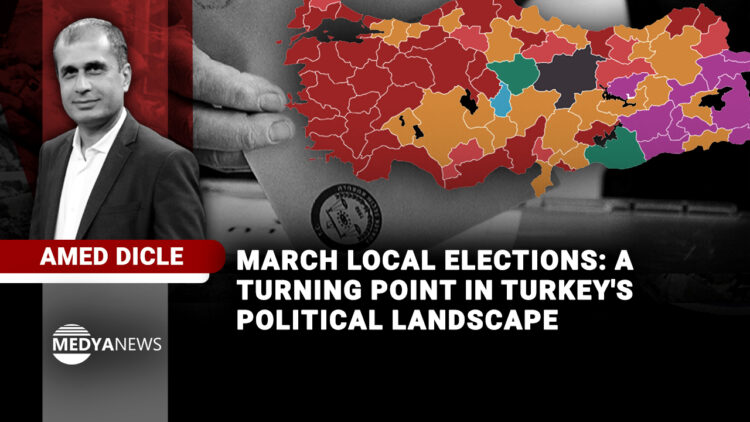
Subsequently, the 31 March local election cycle commenced. The Erdoğan government aimed to consoli-date its power by winning these elections as well. However, it fell short of its goals. Nationally, it dropped to the second party and faced significant defeats in Kurdish regions. These results represented a collective refusal by the Turkish populace to the dictatorial regime Erdoğan sought to entrench. Thus, the elections transcended mere municipal victories, marking a critical juncture in determining the country’s path for-ward.
The role and strategy of the Kurdish political movement
First and foremost, the Kurds played a decisive role in the election outcomes. The DEM Party, which had previously won municipalities in Kurdish cities, presented its candidates. Co-mayor candidates were de-termined through primaries, a method tried for the first time in both Turkey and the Kurdish political movement, despite some setbacks. The public embraced this democratic method, contributing to the suc-cess of the outcomes.
The Kurdish political movement formulated its election campaign with the slogan “win, let win,” aiming to contest and win in cities where they were ambitious with their candidates. In Kurdish cities, they achieved about 90% of their targets. Moreover, the Kurds devised a remarkable strategy to defeat the Erdoğan re-gime, termed ‘Urban Consensus.’ This strategy was primarily applied in Turkish cities. In many cities where Kurds reside in significant numbers and where their votes could change the balance, they supported op-position candidates who adhered to democratic standards. In cities like Istanbul, while they presented their candidates, they also subtly directed their voters to support İmamoğlu against Erdoğan. Thus, they conducted a profound political strategy to ensure the defeat of the Erdoğan regime. Directly doing so had various risks; Erdoğan could have mobilised nationalist-Islamist factions with the narrative, “Look, the CHP is collaborating with terrorist Kurds,” similar to propaganda used in 2023. To avoid giving Erdoğan such propaganda material and to lure him into complacency, the DEM Party both presented candidates and mobilised its electorate in a different manner. It was perhaps a very rare and interesting situation in the history of politics. The highly politicised Kurdish community easily managed this and succeeded. Conse-quently, Erdoğan’s animosity towards Kurds became the primary reason for his loss in these elections.
Economic turmoil and public sentiment
First and foremost, the Kurds played a decisive role in the election outcomes. The DEM Party, which had previously won municipalities in Kurdish cities, presented its candidates. Co-mayor candidates were de-termined through primaries, a method tried for the first time in both Turkey and the Kurdish political movement, despite some setbacks. The public embraced this democratic method, contributing to the suc-cess of the outcomes.
The Kurdish political movement formulated its election campaign with the slogan “win, let win,” aiming to contest and win in cities where they were ambitious with their candidates. In Kurdish cities, they achieved about 90% of their targets. Moreover, the Kurds devised a remarkable strategy to defeat the Erdoğan re-gime, termed ‘Urban Consensus.’ This strategy was primarily applied in Turkish cities. In many cities where Kurds reside in significant numbers and where their votes could change the balance, they supported op-position candidates who adhered to democratic standards. In cities like Istanbul, while they presented their candidates, they also subtly directed their voters to support İmamoğlu against Erdoğan. Thus, they conducted a profound political strategy to ensure the defeat of the Erdoğan regime. Directly doing so had various risks; Erdoğan could have mobilised nationalist-Islamist factions with the narrative, “Look, the CHP is collaborating with terrorist Kurds,” similar to propaganda used in 2023. To avoid giving Erdoğan such propaganda material and to lure him into complacency, the DEM Party both presented candidates and mobilised its electorate in a different manner. It was perhaps a very rare and interesting situation in the history of politics. The highly politicised Kurdish community easily managed this and succeeded. Conse-quently, Erdoğan’s animosity towards Kurds became the primary reason for his loss in these elections.
Economic turmoil and public sentiment
So, what options does Erdoğan have left, if any? Frankly, none. If he chooses democracy, shows respect to everyone including the Kurds, and acknowledges their rights, he could find a way out. However, such an approach is contrary to Erdoğan’s ideological coding, making it an impossibility. Individuals or regimes of Erdoğan’s character cannot democratise; they may sometimes pretend to be democratic. But Erdoğan has long exhausted such credibility, rendering any attempt to deceive the populace with a façade unfeasible. On the other hand, the economic crisis fuelled by warfare is a serious issue. Without fixing the economy, winning another election is improbable. To improve the economy, he must cease the war against the Kurds and engage democratic mechanisms. But due to the reasons summarised above, he is incapable of doing so. Thus, it’s plausible to say that the Erdoğan regime has reached the end of its road.
Of course, in the meantime, Erdoğan will try to do something. For example, on 9 May, he plans to visit President Biden to seek various credits. He will also try to escalate the war against the Kurds to divert at-tention from economic issues. However, none of these actions can provide a lasting solution.
Opposition unity and democratic aspirations
What matters most from now on is not what Erdoğan does, but what the opposition and the Kurds do. If these groups take a wrong step, the country will continue to be doomed to Erdoğan. In this situation, it can be said that the Kurds must maintain the interaction they have captured with democratic segments in Turkey. And in the messages of Kurdish representatives, we see the intention to continue this.
Beyond pragmatic relationships initiated merely to oust Erdoğan, a strategic vision for institutionalising democracy is necessary, requiring collaboration between the Kurds and opposition forces. Kurdish politics is suitable for this. Many political dynamics in Turkey are also amenable. However, highlighting the role of CHP here is beneficial.
Currently, CHP is the most potent candidate for power. This new administration team has shaken Erdoğan. They clearly see that without the Kurds, they could not have shaken Erdoğan. If this party, instrumental in founding the Turkish Republic and harbouring significant nationalist dynamics, truly democratises and maintains its interaction with the Kurds, then a new chapter could be opened in Turkey. The Kurds have already extended more than enough credit to CHP for this. Thus, the future of the Kurdish issue, the root cause of Turkey’s problems, is the most crucial topic. Will CHP develop a perspective for democratisation and democratising the state, or just send Erdoğan home and mediate the creation of a relatively comfort-able environment? If CHP accomplishes the first, it will find the necessary response from Kurdish politics, and the foundations for a democratic future for the peoples of Turkey will be laid.
Is this possible? It’s too early to give a definite answer. This is a matter of struggle. The Kurds, along with many political segments that act with the Kurds, are fighting for this. Even within CHP, there is a signifi-cant force that wants this. The next one or two years will be spent in this struggle, and it will become clear how the situation is set to unfold. For the Kurds, the only constant will be to fight; to protect their demo-cratic gains in any situation, to struggle for their constitutional rights and to develop political solutions to the problem…
*Amed Dicle was born and raised in Diyarbakır, Turkey. He has worked for Kurdish-language media out-lets in Europe including Roj TV, Sterk TV and ANF. His career has taken him to Rojava, Syria, Iraq and many countries across Europe. Follow him on Twitter.


