

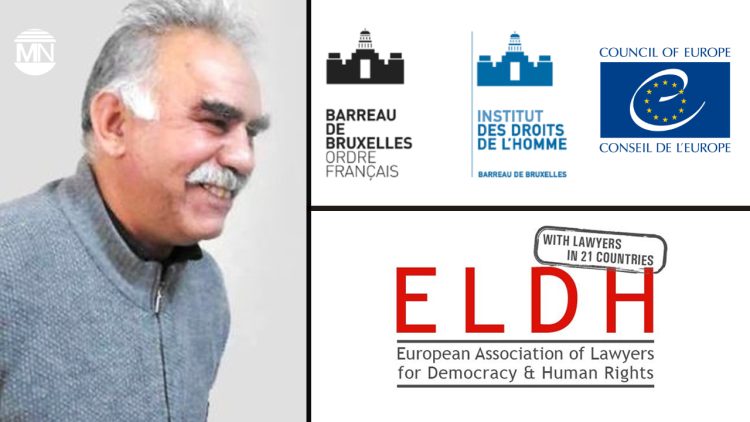
European human rights lawyers are preparing a formal notification to the Council of Europe, urging it to take stronger action against Turkey for failing to implement legal reforms that would allow prisoners serving life without parole—such as Kurdish political figure Abdullah Öcalan—to be considered for release.
The European Court of Human Rights (ECtHR) ruled in 2014 that Öcalan’s aggravated life sentence, which denies any possibility of release, violated Article 3 of the European Convention on Human Rights, which prohibits inhuman or degrading treatment. Despite this ruling, Turkey has made no legal changes in the eleven years since. In response, legal associations and Öcalan’s defence team have submitted repeated notifications to the Council of Europe’s Committee of Ministers, which supervises the implementation of ECtHR decisions.
In September 2024, the Committee issued a warning to Turkey, stating that it would consider issuing an interim resolution if the country failed to enact relevant reforms by September 2025. As the deadline approaches, lawyers and organisations based in Europe—including the European Association of Lawyers for Democracy and World Human Rights (ELDH)—are stepping up preparations to file further submissions.
Speaking to Mezopotamya Agency on Saturday, Rengin Ergül, a lawyer with the International Association for Human Rights and Democracy (MAF-DAD) and member of the Association of Lawyers for Freedom (ÖHD), explained the legal significance of the initiative: “There is an ongoing legal mobilisation in Europe, and ELDH is among the organisations involved,” she said. “This is the first time such a coordinated legal application is being pursued at this level.”
Ergül emphasised that the applications are based on legal precedent and are intended to expose how Turkey’s penal system remains incompatible with international human rights standards. “The notifications show that Turkey has failed to enact legislation guaranteeing the right to hope, and that the current prison regime is unlawful,” she said.
She added that an international submission could increase pressure on the Committee and push it to take a firmer stance against Turkey: “The Committee may be compelled to adopt a more decisive tone, and Turkey’s action plans may face more intense scrutiny. Public criticism could follow.”
The case extends beyond Abdullah Öcalan, whose prison conditions are reported to be more severe than those of other inmates. Thousands of prisoners in Turkey, particularly those sentenced under the country’s Anti-Terror Law, are affected by life sentences that provide no prospect of release. Ergül described the practice as equivalent to “imprisonment until death” and noted that such sentencing violates both Turkish constitutional principles and international norms.
The Turkish Justice Minister has previously claimed that the “right to hope” does not exist in national legislation. Ergül rejected this stance, warning that it amounts to disregarding binding international agreements. “Turkey is obligated to comply with rulings by the European Court of Human Rights,” she said. “This is not a political choice—it is a legal requirement.”
Ergül also criticised any attempt to frame the issue as a matter for political negotiation: “We do not accept that demands for the right to hope should be turned into bargaining chips. However, the abolition of the Anti-Terror Law and its associated practices would be a fundamental achievement in any democratic resolution process.”
If Turkey fails to pass relevant legislation by the September 2025 deadline, the Council of Europe may escalate its response. Ergül noted that although the Committee’s powers are limited—citing the example of the Osman Kavala case—Turkey’s international standing could suffer, and a formal infringement procedure might be initiated.
Ergül concluded by calling for stronger engagement from civil society within Turkey: “Given the current political conditions and the nature of Turkey’s penal system, this process must be conducted with care, coordination and broad participation.”


