

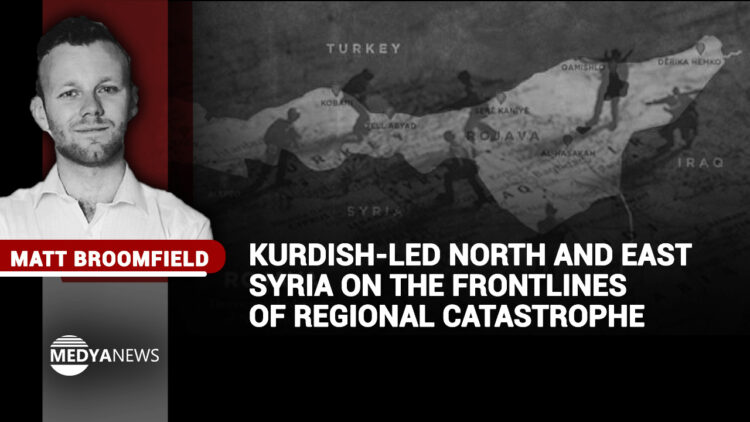
Kurdish-led North and East Syria (NES) is a key faultline in a growing regional confrontation, as Russia, Turkey and the USA seek to use the Syrian theatre to exert pressure on one another. Local Syrians – both Kurds and Arabs – face escalating violence and potentially dramatic shifts in the regional power-balance which has until now enabled the Autonomous Administration of North and East Syria (AANES) to maintain its precarious autonomy and provide a safe haven to millions of civilians.
Syria is divided between the central Assad government’s authoritarian control in the south and western seaboard; roughly 30% of territory under the AANES in the north and east; Idlib, a large city and its environs controlled by al-Qaeda offshoot Hayat Tahrir al-Sham (HTS); and zones along the Turkish border occupied by Turkey and its network of militias. Further complicating the picture, there are both Russian and US soldiers stationed in distinct zones of AANES territory, while Iran and Hezbollah both enjoy a strong presence in regions held by Assad.
As clashes between HTS- and Turkish-aligned factions suggest, all these actors are seeking to strengthen their position in a conflict which is expected to heat up again alongside Israel’s war in Lebanon. With Israel pounding Hezbollah and Iran, these militias sense an opportunity to get on the front foot against Assad, and perhaps garner more US/Israeli sympathy or support. But a recent round of Russian bombing is intended to send a message that Russia remains protective of its client in Damascus. Turkey has also engaged in a show of force in support of its own network of jihadist militias by flying fighter jets over the region, and the US has likewise struck multiple ISIS targets throughout the region in a reminder of its own continued presence.
Israel’s recent aggressive actions notwithstanding, the US position in Syria is generally weakening. US troops are expected to leave neighbouring Iraq in large numbers following the upcoming presidential election, further isolating the long-term US mission in Syria, and the other regional powers are seeking to press their advantage. Russia and Iran sponsor pro-government militias and tribes in attacks on the AANES’ military wing, in a bid to drive a wedge between the Kurdish-Arab alliance which has developed in the course of the war against ISIS. At the same time, Russia has escalated its bombing campaign against extremist-held Idlib, killing at least ten civilians. They hope to reap the benefits of shifting realities on the ground by reaching an accommodation with Turkey. Despite regular confrontations in Syria, the two countries’ interests are deeply entangled.
Meanwhile, Turkey is shelling AANES territory along the line of contact in crucial flashpoint Manbij. While President Erdogan styles himself the defender of Gaza, strategically he continues to try and play both sides of the fence – keeping up a flow of oil to Israel meeting up to 50% of its needs, while seeking to align himself as a post-war mediator with access to reconstruction contracts and a newfound geostrategic role.
For its part, the US would like to use its Syrian platform to confront Hezbollah and making fresh gains but is unwilling to commit its own resources and lacks a clear plan (there are only hundreds of US soldiers on Syrian territory, focused on the continued anti-ISIS mission). Prior efforts to pressure the AANES’ military wing into confrontations with Iranian-backed forces have failed, with the AANES maintaining a defensive posture but also seeking to keep lines of dialogue open with all the actors on the ground in Syria. Israel bombs Iran and Hezbollah in Syria with impunity, but these strikes won’t be able to wipe out the two forces’ deep-rooted presence in the country.
If the US role in the region weakens further, he’ll hope to step up, perhaps seize and ethnically cleanse more Kurdish territory, and use Turkey’s status as NATO’s second-largest member to pursue Turkish policy objectives under the guise of furthering Western interests.
The AANES is aware of these potential shifts in regional power dynamics, and while keeping one eye on internal Turkish dynamics which could create new openings for Turkish-Kurdish dialogue, they will face severe pressure from the US, Turkish and Iranian-Assad axes in the coming months. Time will tell if they’re able to navigate new regional realities placing more power in the hands of the Assad government and Turkey.
Meanwhile, tens of thousands of Arab civilians have crossed into AANES territory after fleeing Israel’s new war in southern Lebanon, including both Syrians originally displaced into Lebanon and . The AANES is among the most popular destinations for those fleeing the war yet desperate to avoid a return to regions under the control of the brutal Assad regime or the jihadi-dominated rump of the opposition. The AANES’ model of multi-ethnic cooperation could be a lifeline for the region. But given the complex geostrategic circumstances it must navigate, the question is rather whether it can navigate the coming storm.


