

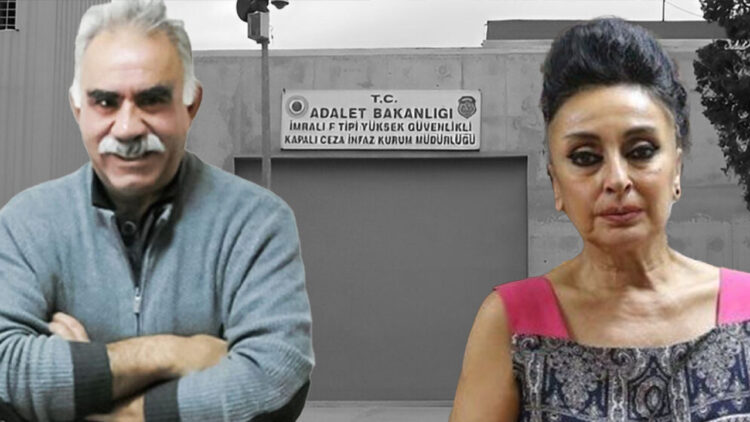
Human rights lawyer Eren Keskin has called for renewed attention on Abdullah Öcalan’s isolation and the Kurdish issue, emphasising that the newly formed Justice Initiative Against Isolation aims to challenge the ongoing situation at İmralı Prison and push for a democratic resolution. Öcalan, the imprisoned leader of the Kurdistan Workers’ Party (PKK), has been held in isolation for 25 years in the Turkish prison, and there has been no contact with him for 42 months.
Speaking to Mezopotamya Agency on Saturday, Keskin explained that the initiative was launched to end the unlawful isolation imposed on Öcalan and the other prisoners at İmralı, and to bring the broader Kurdish issue back to the agenda.
“This isolation isn’t new—it’s been in place since Öcalan was handed over to Turkey in 1999. Despite laws guaranteeing contact with him, no one has heard from him for years. It’s a blatant violation of Turkey’s own legal system,” she stated.
Keskin outlined the initiative’s goals, which include raising public awareness about Öcalan’s isolation and encouraging different sectors of society to engage in discussions about the Kurdish issue. “We formed this initiative to make this illegality a topic of discussion again, to push those responsible to act. The Kurdish issue affects everyone in this region, but apart from a few groups, no one is doing what they should to address it,” Keskin added.
Although the initiative is still in its early stages, Keskin emphasised that they plan to meet with a wide range of political parties, trade unions, and civil society organisations. “We will speak to anyone who has a voice in the Kurdish issue, except for fascist parties like MHP and the Great Unity Party,” she clarified.
Keskin also highlighted the broader implications of Öcalan’s isolation, connecting it to the unresolved Kurdish issue and its impact on Turkey’s economy. “The unresolved Kurdish issue plays a role in everything—from the country’s poor economy to rising hunger. The government diverts funds to jihadist groups in Syria instead of supporting workers and unions. Why aren’t unions speaking up?” she asked, urging people to break their silence on the matter.
Keskin criticised the Turkish opposition for their lack of action, pointing out that the isolation at İmralı Prison is part of a larger issue. “This isn’t just about the denial of contact with Öcalan. It also includes the other prisoners being prevented from seeing their families and lawyers. The isolation feeds into the Kurdish issue’s ongoing deadlock,” she said.
By making Öcalan’s isolation a central issue, Keskin hopes the Justice Initiative Against Isolation can help reopen discussions on the Kurdish question. “Our goal is to bring the issue back into the public sphere, to start discussing a democratic solution for the Kurdish people,” she concluded.


