

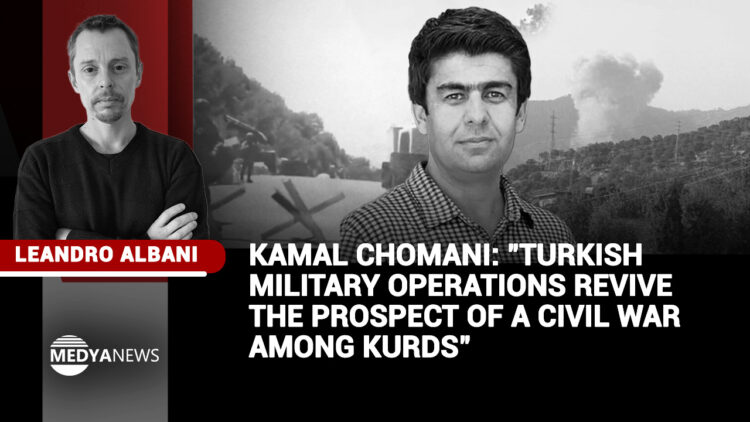
Medya News offers its readers an English translation of Kamal Chomani’s interview, initially published by El Salto* on Wednesday.
In this insightful interview, Chomani addresses the increasing intra-Kurdish tensions in Iraqi Kurdistan, exacerbated by Turkey’s intensified military operations against the PKK. He warns that these operations are not only undermining Kurdish unity but also raising the alarming prospect of a civil war among Kurdish factions as Turkey exploits internal divisions to advance its expansionist goals.
***
The situation in Iraqi Kurdistan is critical. As Turkey intensifies its bombardments against PKK guerrillas and the civilian population, intra-Kurdish tensions are escalating.
The bombs that fall daily in Iraqi Kurdistan (Bashur) are barely heard in the rest of the world. For months, the Turkish state has been launching air and ground attacks in a hot border area that seems to concern very few. The ultimate goal of President Recep Tayyip Erdoğan’s government is to occupy as much territory as possible and annex it. At the same time, the Turkish president is obsessed with defeating the guerrillas of the Kurdistan Workers’ Party (PKK), who have their bases in the Qandil mountains, a border area with Iran that the insurgents have turned into their stronghold.
What is happening in Bashur is similar to what the people of Rojava (Syrian Kurdistan) are experiencing: Turkey occupies several regions—such as Afrin, Serêkaniyê, and Girê Spî—and bombs civilians, self-defence forces’ militias, and essential infrastructure in a territory that has been blockaded and besieged for several years.
Amid this scenario, intra-Kurdish tensions are growing by the day, especially because the Turkish state seeks to exploit these differences, potentially leading to an internal conflict that could be devastating for the Kurdish people. In Bashur, besides the PKK, the Kurdistan Democratic Party (KDP)—which governs the autonomous Kurdish region of Iraq with an iron hand—and the Patriotic Union of Kurdistan (PUK) form a triad that at times appears fragile and conflict-ridden. The KDP, led by the Barzani family, is Ankara’s main ally in its expansionist and occupation policies. Therefore, the KDP leadership fully supports Turkey in its current invasion.
Chomani’s articles, which can be read in the Kurdish Peace Institute or Al-Monitor, delve into his own people and the internal struggles of their main political organisations.
Kurdistan, located in the heart of the Middle East and home to over 40 million people, is one of the major unresolved issues on the international stage. The systematic denial of Kurdish rights is a common policy in Turkey, but also in Syria, Iraq, and Iran, the other three countries in which this people was divided.
For Chomani, it is clear that Ankara’s foreign policy is driven by the Kurdish issue within Turkey. “The Turkish state was founded on the denial of Kurdish rights. Since the foundations of the Turkish state are based on denying the existence of the Kurds, the state continues to fight against them, as the guardians of the Turkish state believe that any victory for the Kurds anywhere is a loss for the Turkish state,” the Kurdish journalist summarises.
What is Turkey’s goal in invading various areas of Iraqi Kurdistan?
The Turkish state has several objectives. First, to eradicate the Kurdish Liberation Movement in Turkey, primarily the Kurdistan Workers’ Party (PKK), which has been a key target of Turkey since the PKK began its military campaign against the Turkish state in 1984. The PKK has been the greatest Kurdish awakening of the 20th century, and its influence has spread to all parts of Kurdistan, including Kurds in the diaspora. The Kurdish nation has undergone a process of assimilation in Turkey, and the PKK has been the key element of the Kurdish awakening and the struggle for freedom. The Turkish state has turned the Kurdish issue into a security matter. This invasion of parts of Iraqi Kurdistan is a continuation of Turkey’s policy of denying the Kurdish nation and securitising the Kurdish issue rather than resolving it through peaceful means. The Turkish state failed to resolve the Kurdish issue in 2015 through peaceful means, and the collapse of peace talks between the Kurds and the Turkish state further strengthened the neo-fascists in the country, who continue with the Turkish state’s doctrine of denying Kurdish rights, hence the need to continue securitising the Kurdish issue.
The Turkish state has succeeded in imprisoning Kurdish politicians and activists, as well as journalists, but has failed to eradicate the PKK as a military organisation. The Turkish state was inspired by the Sri Lankan government, as they managed to end the Tamil Tigers insurgency, although so far, this inspiration has not borne fruit for the Turkish state. Secondly, the Turkish state has geopolitical ambitions, especially under Erdoğan’s presidency, who aspires to be a new Ottoman sultan. Turkey’s neo-Ottoman ambitions are clear. They have their sights set on expanding into other parts of the Middle East. By fighting the Kurds, the Turkish state achieves two key objectives: first, as I mentioned earlier, to eradicate the Kurdish Liberation Movement, and second, to expand its territorial sovereignty. Turkey has invaded two parts of Kurdistan, violating the sovereignty of two states where Kurds live. The Turkish state has problems with both countries only when the Kurds have achieved some degree of political and cultural autonomy in Syria and Iraq.
“The Kurdish nation has undergone a process of assimilation in Turkey, and the PKK has been the key element of the Kurdish awakening and the struggle for freedom”
Why doesn’t the Kurdistan Democratic Party intervene to stop the Turkish attacks?
The KDP not only doesn’t intervene in the Turkish attacks but has become a facilitator for the Turkish state. Unfortunately, one of the Kurdish tragedies is Kurdish inequality. The KDP has been an ally of Turkey since the 1990s for various economic, political, and military reasons. The KDP considers the PKK a threat to its tribal foundations.
Politically, the operations have already brought Kurdish political parties to the brink of another civil war, not only between the KDP and PKK but even between the KDP and PUK, as the KDP uses Turkish operations to continue repressing dissent and consolidating power in Erbil, excluding the PUK and others from power-sharing. Meanwhile, the Peshmerga forces [KDP military forces] have become even more divided. This adds to the market uncertainty amidst the economic crises in Iraqi Kurdistan. International investment is afraid to come to Kurdistan, and local investors prefer to go to other parts of Iraq, as one of the reasons for the economic crisis in Iraqi Kurdistan is the Turkish military operations.
The Kurdish Liberation Movement has suffered from its internal conflicts as much as from the occupying forces in Kurdistan. For the first time in years, Turkish operations are again bringing the prospect of a civil war among the Kurds, especially between the PKK and KDP, as the latter officially and unofficially assists and justifies Turkish operations. Of the entire Iraqi political spectrum, only the KDP supports the operations, which has put the PKK in a very vulnerable position, as it doesn’t want to confront Kurdish forces.
As a result of the impacts in Rojava, Turkish operations have further strengthened relations between the KDP and the Turkish state to some extent. The KDP sees Rojava as an extension of the PKK and does everything possible to undermine advances in that region, as seen in Masrour Barzani’s statement calling on the Global Coalition to Defeat ISIS and the United States to stop arming the Syrian Democratic Forces (SDF) due to their connection with the PKK, a claim that only Turkey has made.
Iraq needs to protect its borders and has been under pressure from Turkey, as it can use the water flow against the country. Iraq, as a failed state, has drastically failed to protect its territories. Turkey has built more than 40 military bases in Iraq, including one in the areas Turkey established in the name of fighting ISIS, but Turkey never participated in the war against ISIS. And although ISIS has been dismantled in Iraq, Turkey maintains its base in Bashiqa. However, there is also another problem: if Iraq moves its forces, it should receive help from the Kurdish Peshmerga, but the KDP Peshmerga considers Iraqi forces as occupiers if they move to the borders, while the KDP Peshmerga has no problem facilitating the advance of Turkish forces against the PKK, as there is an alliance between the KDP and the Turkish state.
The KDP is being treated as a representative of Turkey, and the KDP’s financial line is completely controlled by Turkey. On the other hand, the KDP considers the PKK as an existential threat because the KDP is a neo-patrimonial tribal political party led by a tribal oligarch [Masoud Barzani], while ideologically the PKK holds progressive ideals that oppose the very foundations of the KDP. The KDP has lost popular support among Kurds, not only in Iraqi Kurdistan but also across Kurdistan. Historically, Mullah Mustafa Barzani, Masoud’s father, had decent support among Kurds in Syria and Turkey, but now Masoud Barzani’s supporters cannot reach parliament in Turkey, and in Syria, they are so weak that they have no firm base in Rojava.
“The clientelist and corrupt establishment of Iraqi Kurdistan has become the system”
How would you describe the KDP government in Iraqi Kurdistan?
The KDP government has been the biggest failure of the Kurdistan Regional Government (KRG) cabinets since 2003. Although I don’t entirely blame the current Prime Minister Masrour Barzani, as he took over a government that was deeply in debt. This doesn’t diminish the KDP’s responsibility, as it has been the main party in all KRG cabinets since 2003.
Masrour Barzani not only failed to introduce the reforms he promised but also ended the little freedom the Kurdish people enjoyed. The KRG controls the only region in Iraq where journalists are imprisoned and have been convicted for expressing critical opinions. Political dissent is repressed. Economic development has come to a halt. The KRG has not provided electricity or drinking water. The gap between rich and poor is widening. Corruption is rampant. The Peshmerga remain divided, and the militarisation of the KRG is as widespread as it was in the 1990s. Security forces remain under the command of the KDP and PUK. The unemployment rate is so high that young people have no choice but to take the deadly route to Western Europe. The KRG has failed to create jobs. While the KRG is a failure, the current government doesn’t shy away from privatising the public sector. The private sector is also controlled by the KDP and PUK, where the Talabani and Barzani clans’ companies have taken over the market. The clientelist and corrupt establishment of Iraqi Kurdistan has become the system.
Considering the current Turkish invasion, what is the position of the Patriotic Union of Kurdistan?
The PUK is a divided party. Its members are entirely against the Turkish invasion, and its leaders oppose the invasion to some extent. However, this is not enough, as Iraqi President Latif Rashid belongs to the PUK. The PUK could do much more. While there has been a better understanding between the PUK and PKK, its leaders have failed to see the Turkish state’s ambitions. The Turkish state is sabotaging the PUK’s progress in the Kirkuk region by uniting the Turkmen, Sunni Arabs, and KDP to prevent a PUK member from obtaining the governorship, which is an electoral right of the PUK, as it has more seats than any other political party. However, the PUK doesn’t have a clear policy on how to deal with Ankara and the Kurdish Liberation Movement in Iran and Turkey. Its stance on Rojava was a good mechanism to show Kurdish unity and advance towards better cooperation and coordination to fight ISIS, but it was soon interrupted.
How do Turkish attacks affect civil society in Iraqi Kurdistan?
The Turkish attacks have negatively affected civil society, as the Kurdish civil society wants to adopt a position of opposition to the invasion. However, both the KDP and PUK administrations have not allowed civil society to express their views through protests, although the PUK has been less aggressive compared to the KDP. The KRG is using the Turkish invasion to further suppress civil society. There is a shrinking democratic sphere where the public can express their opinions.
Meanwhile, the long-term impact of Turkey’s operation in the Iraqi Kurdistan region has led to the evacuation of around 600 villages. So far, around 100 civilians have died. Deforestation and the destruction of the mountain ecosystem have also been caused. The impacts of the operations in Iraqi Kurdistan are evident. However, in the Middle East, things are like this: Iran will continue to intervene in Iraq, and its militias will become more numerous and legitimate, as the Iraqi army cannot prevent further Turkish expansion not only in Iraqi Kurdistan but throughout Iraq. Iraq’s efforts to rebuild the state, especially in the security and military fields, are being sabotaged because militias take advantage of the weakness of the Iraqi military and security apparatus to claim legitimacy in the absence of the army to take measures to prevent Turkish occupation. Turkey has military bases in disputed areas, and its neo-Ottoman expansionist ambition to reach Kirkuk’s oil, in the name of protecting the Turkmen, has concerned Iraqis. In such a scenario, the entire Middle East will be drawn into another crisis. Turkey’s expansion into the Qandil mountains, or in a scenario where the PKK is expelled from there, means that Islamic terrorism will have a safe haven to recruit and organise, something Turkey might want to use against the West on one hand, and against the “Axis of Resistance” led by Iran on the other.
“The international community’s policies in Iraq and the region have been about stability, stability, and stability, and perhaps after that democracy and commitment to international law”
Turkey is accused of using chemical weapons in Iraqi Kurdistan, as well as violating international laws by establishing military bases on Iraqi territory. Why doesn’t the international community intervene in this situation?
The international community is aligned with the Turkish state. Firstly, the international community’s policies, primarily those of the United States and the European Union (EU) in Iraq and the region, have been about stability, stability, and stability, and perhaps after that democracy and commitment to international law and norms. Meanwhile, concerning Turkey, the United States and the EU have been on its side, or at least have not opposed Turkish invasions. As for Russia and China, they don’t have much influence. Russia has also failed to prevent Turkey from invading parts of Syria. The United States has a moral responsibility in Iraq to protect the territory, but they have shown no interest in helping to resolve the problem of Turkish invasion and aggression in Iraq. The United States could be helping Turkey and the PKK resolve their issue, a request that the PKK has shared on different occasions.
Does the central government in Baghdad have the ability to stop the current Turkish invasion?
If Iraq and the KRG work together, they can stop Turkey, as they can bring the issue before the UN. Meanwhile, if both Iraq and the KRG turn to the United States, I believe the latter will be more helpful in stopping Turkey.
What is your opinion on the PKK and its current fight against the Turkish invasion?
The PKK is in defensive mode. Although it has lost some territory, it can survive. Now it is deep in the mountains and in tunnels. The tunnels have helped the PKK survive as the Turkish war has progressed. The new Turkish high-tech warfare system has drastically harmed the PKK in the last 10 years, but it hasn’t achieved its objectives. The PKK has been working for years on developing anti-drone systems, and for the first time, it seems to have succeeded, as it has recently been able to shoot down Turkish drones. The PKK may be able to leverage the development of homemade anti-drone drones and missiles in the coming months or years, to the point where it can not only be in survival and defensive mode but also in offensive mode. This is only a matter of time.
(*) El Salto is a Spanish independent media outlet known for its in-depth coverage of social, political and environmental issues, often focusing on stories overlooked by mainstream media.


