After travelling to Sulaymaniyah (Silêmanî) in the Kurdistan Region of Iraq (KRI) as part of a journalist delegation, where she visited the site where Kurdish journalists Gulîstan Tara and Hêro Bahadîn were killed by a Turkish drone strike and spoke to people who knew them, journalist Alice Magar spoke with Medya News about her experience.
Alice Magar is a French journalist based in Marseille in the south of France, where she works for the daily newspaper “La Marseillaise“.
Calling it “shameful and aberrant” that their deaths went unnoticed on the international scene, Magar said that it is “our duty as European media to talk about what happened to Hêro and Gulîstan.”
Magar also spent time learning about the role of women in Kurdish media, meeting with the all-women television channel Jin TV and learning how women organise themselves to play a leading role in the Chatr media production company, the company Gulîstan Tara and Hêro Bahadîn worked for at the time of their assasinations.
This is the second exclusive interview with a member of the journalist delegation. Medya News also spoke to French journalist Emma Audrey, which can be seen here.
Read Magar’s account below, or watch the video interview in full.
Medya News: Can you introduce yourself? What is your name, where are you from and what is your journalistic background?
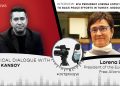
Alice Magar: My name is Alice Magar, I’m 26 years old and I live in Marseille in the south of France and I’m working there for a daily newspaper which is called La Marseillaise. I’m talking a lot about social issues and we are also talking a lot about the Kurdish problem.
So, you just joined a delegation that went to the south of Kurdistan. What were your reasons for joining this delegation?
So, we have a lot of Kurdish people in Marseille and it’s a subject that we report about a lot. So it was really important for us to be a part of this delegation and…
The fact that these two deaths went unnoticed on the international scene, that it was a subject only in Kurdistan and that it was not talked about at all in France, apart from Reporterres sans Frontière and l’Orient le Jour who did articles about it. I found it shameful and aberrant, and so it was important for me to go and shed light on this crime.
When you went to Southern Kurdistan, you also went to the site where the Kurdish journalists Gulîstan Tara and Hêro Bahadîn were killed by a Turkish drone strike. Can you tell me which observations you made there?
When we arrived there was still a black spot representing the place where the burning car stopped after being hit by the drone fire. It was explained to us that the car had been hit a hundred metres before and that it had finished its run there. At the spot where the shot was fired, we went to look on the road, and there was still a hole with metal parts of the bomb that hadn’t been removed. This is proof that the authorities haven’t really investigated what happened.
When you went to Sulaymaniyah (Silêmanî), you met people that knew both Gulîstan and Hêro personally and heard many memories by their colleagues, friends and families. Which memory or which story touched you the most?
We had the possibility to talk with the colleagues and to get to know them in a better way.
We spoke with two friends of Gulîstan and Hêro. We learned that Gulîstan was really the mother of the editorial team, that she had this very maternal aura and was always helping people to feel better, to de-stress. She put a smile on everyone’s face. She was very pedagogical, trying to teach the tricks of the media work to everyone she came into contact with. She was a very experienced journalist, who knew a lot about all political and social issues, and she didn’t hesitate to pass on her knowledge to everyone.
As for Hêro, I spoke a lot to Denis, who was her trainer and very close to her. He explained to me that she was a very strong, very independent woman, who didn’t need or want a man. She made her own way. She had a lot of dreams, and wanted to go to Germany to study. He also said that she didn’t have many friends, but when she did have friends, she did everything for them. For her, it was really a commitment to have a friendly relationship with someone.
During the delegation, you also visited a lot of journalistic institutions. What did you learn about the situation of women in journalism in the Kurdistan Region of Iraq?
We went to see Jin TV, a TV channel entirely made and run by women. I was actually very impressed to see the role and place that women have in Kurdish media. Chatr media, for example, has weekly women-only meetings to reflect on how topics have been covered in the past and how they can highlight women’s voices in the coming weeks. There are also seminars run by women on media-related topics. This enables them to broaden their horizons and learn more about society in general. There’s a real effort being made to bring women’s voices to the fore, and it’s work that’s being done by women. It’s important because who better to talk about women than women themselves?
Is there anything else you want to share?
Yes, I want to say that even if it seems far away, it is our duty as European media to talk about what happened to Hêro and Gulîstan. It’s not a Kurdish issue, it’s about freedom of speech, and freedom of the press and it should concern everybody in Europe and also worldwide.
Thank you a lot.
Thank you too.