

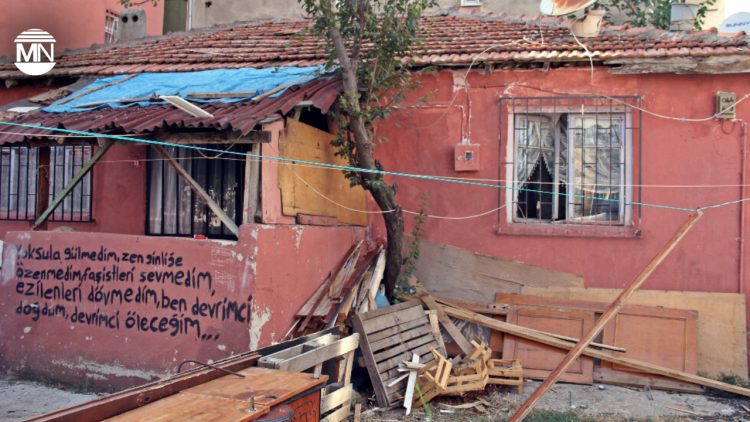
Once a symbol of leftist struggle and grassroots organisation, the ‘1st of May’ neighbourhood in İstanbul’s Ümraniye district is now facing what locals describe as an unchecked rise in crime and drugs resulting in social collapse. The area, officially known as Mustafa Kemal neighbourhood, is still generally referred to by the people as the 1st of May neighbourhood, reflecting its radical past.
Founded by leftist organisers and long associated with Turkey’s revolutionary and Kurdish movements, the 1st of May neighbourhood is now, according to residents, a site of state-driven depoliticisation and state-enabled criminal infiltration. They say this shift accelerated in the early 2000s, when state policies and cultural intervention began to erode the neighbourhood’s political identity.
“They opened cafés, bars and music venues to distract the youth from activism,” one long-time resident said. “Then they brought in betting shops. Later, drugs. Eventually everything was changed.”
State pressure on political organising reportedly intensified after two major waves of protest: the Gezi Park demonstrations in 2013, which mobilised broad opposition to the government’s authoritarianism, and the Kobanê solidarity protests in 2014, which erupted across Turkey in response to the government’s perceived inaction during the ISIS siege of Kobanê, a Kurdish-majority town in Syria. Both moments had galvanised leftist and Kurdish activism in the 1st of May neighbourhood. However, the 2016 coup attempt marked a turning point. Residents say revolutionary groups were broken as a result of arrests, surveillance and forced exile, leaving a vacuum quickly filled by organised crime.
“After 2016, even former revolutionaries gave up and turned to making money,” said one resident. “Some opened illegal betting shops. Some got into security or parking rackets. A few formed gangs. From there, it was a slippery slope.”
Illegal betting dens—often disguised as corner shops or kiosks—have become common, according to residents, who describe a process where legal gambling was used as a gateway to illicit activity. Drugs followed soon after, distributed initially through local teenagers. While this began with secondary school students, it has now reportedly reached even primary school pupils.
Prostitution, too, has risen sharply. Residents allege that vulnerable women, especially younger ones, are being coerced into prostitution often as a result of blackmail or to fund drug habits. “They start a relationship with them, make videos of them, then threaten to release the videos unless they comply,” said one resident. “Others are forced into prostitution just to pay for their next fix.”
While these issues are well-known in the neighbourhood, locals say that police response has been minimal, with the crackdowns basically being for show. In contrast, state pressure on leftist organisation has remained steady. “There are dozens of gangs now,” one resident said, naming groups like Samuray, the Caspers, and the ‘Barış Boyun’ group. “Some demand protection money from local shops. Others sell drugs openly. They act with impunity.”
Once home to revolutionary organisation, community mutual aid and street-level resistance, the 1st of May neighbourhood now appears to many of its residents as unrecognisable. “Even in the 1990s, there was still political work going on,” said one former activist. “Now it’s silent. People no longer trust anyone to defend the community.”
Despite sporadic demonstrations and past uprisings, such as those in response to the Kobanê conflict, the neighbourhood has seen a consistent decline in organised resistance. In its place, residents say, there is a growing sense of isolation, poverty and fatalism—particularly among the youth.
With social services failing and political organising suppressed, the May Day neighbourhood is facing a crisis that, to residents, is not merely the result of neglect but part of a broader strategy. “This didn’t happen by accident,” one resident said. “It was planned. And now, we’re the ones left to live with it.”


