

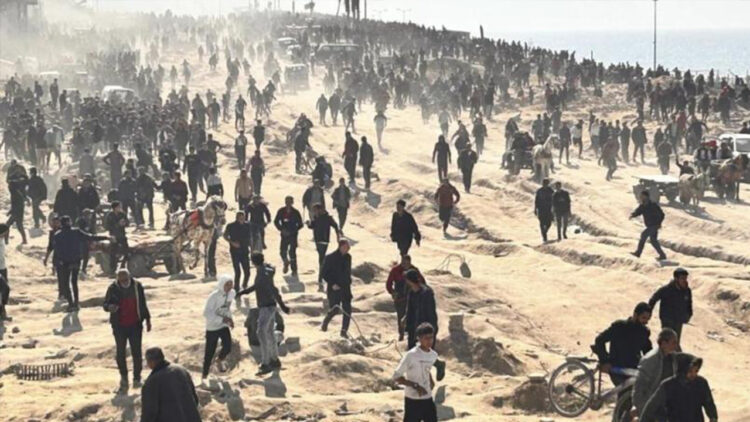
Israeli forces killed 112 Palestinians and wounded over 750 in Gaza on Thursday, firing on civilians assembled for food aid in an attack that is considered among the worst Israeli war crimes since the war’s onset on 7 October, exacerbating the humanitarian crisis and pushing the death toll above 30,000.
According to the Palestinian Health Ministry, the attack targeted civilians at El Nabusi Junction in the western part of Gaza, who were waiting for food supplies. “The severity of injuries and the lack of medical supplies have overwhelmed health teams,” spokesman Ashraf al-Qudra highlighted.
Israeli officials admitted to firing on the crowd, citing a “perceived threat” due to the crowds surrounding the aid trucks. They also released aerial footage of it, which some have condemned as dehumanising the starved Palestinians who ran for the aid. The attack led to a predictable “stampede”, Israeli military officials said, with casualties also resulting from individuals being run over by vehicles.
Eyewitnesses and victims, including Ali Awad Ashqir, recounted the horror of the attack. “The moment they arrived, the occupation army fired artillery shells and guns,” Ashqir said, although the Israeli military later denied using shelling or strikes at that time.
The international community, including the US, Saudi Arabia, and the European Union, has condemned the violence, which they said undermines efforts towards a ceasefire. The UN Security Council convened an emergency meeting to address the crisis, marking yet another “day from hell” in Gaza, as described by the head of the UN agency for Palestinian refugees, UNRWA.
The war, which began on 7 October with a Hamas attack, has unleashed an unprecedented Israeli aggression that resulted in significant casualties on Palestinian civilians, killed more hostages than it rescued, and filled social media platforms with Israeli soldiers’ live streams of their war crimes, strained international relations and undermined international humanitarian law.
Negotiations for a truce, potentially commencing with the Muslim holy month of Ramadan, hinge on hostage exchanges and territorial withdrawals.
As the blockade on Gaza tightens, the threat of famine, an intentionally produced one according to a UN rights expert, looms large, with residents facing dire shortages of basic necessities. Amid the ongoing conflict, calls for humanitarian relief and a sustainable resolution grow louder, highlighting the urgent need for international intervention to prevent further loss of life.


