

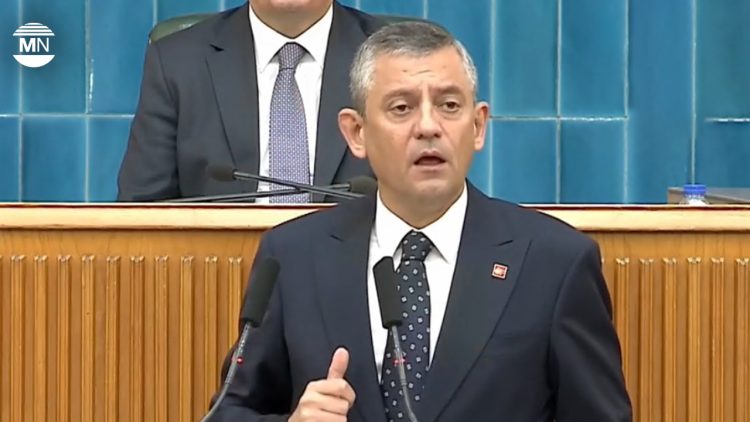
“He [Erdoğan] took donations for illegal buildings, handed out billboard contracts unlawfully, poured money into the media—and then bought them,” declared Turkey’s main opposition leader Özgür Özel on Tuesday, launching one of his sharpest attacks yet against President Recep Tayyip Erdoğan’s government during the Republican People’s Party (CHP) group meeting in Ankara.
Özel’s speech offered a comprehensive denunciation of the government’s handling of recent corruption claims, its alleged control over the judiciary, and what he described as a campaign of misinformation targeting opposition-run municipalities. In an address designed to rally both domestic and international attention, he asserted that Erdoğan’s administration was applying double standards, manipulating court processes, and exploiting the media.
The CHP leader criticised Erdoğan’s rhetoric on the so-called ‘Urban Consensus’, a term the president had used to accuse the pro-Kurdish Peoples’ Equality and Democracy (DEM) Party of forming electoral alliances with CHP in western cities. Özel accused the government of criminalising legitimate political representation.
“You accuse the DEM Party of entering councils to help win elections, yet in Şişli you arrest a deputy mayor simply because of his background,” he said. “Meanwhile, you release all detainees from the Peoples’ Democratic Congress (HDK) Congress and call it justice.”
He warned that this inconsistency was politically motivated and designed to stoke nationalist sentiment ahead of possible electoral shifts. Özel also charged that Erdoğan’s party had been weaponising the media to manufacture narratives around corruption. “They used stock footage to show bundles of cash being pulled from safes. But the safes had no money—only a stamp and a backup hard drive,” he said. “Even the mayor’s mother would be convinced by that footage.”
Özel argued that if legitimate corruption existed, there would be no need for falsified evidence. Referring to a case involving İmamoğlu’s bodyguard, he said: “The chalet safe they raided only had state-issued bullets. Yet they ran footage of cash, claiming corruption. This is how they frame people.”
He went on to say that while Erdoğan’s government had accused current mayors of accepting illegal donations, the president himself had previously justified similar actions. “Erdoğan said himself: ‘We legalise illegal buildings and take donations.’ Now they accuse us of bribery for doing the same, even when it’s on public record.”
In a broader critique of the justice system, Özel alleged that judicial independence was a fiction. “We waited again for the Justice Minister to claim independence of the judiciary, but he stayed silent. Why? Because his own party is devouring itself ahead of a cabinet reshuffle,” he said, suggesting that internal power struggles within the ruling Justice and Development Party (AKP) had paralysed key ministries.
He cited examples from the past, including the 17–25 December 2013 corruption probe, to underline what he called selective memory and justice. “Millions in cash were found in ministers’ homes. They claimed police planted it. Then got the cash back—with interest,” he said. “Erdoğan says ‘corruption means money leaving the state’—so what about the money then?”
Turning to international developments, Özel referenced a diplomatic incident involving Spanish Prime Minister Pedro Sánchez, who held up a placard reading ‘Free İmamoğlu’ during a Socialist International meeting. Erdoğan had reportedly reacted angrily. “He says he explained the truth to Sánchez. Yet even our lawyers don’t know what’s in those sealed files. What truth is he explaining?” asked Özel. “Because in Turkey, our world leader decides who is jailed, and other world leaders decide who goes free. Merkel called—Deniz was released. Trump shouted—Brunson was on a plane to the White House. Macron called—so did the French journalist walk free.”
Özel said Erdoğan had once warned his ministers not to carry suitcases, calling them suspicious. “Now even our jammers are accused of hiding money. They see a suitcase and say ‘There must be cash inside,’” he said, ridiculing the allegations made against his party officials.
He rejected the government’s claim that the Istanbul Metropolitan Municipality, under Mayor Ekrem İmamoğlu, was involved in a 560 billion lira corruption scheme. “The total municipal budget over six years was 497 billion,” he said. “They even claimed a nationalist MP’s car was İmamoğlu’s. They said there was a secret vault—what turned up were old [electronic signal] jammers.”
Özel concluded by referencing past billboard scandals, pointing out that Erdoğan himself had been the subject of a 50-trillion-lira lawsuit involving billboard contracts. “Yet when we’re accused, companies are seized without court decisions. All we say is: show the proof, file the charges, and deliver justice—without faking it.”
As political tensions mount and international figures continue to weigh in, Özel’s accusations underscore an increasingly bitter divide in Turkish politics—one shaped not only by elections and alliances but by clashing versions of justice, truth, and power.


