

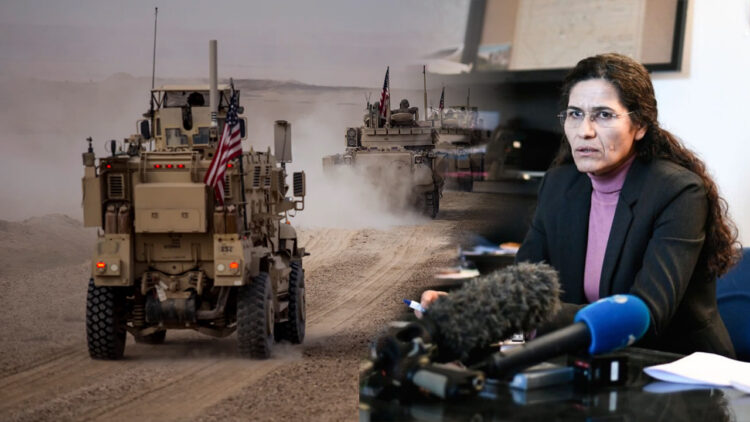
Amid escalating tensions in northeast Syria, Ilham Ahmed, the Syrian Kurdish politician and co-president of the Syrian Democratic Council, issued a stark warning during her recent visit to Germany: if US troops withdraw, the region will swiftly descend into chaos. Speaking on 31 October in an interview with Susanne Koelbl of SPIEGEL, Ahmed stressed that the security and stability of the Kurdish-led Autonomous Administration of North and East Syria (AANES) hinge on continued American presence. “If the Americans withdraw, fighting will break out immediately,” Ahmed declared, outlining a scenario where power vacuums could be exploited by hostile regional forces, especially Turkey.
With northeast Syria representing nearly a third of Syria’s territory, Ahmed explained that the area remains vulnerable to aggression from multiple sides. The region’s forces, who collaborated with the US-led coalition to defeat ISIS in 2019, have since held thousands of ISIS members in detention and safeguarded the stability of the autonomous Kurdish areas. Despite this effort, Ahmed revealed that the Syrian Kurds feel increasingly abandoned by the international community, as geopolitical dynamics shift and pressure mounts on the US to reduce its overseas military presence.
The fate of US involvement in the region has become particularly crucial in light of the American presidential election, Ahmed noted. Though a recent anti-ISIS coalition agreement delayed any troop withdrawal until at least the end of 2025, she fears that a new US administration could re-evaluate this stance. Recalling former President Donald Trump’s abrupt announcement to withdraw forces in 2019—a decision narrowly averted by diplomatic intervention—Ahmed voiced apprehension over similar decisions under a new leadership. The Kurdish-led administration, she believes, would be left to contend with renewed threats from Turkey, Iranian-backed militias, and ISIS remnants.
Ahmed’s visit to Germany, in addition to her interviews, aimed at garnering European support for the embattled Kurdish administration. She stressed that Turkey, which has intensified its cross-border attacks on northeast Syria, presents an ongoing threat to the region’s stability. “We are being bombed daily,” she stated, pointing out that Turkey’s attacks have targeted not only military installations but also civilian infrastructure, exacerbating local humanitarian crises. Ahmed argued that Turkey’s ambitions extend beyond mere security concerns, asserting that Ankara seeks to destabilise the Autonomous Administration and reclaim Kurdish territory. “President Recep Tayyip Erdoğan clearly wants to destabilise the region and bring our territory under his control,” she said.
Ahmed challenged claims that Kurdish forces pose any threat to Turkey. Instead, she suggested that Turkey’s actions might be aimed at freeing ISIS fighters held in Kurdish-administered prisons, with the intent of creating further chaos. Recalling past events during the Syrian civil war, she accused Erdoğan of allowing ISIS fighters to cross through Turkey into Syria, raising concerns over potential coordination between Turkish forces and ISIS affiliates. “He clearly has no conflict with ISIS terrorists, but he does with us,” Ahmed asserted, arguing that Turkey’s goal is to dismantle Kurdish self-governance.
The Kurdish politician underlined that, ultimately, peace and stability require diplomatic solutions with both Damascus and Ankara. Ahmed expressed hope that a mediated agreement might establish autonomy for the Kurdish region similar to the Kurdistan Regional Government in Iraq. Yet, such a resolution requires international support, and she called on coalition countries, including Germany, to act as mediators to facilitate negotiations.
As Ahmed seeks to rally European backing, her appeal highlights the precarious situation of the Kurdish-led Autonomous Administration. The region, vital in holding ISIS fighters and their families, faces severe risks from Turkey’s ongoing hostilities and the uncertain commitment of international allies. Her warnings emphasise the need for consistent international engagement to prevent further destabilisation in Syria’s already war-torn northeast.


