

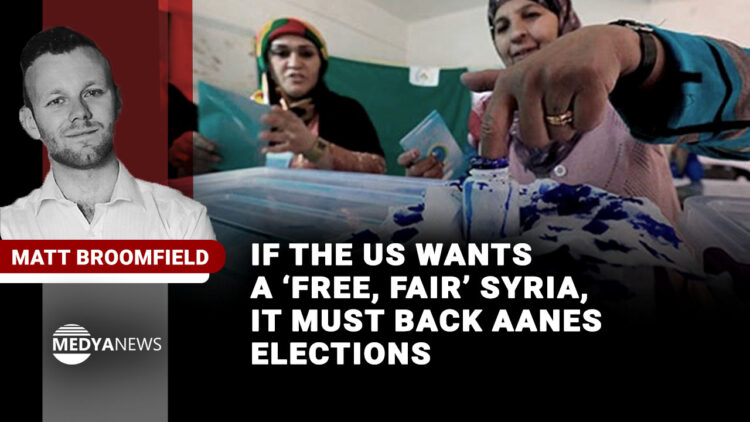
If the USA were serious about fostering democracy, stability and a better future in Syria, there would be only one logical step to take: support the Kurdish-led Autonomous Administration of North and East Syria (AANES) as they prepare to hold unprecedented municipal elections on 11 June. But instead, the USA has hidden behind the protestation that the elections will not be “free or fair”, refusing to lend their support to the process.
As the US State Department know full well, adopting this position is a gift to their NATO allies Turkey, who have already warned the AANES that they will face a military incursion should they go ahead with the planned process. Already, drone strikes have ramped up, killing four over the weekend and injuring a dozen civilians. We can expect further destruction of humanitarian infrastructure at the least, if not a more brutal and dramatic intervention.
Turkey is emboldened by the USA’s approach. The US wants to treat the Kurdish-led autonomous regions as a purely military entity, claiming its forces are only stationed in the region to fight ISIS – when in fact, all the US wants to do is maintain a military foothold against Iranian interests in the region. Turkey has called the US’ bluff, stating they will not buy the US’ excuses over the ISIS war any more. By refusing to engage with the AANES’ civilian and political entities, and attempting to treat the region as a military fiefdom, the USA contributes to Turkey’s delegitimisation of any and all political activity on its southern border as mere ‘terrorism’.
In these conditions, it’s little wonder that the elections face severe challenges. Certainly, elections held in conditions of war will face a struggle for legitimacy. Turkish assaults on North and East Syria have already prohibited prior rounds of electoral politics, the region’s Kurdish-nationalist opposition continues to boycott the political process and bide its time in the hopes of one day winning control of the region for itself. From the perspective of a Western Parliamentary democracy, impartial observers might well raise legitimate questions over the nature of the electoral process.
But there are no impartial observers in Syrian politics, and these elections are not simply intended to replicate the system of liberal, parliamentary democracy, with all its benefits and shortcomings. Rather, these elections are themselves a compromise position, since the Kurdish movement originally intended to supplant the traditional parliamentary system altogether, and replace it with a bottom-up system of direct democracy, based on local councils in individual villages and neighbourhoods.
The realities and contingencies of the Syrian conflict and consensus-building on the mass scale forced it to compromise its utopian vision, introducing a limited electoral process to enable this gradual transition. As such, the real significance of 11 June ultimately lies not in the overall results (given boycotts and regional realities, the Kurdish movement’s bloc will surely take home most seats), but in the newfound participation of Arab candidates, independents, and others participating in the AANES system for the first time, including in ISIS’ former heartlands.
If the USA were seriously concerned about ensuring international standards of electoral politics were respected, it would monitor and engage with the electoral process despite these shortcomings, treating the planned local polls as a starting-point to demonstrate that these flaws do not prohibit an electoral process from taking place in Syria. Instead, it has taken the typical, short-sited cowardly approach of hiding behind UN Resolution 2254 – a tactic common to all parties in Syria, Russia, Turkey and the Assad regime included, who are in fact totally disinterested in achieving the peaceful, democratic resolution to the conflict that text famously demands. With no such end in sight, citing UNR2254 ultimately serves as a get-out-of-jail-free card legitimising inactivity and the perpetuation of the status quo.
The AANES’ elections are not perfect, but they are part of what is by far the best offer on the table for the Syrian people. Lamenting the conditions does nothing to change the realities in Syria. The AANES’ brave efforts to build an alternative, trans-ethnic coalition may be critiqued where necessary, but they must ultimately be supported by international powers if they’re to result in lasting, democratic change for millions of Syria. These elections are only starting point, but they offer the only potential route to a truly “free and fair” Syria.


