

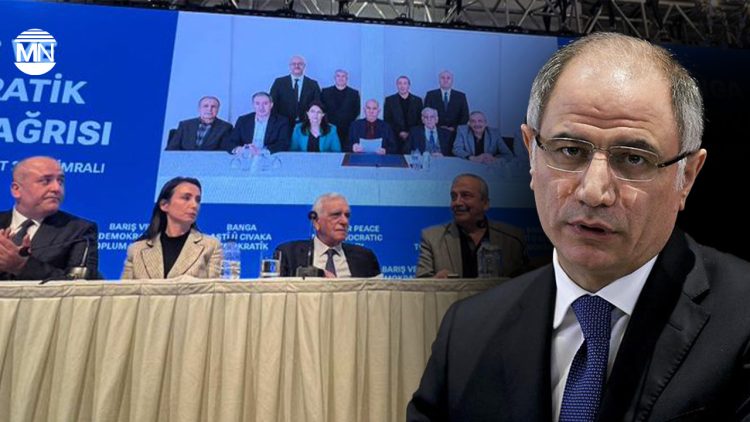
Turkey will “break free from its shackles” if the Kurdistan Workers’ Party (PKK) accepts Abdullah Öcalan’s call and dissolves itself, a senior official from the ruling Justice and Development Party (AKP) said on Thursday. AKP Deputy Chair Efkan Ala made the remarks during a live interview on A Haber, following Öcalan’s historic call for disarmament and democratic reconciliation.
“Turkey’s counterterrorism efforts have never faltered and will continue with determination,” Ala said. “The sacrifices of our martyrs and veterans have shown the world that terrorism is doomed to failure.” Then, underlining the importance of the PKK’s response to Öcalan’s appeal, Ala stated: “If the PKK considers this call and dissolves itself, Turkey will break free from its shackles.”
“We hope that these calls receive a response,” he added. “We will assess the outcome. Our President and the AK Party have taken every necessary step to remove terrorism from Turkey’s agenda. What matters now is whether the organisation will comply with the call.”
Ala stressed that the essence of Öcalan’s call is the laying down of arms and the dissolution of the PKK, adding: “We focus on the outcome.”
Abdullah Öcalan’s statement, publicly read in Turkish by Pervin Buldan and in Kurdish by Ahmet Türk, marked what some observers see as the most decisive intervention in the decades-long Kurdish conflict.
In his message, Öcalan urged the PKK to voluntarily dissolve itself and convene a congress to formally declare an end to armed struggle. He argued that the PKK, which emerged under the oppressive conditions of the 20th century, had fulfilled its historical mission, and that the time had come for a transition to democratic politics.
“The PKK was formed under conditions where Kurdish identity was denied, and democratic avenues were blocked,” Öcalan stated. “However, with the dissolution of those denialist policies and the advancements in political freedoms, armed struggle has become redundant. A democratic society and political space must replace it.”
Öcalan framed his call as a historic responsibility, urging all Kurdish political actors to embrace peaceful and democratic methods as the only legitimate framework for resolving long-standing disputes. He described democratic reconciliation as the fundamental method, rejecting separatist or nationalist alternatives, including federalism and autonomous governance models, which he deemed insufficient for addressing the realities of Kurdish-Turkish coexistence.
Earlier this month, the PKK stated that it was ready to transform itself in accordance with Öcalan’s requests, indicating a shift in the organisation’s stance even before the historic announcement. The statement, which came from PKK leadership, suggested that the group was prepared to take steps towards a non-armed political phase, dependent on Öcalan’s directives.
While Öcalan’s latest call explicitly asks for the dissolution of the PKK and the laying down of arms, it remains unclear how and when the organisation will act upon it. Observers note that the PKK’s readiness to comply will largely depend on the Turkish state’s approach to political reconciliation and democratic guarantees for Kurdish rights.
Although the PKK is designated as a terrorist organisation by Turkey, the United States, and the European Union, its classification has been subject to legal and political controversy. The Belgian judiciary, in a landmark ruling, determined that the PKK’s activities constitute an armed conflict rather than acts of terrorism, citing international humanitarian law. Similarly, the Council of Europe (CoE) Court of Justice has raised concerns over the ambiguities in the legal basis for listing the PKK as a terrorist organisation.
Despite these rulings, Turkey has actively pursued diplomatic efforts and intensive lobbying to criminalise the Kurdish movement at an international level. Ankara has sought to secure legal and political concessions from its allies, pushing for restrictions on Kurdish political and civil organisations across Europe. While Turkey has framed the issue as a counterterrorism struggle, critics argue that the designation has been used to suppress legitimate Kurdish political mobilisation and curtail democratic rights.
With thousands gathering in Turkey’s Diyarbakır (Amed), Van (Wan), and Mersin, North and East Syria’s Qamishli (Qamişlo), and Kurdistan Region of Iraq’s Sulaymaniyah (Silêmanî), to witness the announcement, and over 250 journalists and 120 press agencies covering the event, the coming days are expected to bring further political discussions and strategic shifts within the Kurdish movement. Whether Öcalan’s appeal for a peaceful and democratic resolution will materialise into concrete steps remains uncertain, but it has undeniably set the stage for a new chapter in the long-running conflict.


