

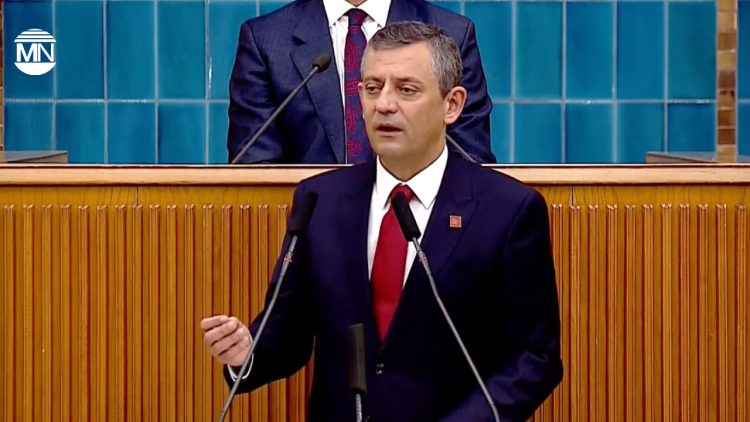
“If Kurds have a problem, there is a Kurdish question, and it must be resolved,” Turkey’s main opposition the Republican People’s Party (CHP) leader Özgür Özel declared on Tuesday, reiterating his party’s long-standing position on the matter, at his party’s parliamentary group meeting in Ankara. He emphasised that CHP does not view the Kurdish question through a “situational” lens and called for a democratic solution through parliament.
Özel’s remarks came a day after he met with the co-chairs of the pro-Kurdish Peoples’ Equality and Democracy (DEM) Party, Tülay Hatimoğulları and Tuncer Bakırhan. “We hosted and welcomed DEM Party’s esteemed co-chairs and their delegation at our headquarters. It was a productive meeting,” he said.
He underscored CHP’s consistency in addressing the Kurdish question, positioning his party as historically committed to democratic solutions. “CHP is the political party with the clearest stance on this matter. All public opinion polls confirm that people view our approach as consistent and reliable.”
Özel reiterated his belief that the Kurdish question, along with broader freedoms in Turkey, must be addressed through Parliament. “The solution lies under the roof of this Parliament. We need a democratisation package that not only resolves the Kurdish question but also addresses Alevi rights, freedom of expression, and individual liberties, all of which have significantly regressed in recent decades,” he said.
He criticised the government’s policies towards Kurdish-majority municipalities, where elected mayors have been replaced by state-appointed trustees. “On the one hand, you appoint trustees in Kurdish-populated cities, claiming ‘you are terrorists, we will govern.’ Then, on the other hand, you talk about negotiations and initiatives. This contradiction must end,” he said.
Özel also took aim at what he described as the government’s shifting rhetoric on the Kurdistan Workers’ Party (PKK). “PKK, which was a terrorist organisation in the past, is now apparently no longer a terrorist organisation for the future. They are inventing new ‘future terrorist organisations’ instead,” he said, accusing authorities of arbitrarily redefining threats to serve their political agenda.
Addressing the broader context of Turkey’s political landscape, Özel argued that a democratic transformation is essential for peace. “The path to ending the terror problem and burying the Kurdish issue in history is democracy—for both Kurds and Turks,” he said. “This means ending trustee appointments, securing freedom of expression, and ensuring religious freedoms. The state must become impartial and reject all forms of oppression.”
He also renewed his call to Parliament Speaker Numan Kurtulmuş to take the initiative on a national democratisation process. “I urged Mr. Kurtulmuş to act. Let’s bring together all parties in Parliament and start a major democratic reform process that will open the way for Turkey’s progress and prosperity,” he said. “Despite everything, I expect him to act swiftly.”
In a separate part of his speech, Özel strongly condemned a recent column by pro-government newspaper Yeni Şafak’s writer İsmail Kılıçarslan, which he said incited hatred against Alevis. Referring to the article’s alleged targeting of Alevi communities in Syria, Özel labelled Kılıçarslan a “despicable man”.
“Is there any other definition of inciting hatred, exploiting religious sentiments to create hostility and division? Those Nusayris you talk about have relatives just 50 kilometres away in Hatay, grieving for their loved ones,” he said.
Anticipating legal action against him, he doubled down on his remarks. “If a lawsuit is filed, let it be clear—I called the author of that article a ‘despicable man’. If others want to sue, they always find a reason. But let me say this: Wherever innocent blood is shed—whether in Palestine, Ukraine, or anywhere in the world—we stand with the victims.”


