

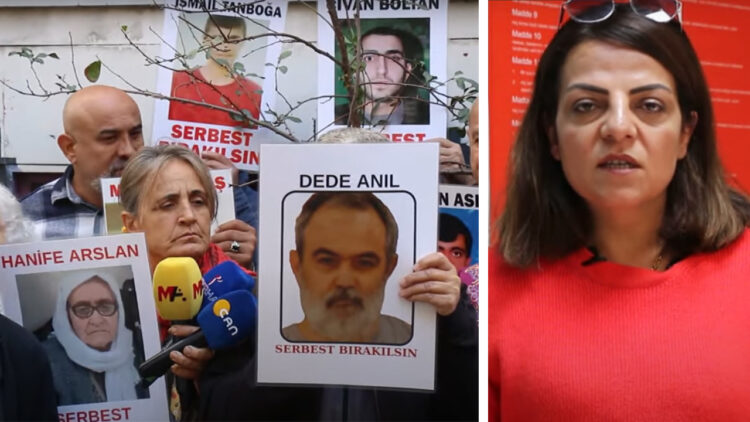
Human rights defenders in Turkey are demanding the immediate release of two severely ill political prisoners who require constant medical care, one of whom is barely able to walk, the other unable to recognise family members.
Dede Anıl, a 98% disabled political prisoner held in Marmara No 1 L-Type Prison, was the focus of the 659th ‘F Sit-in’ protest (named for F-type prisons, now called L-type) outside the office of the Human Rights Association (İHD) in Beyoğlu, İstanbul, while activists in Ankara drew attention to the condition of Melek Akgün in Kayseri Women’s Prison in their 531st weekly demonstration.
Anıl suffers from heart failure, COPD and fibromyalgia, along with partial paralysis and severe brain damage, according to former political prisoner Nevzat Açan. Anıl’s former wife said after visiting him, “He’s like a half-dead person. He doesn’t remember our 20-year marriage and cries like a child constantly.”
Ignoring an 82% disability report issued by a state hospital for Anıl on 24 January, Turkey’s Forensic Medicine Institute ruled on 22 July that he was fit to remain in detention. Akgün (58), who was arrested on 6 February 2024, likewise received an 82% disability rating, due to multiple conditions including heart disease, COPD and chronic kidney failure.
In an interview with Mezopotamya Agency on Sunday, the İHD’s Hakkari (Colemêrg) Branch Co-Chair Sibel Çapraz highlighted that the Prison Administration and Observation Board has blocked the release of 8,521 prisoners, including those with severe illnesses. “The Board makes completely arbitrary decisions, preventing the release of prisoners who have completed their sentences, using fabricated pretexts to justify the decisions. The decisions made by the board are not fair. The Prison Administration and Observation Board must be closed immediately,” she said.
“According to İHD data, there are 1,517 ill prisoners, of whom 651 are in a critical condition,” said Nuray Çevirmen, İHD Central Executive Board member. “The state is responsible for protecting the right to life both under domestic law and under international conventions that Turkey has signed.”


