

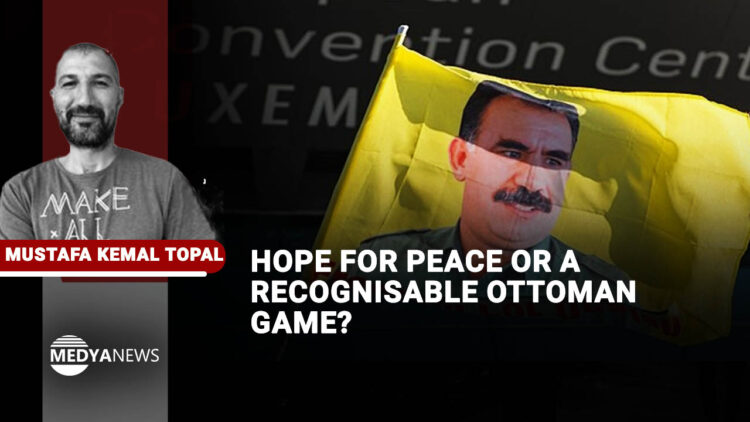
Mustafa Kemal Topal
Translated from the original, published by POV International.
At this time, there are many conflicting signals coming from Turkey. On the one hand, the government wants to make it clear that it is still waging an aggressive struggle against the Kurdistan Workers’ Party (PKK) and that it can win the battle, and on the other hand, the government is quietly opening the door to a peaceful solution with Öcalan at the head.
These days, either a new political process is flourishing for a peaceful solution to the long-standing Kurdish-Turkish conflict in Turkey, or the Turkish Government is trying to cheat the Kurds again.
Strange things are always happening in Turkey: from changing the country’s English name from Turkey to Türkiye to the abolition of daylight saving time and to the recent decision to euthanize all homeless dogs in the country. But despite the country’s persistently unpredictable political initiatives, no one expected that the leader of the Nationalist Movement Party (MHP), Devlet Bahçeli, would one day call on the imprisoned leader of the Kurdistan Workers’ Party (PKK), Abdullah Öcalan, to make a speech in the Turkish Parliament to declare that the PKK is laying down its arms and thereby ending its “terrorism” against the Turkish state.
This is what Bahçeli said on 22 October at his party’s parliamentary group meeting. He went on to surprise by adding: “If he (Öcalan) shows this wisdom and determination, the way should be wide open for the legal regulation regarding the use of the ‘right to hope’ and for him to benefit from it.” Since 1999, Öcalan has been imprisoned on the Turkish island of Imrali, where he has had no contact with anyone, neither lawyers nor family, for the past 43 months.
That is to say, Bahçeli will not only allow Öcalan to speak in parliament, but he will also remove the isolation to which Öcalan has been subjected by reconsidering his sentence, which is life imprisonment. Bahçeli has always been against Öcalan’s life sentence because he did not find life sentences harsh enough and preferred that he should be hanged in public.
Bahçeli actually began to surprise, including his supporters. At the opening of the new year of the Turkish Parliament on 1 October, he held out his hand to the members of the pro-Kurdish Peoples’ Equality and Democracy Party (DEM). Bahçeli justified his hand of reconciliation with: “If we want peace in the world, we must start with it in our own country.” Here he alluded to Turkey’s desire for a ceasefire between Israel and Hamas.
For several years, Bahçeli has denied not only the existence of the so-called Kurdish conflict, but also the existence of the Kurds in general. But despite the attack in Ankara, the government chose the next day to end the long isolation for Öcalan by allowing Öcalan’s nephew, who is also a Member of Parliament for the DEM Party, to visit him. That is to say, many contradictory actions are taking place in Turkey. On the one hand, the government wants to signal that it is still waging an aggressive fight against the PKK and that it can win the battle, and on the other hand, it is slowly opening the door to a peaceful solution with Öcalan at the helm.
According to his nephew, Öcalan said: “I am ready to take responsibility for resolving the conflict if the terms are made available.” The PKK leadership identifies Öcalan as the only legitimate party in a possible peace talk. The PKK leadership sees the Turkish willingness to negotiate a peaceful solution as an acknowledgement that they cannot win the war against the PKK by military means.
Perhaps the PKK has a point. According to several analysts, Turkey’s poor economy, corruption cases, refugee crisis and collapsed service sector are not the only reasons for the government’s U-turn. Analysts see it as more likely that the Turkish government is worried that it is losing its grip on its “internal” conflict with the Kurds and that it is on its way to becoming an international or regional conflict.
The ongoing war between Israel and Hamas and Hezbollah is helping to weaken Iran’s influence in the Middle East. The Syrian and Iraqi governments, which otherwise have good cooperation with Iran, have both begun to distance themselves from Iran, as they are worried that the conflict could spread to their countries. They will certainly avoid a confrontation with Israel and the United States. A weakening in Iran or a new regional arrangement in the Middle East will allow the PKK to increase its influence in Syria, Iraq and Iran in particular, where the Kurds are already fighting for recognition.
Although it seems that it is Bahçeli who is in charge of this process, there are many indications that he is acting in collaboration with Erdoğan.
Although the PKK appears on the US and EU terror list, the PKK, with 40 years of combat experience against the Turkish military and the international recognition that the PKK has gained in the fight against the Islamic State, has created a lot of fear in Ankara. In short, the fear is that the PKK may become larger and gain more influence in the region than they can handle themselves. The pro-government newspapers are therefore filled with conspiracy theories about whether the US and Israel intend to divide Turkey with the aim of creating a new country, Kurdistan, which is why they support the PKK.
The question is, of course, whether the PKK can agree to dissolve itself without obtaining any concessions from Turkey, including constitutional recognition of the Kurds as citizens of the country, especially when there is a geopolitical prospect of the movement growing and strengthening?
Whatever the intentions of the Turkish Government, it seems that a new negotiation process, if not a peace process, has begun between the government and the PKK. Although it seems that it is Bahçeli who is in charge of this process, there are many indications that he is acting in collaboration with Erdoğan. Domestically, it is also tactically wise for Bahçeli to be in charge of the negotiations, because he is the only leader in Turkey who can persuade the nationalists to accept an agreement with the PKK.
Thus, it will not be Erdoğan’s fault if the negotiations do not succeed. There are already rumors that Erdoğan’s demand is also that the Kurds must agree to support his government in connection with a constitutional amendment that will make it possible for Erdoğan to be a candidate again in the upcoming presidential election.
However, however strange things are in Turkey, it is remarkable and in a way tragic that another cruel war in the Middle East should pave the way for a possible peaceful solution to the Turkish-Kurdish conflict.
Mustafa Kemal Topal is assistant professor at the Roskilde University in Denmark, where he also received his PhD. He is also a fellow at the Bergen University in Norway. He recently authored a new book, ‘Women Fighters in the Kurdish National Movement: Transforming Gender Politics and the PKK’.


