

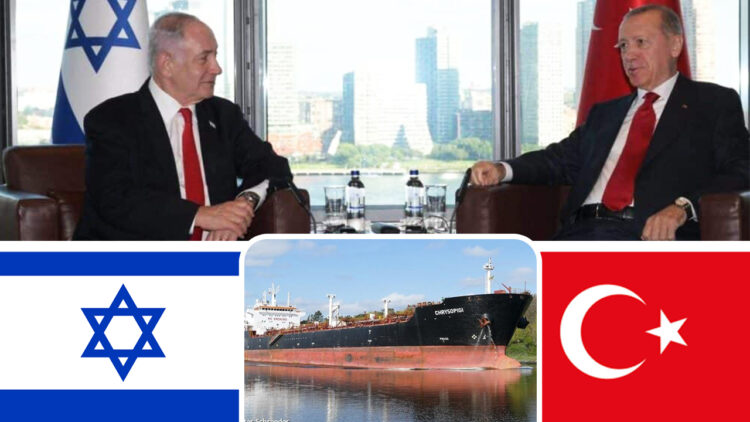
While Turkish President Recep Tayyip Erdoğan publicly declares his support for Hamas and for the Palestinian people, an investigation made by the Rise Up For Rojava Network exposes hidden trade relations between Israel and Turkey, which are continuing even after Turkey declared a total trade ban with Israeli entities.
Rise Up For Rojava (R4R) describes itself as a “network of revolutionary collectives organising solidarity for the Revolution in Rojava and aiming at targeting Turkish fascism and its collaborators.”
The report, titled ‘Turkey’s deception: Ankara’s role in the Palestinian Genocide’ exposes the historical relations between Israel and Turkey, and Turkey’s ongoing support for the massacre that Israel is committing in the Gaza Strip, while also highlighting Turkey’s support for Hamas. The following story summarises this investigation and includes research conducted by Medya News.
Israel’s attacks on the Gaza Strip have been loudly condemned by Erdoğan, and in recent days the Turkish regime has taken more concrete steps, such as banning the export of Turkish goods to Israel and announcing that it will join South Africa’s lawsuit against Israel at the International Court of Justice (ICJ). Despite Turkey’s expressed solidarity with the Palestinians and Erdoğan’s portrayal as a leader of the Muslim world and a champion of the Palestinians, questions arise over the increasingly coercive relations between Turkey and Israel and Turkey and the Palestinians.
The Israel-Turkey relationship has its roots in the very first years of the creation of the State of Israel, with Turkey being the first Muslim country to recognise Israel in 1949. These strategic relations continue today. Important military partnerships that include air, sea, land, and intelligence cooperation, manufacturing of aircraft and missiles, mutual training, and joint exercises have developed over the years.
Remarkably, Israeli airforce pilots have been training in Turkey as part of joint exercises with Turkish forces. Despite superficial frictions, notably following the Mavi Marmara incident in which nine Turkish citizens were killed damaging a certain level of diplomatic ties, the relationship between the states never ceased and economic exchanges further developed.
Since the Hamas attacks on Israel on 7 October and the subsequent Israeli attacks on the Gaza Strip, in which at least 35,000 civilians – including many women and children – were killed, Turkey has maintained trade relations with Israel. Turkey stands as the sixth largest supplier of goods to Israel and as of 2022, 37% of Israel’s demand for iron and steel was met through imports from Turkey. From the beginning of the war in October until December, 700 Turkish ships transported over 100 tons of materials such as oil, steel, and textiles to Israel, which are assumed to be used in the war in Gaza.
While Erdoğan announced on 26 April that Turkey would cut off relations with Israel and on 3 May declared a total export ban, this does not appear to have been fully implemented. Oil from Azerbaijan, Israel’s main supplier of crude oil, is reportedly still being shipped through a Turkish port in Ceyhan. There are also indirect shipments taking place, meaning that Turkey uses third countries for goods transfer so Israel is not listed as the destination port on the bill of lading.
Recent election losses suffered by Erdoğan’s Justice and Development Party (AKP) during Turkey’s local elections in March to Islamist parties and movements inside Turkey, which accuse the Erdoğan government of inaction, put domestic political pressure on the president, forcing him to act, announcing the export ban and the joining proceedings against Israel before the ICJ.
Rise Up For Rojava also reported that Turkey benefits from Israeli war technology tested in Gaza, and explained that Hamas, which, like other Islamist movements, was supported by the Israeli state in its early days in order to weaken Palestinian unity and marginalise socialist movements in Palestine, received political support from Turkey. With its support, Turkey has indirectly supported the Israeli strategy of isolating the Palestinians in Gaza from the Palestinians in the West Bank.
Erdoğan, who called Hamas a “liberation group”, recently announced at a press conference in Greece that more than 1,000 Hamas members are being treated in Turkish hospitals. He uses the Palestinian issue as a means of presenting himself as a mediator – as in the case of the Ukraine war – and maintaining the image of an important player in the region.
Turkey’s role in the Israeli-Palestinian conflict can be described as a dual-use policy, which on the surface appears to support the Palestinian cause, but at the same time supports the Israeli state in its attacks on the Palestinian population in the Gaza Strip. This hypocritical policy will not solve the Palestinian-Israeli question or other struggles in the Middle East but only serves to exacerbate the issues, the network concluded.


