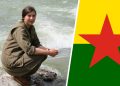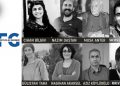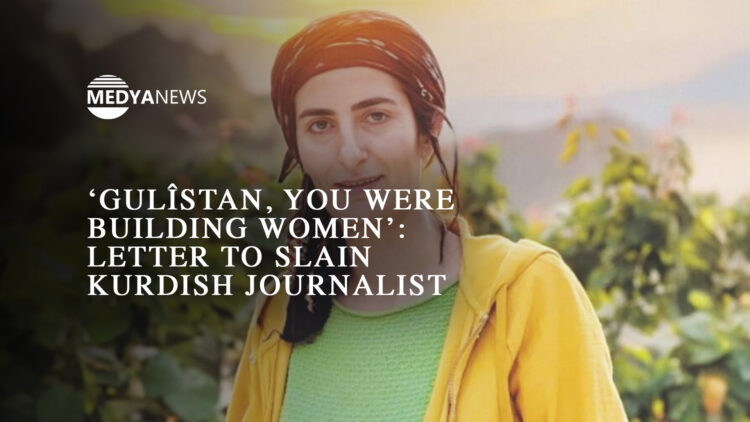
Gulîstan Tara was one of two women journalists who were killed in a Turkish drone strike on 23 August. Alongside fellow journalist Hêro Bahadîn, she was on her way to record a television programme for Kurdish channel Stêrk TV. Journalist Rêbîn Bekir was heavily injured in the attack and five other journalists sustained lighter injuries.
Tara also worked for the all-female TV channel Jin TV. An international volunteer who also worked at Jin TV has penned a letter commemorating Tara’s life and work, and calling for her attackers to be brought to justice. The text, published in full below by Medya News, offers personal reflections on Tara’s personality, support for other women and efforts to build up a Kurdish, women-led press in the midst of war and violence.
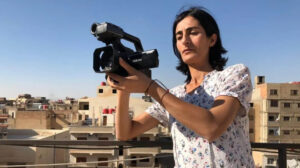
Gulistan,
They murdered you. It’s the kind of news one doesn’t believe, can’t believe. Not again, and especially not you. I had little chance of seeing you again, I think. At least I wasn’t expecting to, I’d got used to the idea. In fact, the pain I feel now is not so much that of missing someone, but that of knowing that the women of this world are a little less strong without you.
I hesitated to write; other comrades have written magnificent texts, which are blossoming because you left us such a strong memory. When I decided to do it, it was painful to bring the memories to the surface, to recall your voice, your smiles, your walk. I write now thinking about what you would have said to me, to give me confidence, and what you would have done for someone other than yourself. You give me strength, as you always have.
I met you at Jin TV, and that’s all I can talk about. A shock. I came as a driver from this women’s TV station. And I discovered a magical world, where young women who hadn’t been destined for this future, or who had never dreamed of being journalists themselves, were learning this profession, with you as their teacher. You were in charge of the TV station and its development, and you worked towards this goal at all times. But more than that, you were building a team of journalists. You were building women.

Of course, it may seem obvious in writing: a television station can only function through its workers, its journalists. But it was your ability to create this team that changed everything. With love and trust, and always with the highest standards. Lorîstan, Evîn and Medya, who knew you on television and worked with you, recently testified in a program on Jin TV devoted to your assassination. They said it themselves: your strength of conviction in getting them to work on TV, your ability to give them self-confidence, to turn them into experienced journalists and even department heads.
You were confronted with all the obstacles of patriarchal society in this effort to build an all-women television: the superior attitude of men to our technical troubles at times, the families of working women who had to be convinced to let their daughters participate, the internalised belief of young women in their inability to develop, or the very fact that a women’s television that broadcasts live has never existed…
But you insisted on creating that.
You insisted almost every night when you finished correcting the day’s edits, when I told you to go to bed at one in the morning but you sent me to sleep instead, repeating “em çi bikin?” (what else can we do?).
You insisted on fighting patriarchal capitalist influence, as when you promised a working woman that you’d only come to her wedding if she married in traditional Kurdish clothes rather than a white meringue dress.
You insisted on learning more and more yourself. You asked me to teach you to drive. Maybe it was illegal, we weren’t sure. In Rojava, the highway code wasn’t very fixed, but it’s certain that most drivers had never passed an official driving test, so why not you? That’s what led us one day, in a mix of languages and instructions, to put the TV car in the ditch during an attempted U-turn on a main road. Stuck. There was nothing we could do, so we had to rely on the men who came to get the car out with a tractor. We would have kept it to ourselves, avoided feeding the nagging belief that women can’t drive, but of course the next day the story was all over town…
You insisted on high standards. In all of us, in yourself, in our work. The way you made us want the quality, the beauty that was the hallmark of our work at Jin TV. You could get angry at times, in the face of all the problems that arose on a daily basis, but you always came back from that frustration to the constructive attitude we knew you for. You never discouraged or broke down the people around you, but supported them, while setting clear limits.
You always devoted attention and time to a person when it really mattered. If there were days when we didn’t see each other much because you were working and I was driving around, there would always be a moment when you’d stop by and ask me how things were going, really offering the time to welcome my response of, “It’s not going ok”. You worked so hard that I loved it when you’d ask me to take you to a meeting, and I’d have real-time to chat with you, ask your opinion on any aspect of our work or life, or just sing a song as we drove along the green fields, like Newroza Arî, one of your favourites, which provided the soundtrack for many (too many?) programs made during the period.
It was the thought of going to our colleagues’ children’s birthdays or visiting their families, or the one on 8 March, when you gave us all a flower keffiyeh, choosing a very specific colour for each of us.
One last memory to share, perhaps the most significant: sometimes, while we were in the TV studio, concentrating on our editing, we suddenly heard a small voice raised from the refectory. It was Aya again, the little neighbour girl, 3 years old with a moon face, eating a sweet. You’d brought her back when you returned from your commune, because she was your – our – ray of sunshine. Every day you spent time with her on the way to work, filming her teaching us how to form [traditional Kurdish dumpling] kutilks, for example. She even became, with her sisters and neighbours, the star of a clip for Kurdish Language Day that we broadcasted on television. I’m sure Aya still remembers you, as do all the others who were marked by your presence of integrity.
The comrades who still work in TV say it better than I can: beyond your talent for telling the story of your people and women, you were building women. You built women with a will, women who, whatever they did in the end, would think and stand up for themselves. I know some of them, they know themselves, and you can be very proud of the work you’ve achieved. They’re the ones who just yesterday promised to walk in your footsteps, they’re the ones who said they’d be journalists despite the threats and despite the bombs. Roses, with their cameras and pens as thorns to defend themselves.
Gulistan, they tried to murder you, but you live on, through all of us who have crossed your path and through all those who will cross the one of your memory.