

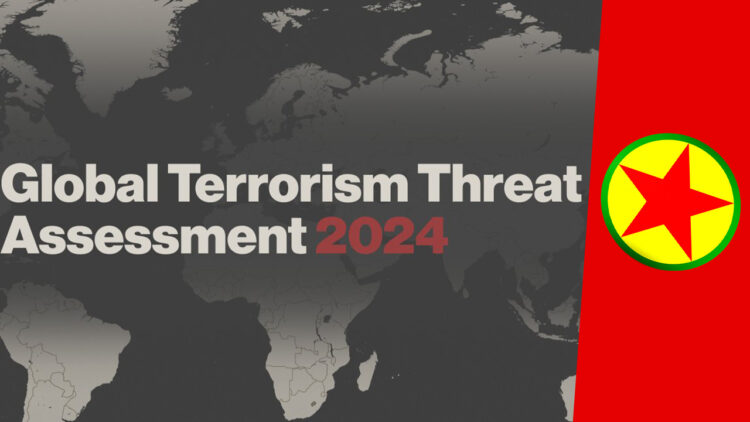
The Kurdistan Workers’ Party (PKK) is “no threat to the West”, poses “no meaningful threat” to Turkish integrity and will not be destroyed so long as related forces play a key role in the global fight against Islamist terrorism, a Global Terrorism Threat Assessment has found.
The report, published by the pro-US think-tank Center for Strategic and International Studies (CSIS), highlights the role of the broader Kurdish political movement in working alongside the USA to combat the Islamic State, or ISIS. By emphasising the limited threat which the PKK poses to Turkey and the fact the movement has never sought to attack or threaten Western states, and noting the movement espouses a democratic ideology which doesn’t seek to challenge pre-existing borders in the region, the report will further fuel arguments that the PKK should be removed from international terrorism lists and treated as a legitimate political and military actor.
“The PKK poses no direct threat to Western countries other than Turkey,” the report’s authors find, noting that “there is nothing about its ideology that suggests a threat to the United States, and it has no history of attacks against US citizens or facilities, even when it was a Marxist-Leninist organisation fighting against a NATO ally during the Cold War.
Moreover, the militant group has undergone an ideological evolution, now espousing “an ideology [jailed leader Abdullah] Ocalan calls ‘democratic confederalism’, which attempts to achieve self-determination ‘without questioning the existing political borders’”, the report notes. This ideological move to an approach aimed at achieving grassroots, bottom-up democratic change and a democratic, federal settlement within Turkey and other neighbouring countries has come along with material changes on the ground.
As statistics cited in the report indicate, the PKK withdrew from Turkey to Iraq in line with subsequently-collapsed peace negotiations, meaning most violent incidents now take place in that country and constitute armed clashes between the Turkish Armed Forces and PKK militants, along with widespread Turkish airstrikes often resulting in civilian casualties.
As such, Turkey’s attacks on Kurdish groups including the PKK and the US-allied, Kurdish-led Syrian Democratic Forces (SDF) only serve to “increase instability and draw resources that could otherwise go to countering the Islamic State”, the authors warn, noting that Turkey has used incidents within its own borders as an excuse to target Syrian regions with no connection to the incident. It is Turkey’s actions which imperil the USA by strengthening ISIS, the report’s authors warn: “a diversion of resources to resist a Turkish incursion into northern Syria could create the conditions for the Islamic State to stage a major break-out.”
The authors note that the “PKK has not disavowed violence and shows no desire to do so”, but argue that this threat cannot be eliminated by the “intensification of military pressure”. On the one hand, they argue that “while the USA will not fight a NATO ally to protect [its Syrian Kurdish allies], US officials would not accept the destruction of a US-aligned counter-terrorist force by the Turkish military and apply diplomatic pressure to prevent such an outcome. The result is that Turkey has no hope of destroying the PKK while Kurdish forces are important allies in the US counter-terrorism fight.”
By representing the PKK as a democratic force posing no threat to the West, the report lends credence to arguments that the group should be removed from terror listings. A recent, landmark ruling by Belgium’s top court upheld a decision indicating that the PKK should not be considered a terror organisation at all, but a legitimate party to an internal conflict in Turkey.
According to legal experts, the global delisting of the PKK would: enable both Turkey and the PKK to be held equally responsible for any crimes during the ongoing conflict under internationally-established law; prevent Turkey from using its opposition to the PKK as a pretext to liquidate the domestic, pro-Kurdish opposition and invade and bomb neighbouring countries; and create pressure for re-opening peace negotiations in Turkey. But continued Turkish pressure on its international allies means any such step remains a distant possibility.


