

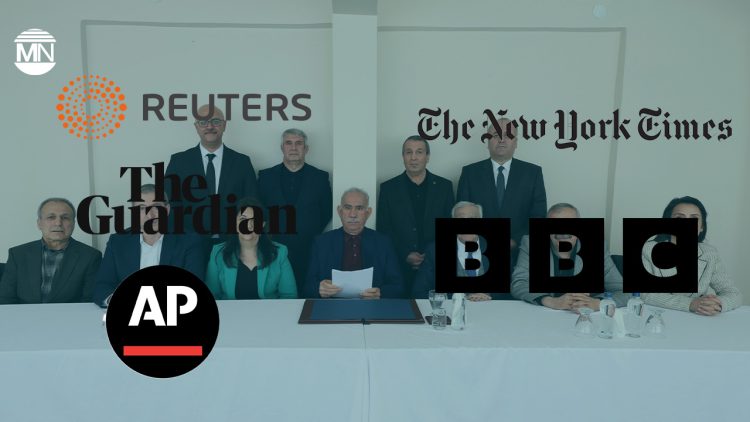
Global media reacted to imprisoned Kurdistan Workers’ Party (PKK) leader Abdullah Öcalan’s historic call from behind the walls of İmralı prison yesterday. We have provided a brief summary of some of the notable media reactions’.
“Achieving a democratic consensus to resolve tensions”
Highlighting Öcalan’s emphasis on “achieving a democratic consensus to resolve tensions” the BBC noted the shift in the rhetoric of Turkish Nationalist Movement Party (MHP) leader Devlet Bahçeli. Having long advocated for military action against the PKK, Bahçeli surprised observers last October by shaking hands with MPs from the pro-Kurdish Peoples’ Equality and Democracy (DEM) Party in parliament. He later suggested that Öcalan could be granted parole if he renounced violence and disbanded the armed movement.
The report also reflects cautious optimism within various political circles. The BBC quoted Efkan Ala, a senior AKP figure, who stated that the situation warranted close monitoring. However, deep uncertainties persist among both Kurdish and Turkish communities about what lies ahead. Despite these discussions, the BBC referenced statements from PKK Executive Council member Duran Kalkan which expressed a more skeptical view—that the AKP is not genuinely seeking a solution but rather aiming to “take over, dismantle, and eliminate.”
Turkey is motivated by “domestic political considerations”
The Guardian highlights Abdullah Öcalan’s historic responsibility in ending the 40-year conflict with Turkey, noting that Turkey’s motivating in restarting talks is:
"a move likely driven by domestic political considerations and regional dynamics, including the Gaza war, Syria’s instability, and rising Iran-Israel tensions."
According to The Guardian, the potential regional impact is significant: In Turkey, it echoes the short-lived 2013 peace process; in Syria, it could alleviate hostilities between the Kurdish-led administration and Turkish-backed factions; and in Iraq, PKK military leaders face the critical decision of whether to comply with Öcalan’s call amidst ongoing Turkish airstrikes. Substantial obstacles remain, including uncertain PKK compliance and the necessity for meaningful political concessions.
Ending the “decades-long” conflict
The Associated Press (AP) also released a report on Öcalan’s historic message and renewed call for peace. According to AP, his statement is seen as part of fresh efforts to end the decades-long conflict between Kurdish groups and the Turkish state. The timing is telling: Turkish President Recep Tayyip Erdoğan may need the DEM Party’s backing to push through a new constitution that could cement his grip on power. Coincidence? Maybe not.
AP highlights Öcalan’s firm stance on democracy, quoting him directly: “There’s no alternative to democracy in building a political system. Democratic consensus is the only way forward.” A pointed message—peace through dialogue, not violence.
The AP report quotes Hoshyar Zebari, former Iraqi foreign minister and a key Kurdish politician, who called Öcalan’s statement “historic and powerful.” He noted its potential ripple effects beyond Turkey, reaching northeastern Syria and Iraqi Kurdistan—a significant observation from a Kurdish Democratic Party (KDP) figure, given the party’s tensions with the PKK because of its close ties with Turkey.
Öcalan’s far-reaching influence
The New York Times, in its recent coverage of Öcalan’s historic peace call, dissects the key dimensions of this pivotal moment. According to NYT, While Ankara’s response has been cautiously optimistic, skepticism lingers over its genuine commitment and the practical steps required to realize Öcalan’s vision.
The NYT underscores Öcalan’s far-reaching influence, emphasising that his call extends beyond Turkey, shaping Kurdish dynamics in Iraq, Syria, and Iran. Amid a mix of hope and uncertainty, the report outlines critical challenges: ensuring compliance with Öcalan’s appeal, determining the fate of fighters, and navigating potential concessions from the state.
The PKK’s internal response remains unclear, according to the NYT, with some factions likely to resist disarmament. As the situation unfolds, this moment represents a potential turning point in a decades-long conflict—one that could redefine Turkey and the broader region. Yet, the path forward is fraught with significant obstacles.
“Hope and skepticism”
Reuters’ coverage of Abdullah Öcalan’s peace call strikes a balanced tone, capturing both hope and skepticism. According to Reuters, the historic appeal has sparked mixed reactions in Turkey—some see it as a potential breakthrough, while others remain wary.
Öcalan’s push for PKK disarmament is a significant step toward ending the 40-year conflict. Reuters underscores the complexity of the situation, noting that while Öcalan’s influence is undeniable, the real test lies in how PKK fighters and the Turkish government respond.
The Reuters report also explores the broader implications for regional security and politics, particularly in southeastern Turkey, Syria, and Iraq. With reactions ranging from cautious optimism to outright doubt, the path to peace remains fraught with challenges.
Some mainstream media reporting according to “Ankara’s framing”
In parallel, The Jerusalem Post underscores Öcalan’s historic role in achieving peace and explores its potential impact on Iraq. A successful peace process in Turkey, according to the outlet, could ease tensions in oil-rich, Kurdish-run northern Iraq, where the PKK established its base two decades ago, removing a persistent regional flashpoint.
The Times of Israel calls Öcalan’s historic call a “major shift”, but leans heavily on Ankara’s framing—portraying it as a unilateral call for PKK disarmament rather than a step toward negotiated peace. Still, the report acknowledges the potential for dialogue, noting that Öcalan’s message could open doors if met with genuine negotiation.
The Turkish government has yet to issue an official response to Öcalan’s remarks. main outlets, therefore, suggest that Ankara may either view it as an opportunity for renewed diplomatic engagement or dismiss it as a direct challenge to its hardline stance against the PKK and its affiliates.
RELATED ARTICLES
PKK urged to dissolve as Öcalan takes responsibility for new era of peace

Iraqi Kurds support Öcalan’s call for disarmament and democracy

Washington acknowledges Öcalan’s message, expresses hopes of easing Turkey-SDF conflict

EU calls Öcalan’s disarmament appeal a ‘historic step’ towards democracy and peace in Turkey


