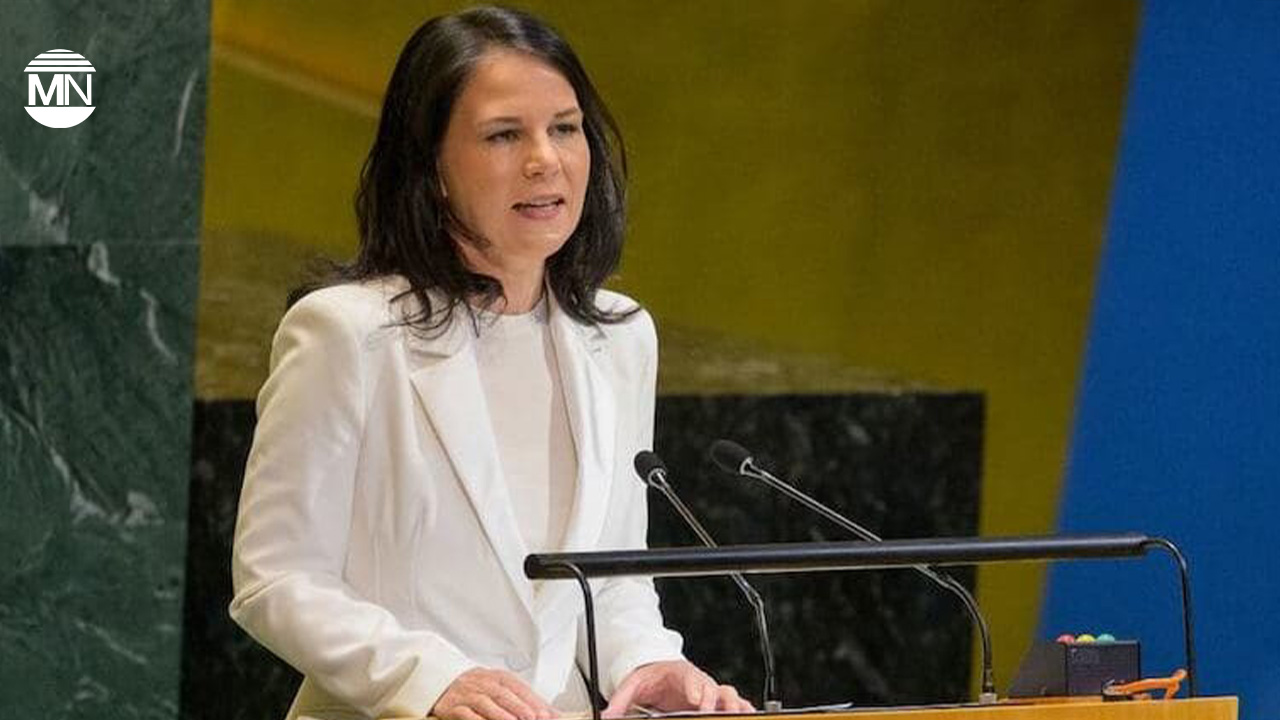
Germany’s former foreign minister Annalena Baerbock was elected on Monday as President of the 80th United Nations General Assembly (UNGA), becoming the first woman from the Western European group and one of the youngest ever to hold the position, at a time when the multilateral system faces mounting global instability, institutional paralysis and urgent reform demands.
Baerbock, 44, secured the presidency with 167 votes in a secret ballot at the General Assembly Hall in New York. Her German rival, Helga Schmid, received seven votes, while 14 delegations abstained. Her one-year term begins on 9 September 2025, during what UN Secretary-General António Guterres called a “difficult and uncertain moment” for the world body.
Baerbock’s appointment comes as the UN grapples with intensifying wars in Gaza and Ukraine, deepening global inequality, climate breakdown, and the search for a successor to Guterres, whose second term ends in 2026.
“Better Together” will be the central theme of Baerbock’s presidency — a message she underlined in her acceptance speech by vowing to be “an honest broker and a unifier” for all 193 Member States. “This is the place where all nations come together and every country has a seat and a voice,” she declared.
She also pledged to prioritise three core goals: making the United Nations more efficient and effective, advancing the 2030 Agenda for Sustainable Development, and ensuring the Assembly becomes a “truly inclusive forum” – especially for civil society, youth, and underrepresented groups.
Her presidency begins amid renewed relevance for the General Assembly as a platform for international accountability. Since 2022, the “Veto Initiative” has allowed the Assembly to debate Security Council actions that have been blocked by the permanent five members — China, France, Russia, the United Kingdom, and the United States — providing a crucial space for global engagement on otherwise stalled crises.
Despite lacking binding power, the Assembly’s symbolic weight has grown. In recent months, it has passed resolutions calling for ceasefires, humanitarian access, and protection of civilians in Gaza and Ukraine — efforts widely seen as attempts to keep diplomacy alive where the Security Council has failed.
Baerbock, known for her vocal support of international law and a rules-based order during her time as Germany’s foreign minister, now steps into a post that demands delicate balancing between moral clarity and diplomatic compromise.
She will also oversee key elements of the UN80 Initiative — a reform drive launched by Guterres in March — and play a role in shaping the nomination process for the next UN Secretary-General.
“The UN80 initiative should not be a mere cost-cutting exercise,” she said. “We need bold ambition and difficult decisions to build a UN that delivers on peace, development, and justice.”
Philemon Yang of Cameroon, outgoing Assembly President, praised Baerbock’s leadership and commitment to multilateralism. “She brings a fresh and inclusive vision that the General Assembly urgently needs,” he said.
Baerbock is only the fifth woman to hold the Assembly’s top role in the organisation’s 80-year history. Her election follows an informal interactive dialogue process, which, in line with General Assembly Resolution 71/323, sought to improve transparency by involving civil society and Member States in the selection process.
As expectations grow for a more responsive and inclusive United Nations, Baerbock’s leadership will be closely watched — not only for how she navigates the fractured geopolitics of the moment but also for whether her “Better Together” mantra can unify an increasingly polarised global community.