

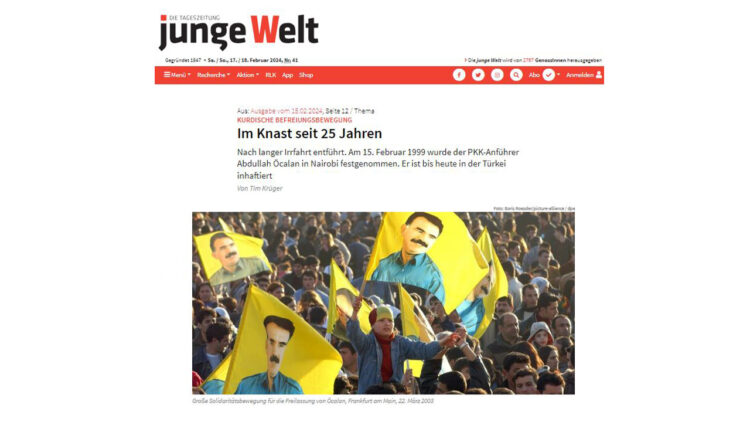
Junge Welt, a German publication, offered an in-depth narrative on Kurdistan Workers’ Party (PKK) leader Abdullah Öcalan’s capture and its implications for the Kurdish movement in a piece on Thursday, arguing that his incarceration is emblematic of a wider struggle for Kurdish rights and autonomy.
The report revolves around Öcalan’s journey from a modest upbringing to becoming a pivotal figure in Kurdish politics, his radicalisation in the face of Turkish assimilation policies and the international orchestration of his capture, painting a portrait of a man who is more than just the founder and leader of the PKK.
Born in 1949 in a small Kurdish village, Öcalan’s early experiences of cultural repression and linguistic punishment at school were formative in his political awakening. His academic excellence provided a pathway to higher education, where he encountered socialist theories and gravitated towards Turkey’s revolutionary movement.
Öcalan’s political activism intensified when he witnessed the brutal suppression of political dissent after the 1971 military coup in Turkey, leading to his brief imprisonment. Upon release, he assembled a diverse group of students, laying the groundwork for what would eventually become the PKK in 1978, with a vision for Kurdish self-determination.
The narrative further unfolds to describe Öcalan’s exile in 1979, amidst escalating tensions in Turkey, his strategic alliances with Palestinian factions in Syria and Lebanon, and the foundational years of the PKK. Junge Welt meticulously documents the geopolitical pressures leading to Öcalan’s expulsion from Syria in 1998, propelled by Turkey’s military threats and the strategic manipulation of water resources as leverage.
The article portrays Öcalan’s subsequent odyssey as a desperate search for asylum, highlighting the intricate web of international relations that influenced his fate. His transient stays in Greece, Russia, Italy and ultimately Kenya, underscore the complex interplay between global powers, culminating in his capture in Nairobi through an operation that Junge Welt argues was facilitated by international collusion, notably implicating the CIA and Mossad, despite their denials.
The news agency emphasised the symbolic significance of Öcalan’s imprisonment, linking it to broader Kurdish aspirations for freedom and dignity. They pointed to the “black day” of his arrest as a moment of collective Kurdish mourning and a catalyst for international solidarity movements. The continued isolation and restricted access to Öcalan by legal and family representatives, as reported, mirrors the ongoing suppression of the Kurdish cause.
Junge Welt’s coverage encapsulates the life and legacy of Abdullah Öcalan within the larger narrative of Kurdish resistance and the quest for self-determination. The call for his release, echoed in demonstrations and campaigns worldwide, is framed not just as a plea for an individual’s freedom, but as a cornerstone for resolving the Kurdish question and achieving peace in a region fraught with conflict.


