

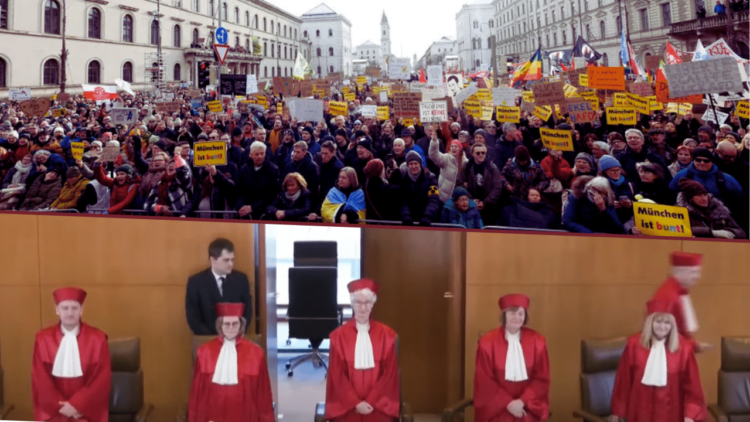
Germany’s Constitutional Court declared on Tuesday that the far-right extremist party Die Heimat (Homeland), formerly known as the National Democratic Party (NPD), will be stripped of the state funding and tax benefits granted to political parties in the country. The court justified its decision by asserting that Die Heimat displays “disdain for the free democratic basic order” and advocates for an authoritarian state rooted in Nazi-era ideologies.
The verdict follows widespread protests across Germany over the weekend, as more than a million citizens rallied across the country, gathering among other places outside the national parliament, to voice their opposition to far-right extremism and the increasing influence of the anti-immigrant party Alternative for Germany (AfD).
The protests gained momentum after reports that two senior members of the AfD attended a meeting of right-wing extremists where plans to deport millions of immigrants, refugees and German citizens were discussed. The controversial “re-migration” plan, reminiscent of Nazi policies from the 1930s, would reportedly be implemented if the AfD took power.
The AfD, partially classified as right-wing extremist by the Federal Office for the Protection of the Constitution, has seen a surge in support, reaching around 22 percent in opinion polls – well ahead of Chancellor Olaf Scholz’s centre-left Social Democrats (SPD).
The current political landscape has prompted a debate in the German Bundestag about how to address the growing influence of the AfD, with the three governing parliamentary factions – the SPD, the Greens, and the Free Democrats (FDP) – submitting a motion titled “Resilient democracy in a diverse country – a clear stand against the enemies of democracy and their plans of forced displacement.”
Notably, Tuesday’s ruling marks the first instance in Germany’s history where state financial support for a party has been cut without officially banning the party. Observers view this as a potential model for addressing the surging support for the AfD, which consistently polls above 20 percent nationally and exceeds 30 percent in eastern Germany, where crucial regional elections are scheduled later this year.
The decision by the Constitutional Court is seen as a significant victory for the diverse groups of protesters who have taken to the streets in recent days in major German cities, such as Hamburg, Munich, Cologne, Frankfurt and Berlin. Organised by church groups, environmentalists and left-wing activists, Sunday’s demonstration in Berlin drew over 100,000 participants, reflecting a broad spectrum of society united against the far-right forces gaining traction in the country.


