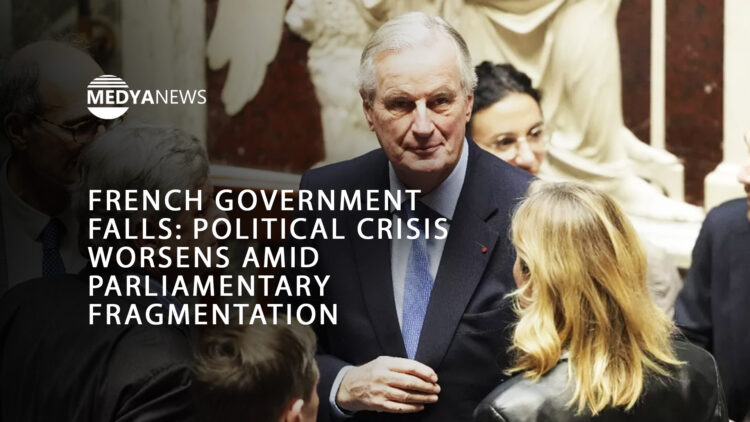
France faces a critical political crisis following the unprecedented no-confidence vote that toppled Prime Minister Michel Barnier’s government. This marks the first time in the *Fifth Republic’s history that a government has fallen in such a manner, plunging the country into a period of uncertainty. France, as the birthplace and champion of Republicanism, has developed a distinct political lexicon to articulate its historical and political evolution since the 1789 French Revolution, of which the final period has started since the post-World War II landscape of 1945.
The motion, triggered by discontent over the government’s forced passage of the 2025 budget bill, reflects growing dissatisfaction with the government’s solution plan of key issues. Critics cite France’s faltering economy, increasing inequality, and perceived inaction against rising racism as driving forces behind the political turmoil.
Observers and news stories from Le Monde and L’Humanité highlight that this political upheaval reflects deeper fractures in French society. Economic growth has stagnated, with inflation squeezing household incomes and fuelling public discontent. Simultaneously, rising xenophobia and far-right rhetoric, part of a broader European trend, have added strain to France’s political climate, complicating governance.
Internationally, Barnier’s administration has faced criticism for its inability to assert a cohesive foreign policy, particularly amid tensions in Europe over Ukraine and a lacklustre stance on broader EU reforms. The government’s collapse raises questions about France’s role as a stabilising force in the European Union.
President Emmanuel Macron now faces a challenging task of appointing a new prime minister who can secure parliamentary support. Options include forming a technocratic government or appointing a caretaker administration, but neither guarantees stability. Legislative deadlock could also delay the passage of critical budgets, further impacting governance.
On the other hand, the French left-wing alliance, the New Popular Front (NFP), attributes the government’s collapse to Prime Minister Michel Barnier’s enforcement of austerity measures without parliamentary consent. NFP, as the coalition of parties such as France Insoumise, the Socialist Party, Les Écologistes, and the French Communist Party, had won the summer election of 2024. The NFP argues that Prime Minister Barnier’s use of Article 49.3 of the Constitution to pass the social security budget without a vote undermined democratic processes and disregarded the electorate’s will.
Following the government’s collapse, the NFP has expressed its readiness to govern, and has called for the opportunity to implement its program aimed at reversing austerity measures and promoting social justice.
As France navigates this political quagmire, the international community will closely monitor its ability to manage internal discord while maintaining its commitments on the European and global stage. The current crisis underscores the urgent need for systemic reforms to address socio-economic disparities and growing polarisation in French society.
President Macron’s leadership has faced increasing scrutiny from political parties and the public, with calls for his immediate resignation despite having two years remaining in his term.
* The Fifth Republic is the current republican government system in France, established by Charles de Gaulle in 1958. It succeeded the Fourth Republic, which struggled with instability and short-lived governments. The Fifth Republic’s constitution strengthened the role of the presidency, giving the president significant executive powers, including the ability to dissolve the National Assembly and appoint the Prime Minister. Over time, the system has evolved, but it remains a highly centralised form of governance. The Fifth Republic has seen more stability than its predecessors, although recent challenges—such as political deadlocks and protests—have sparked debates about the system’s adaptability in a modern context.