

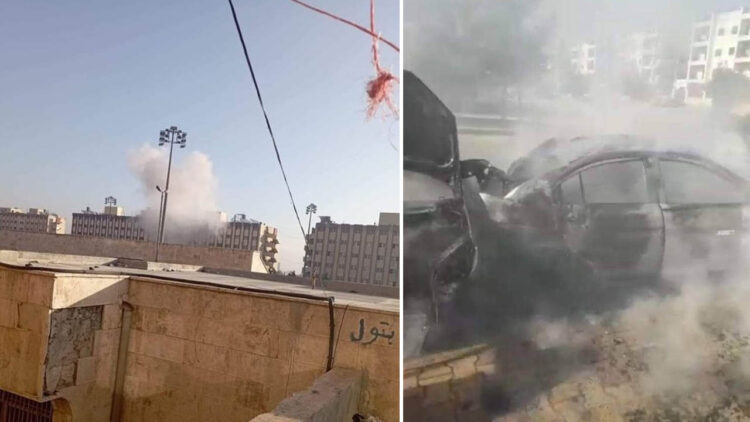
Four civilians, including two students, have been killed on Friday 29 November in the Syrian city of Aleppo. The deaths were as a result of shelling by Islamist group Hay’at Tahrir al-Sham (HTS), formerly known as the al-Nusra Front.
The HTS militia began its attack on Aleppo on Wednesday 27 November. The assault on the city is the biggest since the ceasefire of 2020. This invasion marks the most extensive operation by Islamist factions in Syria since the major conflicts of 2016. HTS is supported by the Turkey-backed Syrian National Army (SNA).
The shelling caused panic in the Furqan neighbourhood of western Aleppo. Footage of the aftermath of the bombing was captured on social media platform X by Kurdish journalist Jamal Balî:
#BREAKING_NEWS
Most students leave #Aleppo University, massive displacement from western neighborhoods.#Syria pic.twitter.com/Bk9dVNGRRD— Jamal Balî (@Jamal_Bali7) November 29, 2024
Balî reported a “massive displacement” from Aleppo’s western neighbourhoods.
Journalist Scharo Maroof has confirmed that HTS forces have now entered Aleppo. One video shared by Maroof on X shows Syrian regime soldiers fleeing the battlefield and rushing towards the city centre.
First picture from inside of Aleppo Taken by HTS
Second video shows Syrian regime soldiers fleeing the battlefield; rushing towards the city center.
Same window photographer provided us with footage of Syrian regime artillery heading towards the city center yesterday (3rd… https://t.co/sOZrd93Lqv pic.twitter.com/EwTHRu5KQE
— ScharoMaroof (@ScharoMaroof) November 29, 2024
HTS have reportedly used a suicide bomber to attack positions held by regime forces. Their forces have been confirmed to have taken over Tal Hadya, and are also claiming to be in control of Al-Eis.
Battle of Aleppo:
HTS is storming the suburb of Aleppo *New Aleppo* trying to reach the highway ring of Aleppo (marked in red).
Syrian regime retreated units from southwest to be redeployed into the battle of Aleppo (marked black).
The battle of Aleppo is on.
HTS used a… https://t.co/43ZhWSiUIq pic.twitter.com/netJ1SQG77
— ScharoMaroof (@ScharoMaroof) November 29, 2024
Kurdish organisations are expressing increasing concerns that HTS, which consists of many ex-ISIS fighters, is likely to attack Kurdish civilians and Kurdish forces. The Kurdish neighbourhoods of Eşrefiye and Shasmeqsûd in Aleppo are now very vulnerable. The Kurdistan National Congress KNK gave a stark warning of the seriousness of the situation on X:
KNK: Following the outbreak of the heaviest fighting in Syria in several years, Kurdish areas are now under acute threat from attacks by jihadist groups cooperating with Turkey. https://t.co/RlYi6WoFJU
— KNK-Kurdistan National Congress (@kongrakurdistan) November 29, 2024
The KNK statement warned that the SNA was taking full advantage of the HTS attack. They wrote: “While the Islamist group Haiat Tahrir Al-Sham (HTS), the Syrian branch of al-Qaeda formerly known as al-Nusra Front, has been advancing on Aleppo since Wednesday and fighting with the Assad regime’s forces, the Turkish-loyal mercenaries of the so-called Syrian National Army (SNA) are currently preparing a major attack on the Kurdish region of Tal Rifaat in northwestern Syria. The Turkish army is already bombing the region from the air and on the ground. Attacks on the Kurdish town of Ain Issa have also been reported. According to local sources, Turkey has also opened the border to northwestern Syria, allowing more jihadist fighters to enter Syria.”
Tal Rifaat is home to several hundred thousand Kurdish refugees, who fled from Turkey’s 2018 invasion of Afrin (Efrîn).
HTS has controlled Idlib province since 2017. According to the KNK, “HTS seeks to project an image of respectability and governance reliability, despite reports of an increasingly totalitarian regime and Islamist theocracy in Idlib.”
The KNK warned the international community about the threat posed by HTS, saying that states should be “wary of HTS’s expansion into Turkish-occupied territory, as it has been linked to anti-Semitic propaganda and has ties to al-Qaeda, despite efforts to distance itself from its jihadist roots. Notably, a perpetrator involved in a foiled terrorist attack in Munich expressed sympathy for HTS, highlighting the group’s continued relevance in the broader landscape of extremist threats.”


