🔴Former int’l PKK fighters emphasise organisation’s influence on activism worldwide
📌Exclusive: Former PKK fighter Anja Flach(@AnjaFlach) shares insights on the movement’s resilience & global impact. Watch the first episode now!#AnjaFlach | #Ocalan | #PKK… pic.twitter.com/xnTEZt09lW
— MedyaNews (@medyanews_) November 28, 2024
Over the decades, the PKK has evolved from a primarily Kurdish nationalist organisation into a movement that has embraced broader ecological and feminist ideals, particularly under the leadership of Abdullah Öcalan. Despite its controversial designation as a terrorist organisation by Turkey and other states, the PKK has profoundly influenced regional dynamics and inspired a generation of activists worldwide.
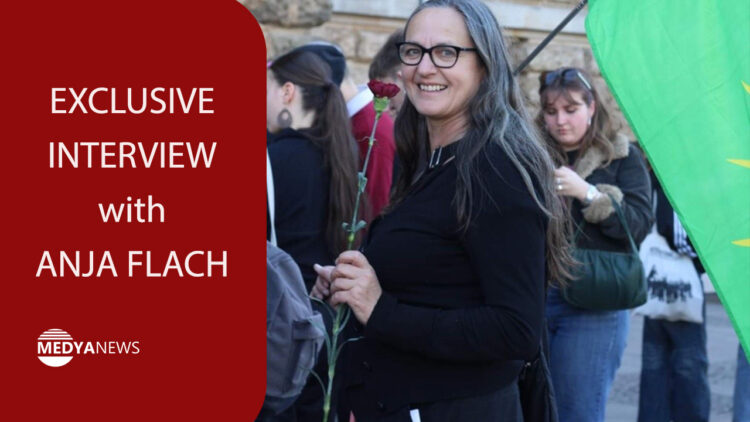
To mark this milestone, Medya News presents exclusive interviews with former international PKK fighters. In this interview, Anja Flach shares her unique perspective on the movement, shaped by experiences in the mountains of Kurdistan during critical phases of the struggle.
As we delve into their stories, readers will gain a deeper understanding of the challenges, sacrifices and aspirations that define the Kurdish freedom movement. Through these testimonies, we aim to shed light on the PKK’s enduring significance – not only for the Kurdish people, but for global struggles against oppression and inequality.
The full interview with Anja Flach follows below:
We would like to start by having you introduce yourself: What is your name, and what do you do? Then we will go back to discuss what you did in the past.
My name is Anja Flach. I live here in Hamburg, and I am actively involved in the Kurdish women’s movement, the Kurdish Women’s Council, and the organisation Gemeinsam Kämpfen.
You are one of the few early international female fighters of the PKK. What led you to join and participate in it?
I came from the German left. Back in the late 1980s, there was a sense of hopelessness. But I was just starting to move forward, and through a friend, we got to know the PKK. I also met female fighters and the Kurdish association.
We recently celebrated 30 years of the Kurdish Women’s Council here in Hamburg. I was inspired by the determination with which people dedicate themselves to their cause, the participation of all generations, and the prioritisation of the women’s issue. That deeply impressed me. Was this also your understanding of the PKK’s stance on Kurdish self-determination? Did you see a personal connection or gain something from it?
At the time, the German left was very weak and poorly organised, whereas I saw strong organisation in the Kurdish movement, which inspired me. Of course, I was less interested in the Kurdish question and more in the perspective of women’s liberation and internationalism.
This time frame takes us to 1995, which I recall as a challenging period for the entire Kurdish society across its four divided regions. What experiences did you gain during that time?
In 1994, I travelled to Kurdistan for the first time with a delegation to Batman (Êlih). We saw that villages all around had been destroyed, even with German-made BRT-60 tanks.
It was during Newroz, and we were barely allowed to leave the hotel. Yet, despite all this, people told us, “Tell our people in Europe that we will fight and will not give up.” The determination of the people, including children, adults, and the elderly, truly inspired me. In the 1990s, demonstrations here in Europe were sometimes massive—thousands, even hundreds of thousands of people took to the streets. That left a lasting impression on me, as did the resoluteness of the people.
This question has another aspect I must ask about: What did you observe there in more detail?
Are you referring to 1994? Yes, I saw that the people, despite everything, were determined to fight. For instance, we could not leave the hotel, but a family took us into their home. They threw their Turkish passports onto the ground and spat on them.
Although we did not share a common language, they still showed us their resolve and their commitment to fighting.
In 1995, I went to the PKK’s school in Damascus. Politically, I was inexperienced at the time. I had come from the German left without any significant background knowledge. Initially, I struggled with the concept that a man could play such an important role for women too. But I quickly realised that Öcalan prioritised women’s issues in the Kurdish movement.
He gave many women the opportunity to develop. He brought women down from the mountains so they could study in Damascus, provided housing for them to conduct research, and created platforms for them to flourish.
What impressed me the most was that commanders from across the fighting regions came to the party school and were required to engage in self-criticism. The focus of this self-criticism was how they had dealt with the women’s issue—how they supported women in their units and regions. I was shocked to see experienced fighters being harshly criticised by 15-year-old girls. It was astonishing, and I must say it left a deep impression on me. I quickly realised that Abdullah Öcalan is a person who can look into people’s hearts.
He also quickly understood the difficulties I faced—not just with the language and culture but also due to my lack of political knowledge. He wrote in The Sociology of Freedom that many people assume Europeans are educated and confident. However, he said his experience was quite different: Europeans are naïve and lack the resilience to survive in the Middle East for an extended period. This was absolutely true of me as well.
I came to know him as someone who worked tirelessly for the people of Kurdistan and the Kurdish liberation struggle. He never thought of himself, always putting the comrades first. He would speak individually with each person, quickly grasping their struggles and trying to give them a perspective. He did the same for me.
This perspective also carried a message—one from him and from the organisation. How would you define or recall this message today?
For me, the key message was that there can be no revolution without women’s liberation. That was the most important takeaway for me.
This is evident in other revolutions as well. Take, for instance, Nicaragua in 1979—many revolutions failed because they did not prioritise the gender issue. For me, Öcalan’s emphasis on this matter was the most significant.
Furthermore, his perspective was internationalist. It was never just about Kurdistan. He developed solutions for the challenges we all face under capitalist modernity. This was not entirely clear at the time, but I believe he already thought in those terms back then.
I now also believe that this was never solely about Kurdistan but about something much larger. Initially, it focused on the Middle East and then extended to North Africa and, ultimately, Europe. I do not wish to delve too deeply into political specifics, such as Turkey and the Kurdish question there.
I have little understanding of this because I have never been to Turkey, apart from the mountains. But what can the PKK’s resistance contribute to a global revolution, or what can societies in other countries—those facing resistance, such as in Colombia or Argentina—learn from it?
Even in economic struggles, lessons from the past, such as the Saturday Mothers in Istanbul, can offer insights.
Perhaps this resistance was inspired by movements in Argentina, but what contribution can the PKK’s struggle make overall?
In 2014, I visited Rojava for the first time and reunited with a former guerrilla fighter with whom I had been in the mountains. She told me, “What we are doing here is directly implementing Abdullah Öcalan’s vision.”
Everything we are building here was described to us by him. I believe that the books Öcalan has written in prison serve as a manifesto for all of us. They outline a vision for an alternative world—one that is free of gender-based oppression, ecological in nature, diverse, and rooted in grassroots democracy. There is so much to learn from them.
In three days, we will mark the anniversary of the founding of the PKK on 27 September. Its founding conference took place many years ago. In this context, what significance does the PKK hold, for instance, for Germans? And what is your assessment of the PKK’s ban in Germany?
There has been a centuries-old military alliance between Germany and Turkey. Lifting the PKK ban in Germany is extremely challenging.
Every day, individuals advocating for the freedom of Kurdish men and women are imprisoned. There are daily house raids, and people are criminalised—most recently here in Hamburg, with the arrest of Kenan Ayaz. I believe German politics are hypocritical and two-faced.
On the one hand, they speak of peace and women’s liberation and even use slogans like Jin, Jiyan, Azadi (Woman, Life, Freedom). But in reality, they contribute to and bear responsibility for the destruction of Kurdish women and not only women in the Middle East. Appeals to this government, in my view, achieve nothing. We must organise more strongly and fight against this, forcing them to adopt a different stance.
This can only be achieved through pressure from the streets, in my opinion—from the bottom up.
Exactly.
What should be communicated within German society, and what role do you see for yourself?
Murat Karayılan once said that every Kurd in Germany should act as a diplomat and advocate for the Kurdish cause everywhere. This needs to be much stronger, in my opinion. Anyone living here in Germany and connected to this movement, whether in schools, universities, or workplaces, should speak about this topic and not hide it.