

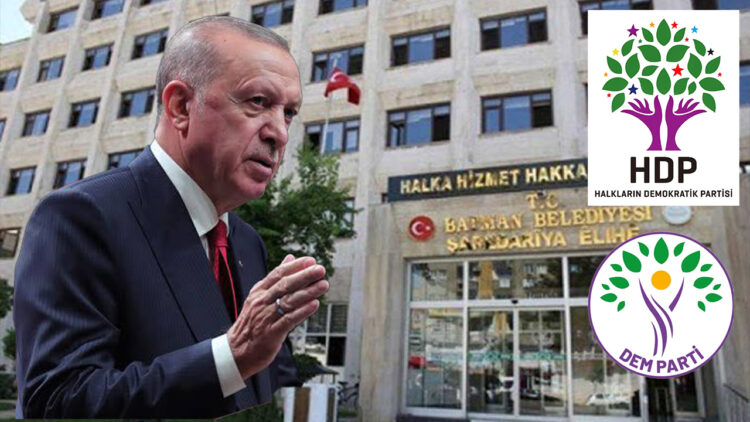
The Turkish government is reportedly planning to investigate 37 municipalities governed by the pro-Kurdish Peoples’ Equality and Democracy (DEM) Party over alleged ties to terrorism, Middle East Eye (MEE) reported on Monday.
Earlier this month, the Turkish government dismissed three mayors affiliated with DEM, citing terrorism-related investigations. The mayors from Mardin (Mêrdîn), Batman (Êlih) and Halfeti (Xelfetî) were replaced by state-appointed trustees.
“The police are currently reviewing dozens of DEM-controlled municipalities to determine if there is sufficient evidence to launch formal investigations,” one source told MEE.
If formal investigations proceed, the government may legally unseat all 37 mayors and replace them with state-appointed temporary administrators. The DEM Party is currently Turkey’s third-largest political party, holding 57 seats in parliament and winning local elections in 10 provinces, 58 districts and seven towns.
Turkish President Recep Tayyip Erdoğan indicated in a speech on Sunday that his government would continue targeting Kurdish municipalities. “We cannot turn a blind eye to the terrorist organisation’s establishment of extortion mechanisms through municipal power,” Erdoğan stated after a cabinet meeting.
The government’s decision to replace elected Kurdish mayors with state-appointed trustees has faced criticism from rights groups, who argue that the move disregards the votes of over half a million Turkish citizens in the March local elections.
“Denying hundreds of thousands of voters their chosen local government representatives and replacing them with the government’s own appointees not only undermines the democratic process but also violates the right to free and fair elections,” said Hugh Williamson of Human Rights Watch.
The Erdoğan-led government has removed elected mayors and taken control of municipalities, particularly in Turkey’s Kurdish-majority southeast, in three separate waves—a move criticised by rights groups and the Kurdish community as a strategy to undermine Kurdish self-governance.
First wave (post-2016 coup attempt)
Following the 2016 coup attempt, the Turkish government invoked Decree Law No 674, amending Municipal Law No 5393, allowing the state to replace mayors and other municipal officials under investigation for terrorism-related offences. The law, passed in parliament on 10 November 2016 during a state of emergency, granted extensive authority to the central government, primarily targeting Kurdish autonomy on a pretext of national security, despite Kurdish parties being uninvolved in the coup attempt. The first wave saw extensive trustee appointments in Kurdish-majority areas.
The ‘Local Services and Trustee Report’ by Spectrum House Research Centre noted negative impacts on local services, local representation, voting rights, and freedom of organisation. Public sentiment largely opposed this intervention, with 75% of surveyed citizens in eastern and southeastern regions viewing trustee practices as harmful to societal peace.
Second wave (2016-2019)
Between the enactment of Decree Law No. 674 and the local elections of 31 March 2019, trustees were appointed to 101 municipalities, with 94 of them under the pro-Kurdish Peoples’ Democratic Party (HDP). This period continued the government’s strategy of undermining local autonomy, primarily in the Kurdish southeast. International criticism grew as many elected mayors were dismissed and replaced by government-appointed officials, but the Turkish government remained unwavering, justifying the appointments as necessary for national security and counter-terrorism.
The policy further entrenched state control over local governance, intensifying tensions and fuelling accusations of discrimination against Kurdish political representation.
Third wave (post-March 2024 local elections)
Following the 31 March 2024 local elections, trustee appointments intensified, impacting both pro-Kurdish and opposition-held municipalities. On 31 October, Esenyurt Mayor Ahmet Özer from the CHP was dismissed and replaced with İstanbul Deputy Governor Can Aksoy.
On 4 November 2024, the mayors of Mardin, Batman and Halfeti from the pro-Kurdish Peoples’ Equality and Democracy (DEM) Party were removed and replaced by trustees. This was the third time that Batman and Mardin municipalities had their elected mayors replaced by state-appointed trustees.
The pattern of replacing elected officials with trustees, known as kayyum in Turkish, continues to raise serious concerns about the erosion of democratic governance and local representation in Turkey.


