

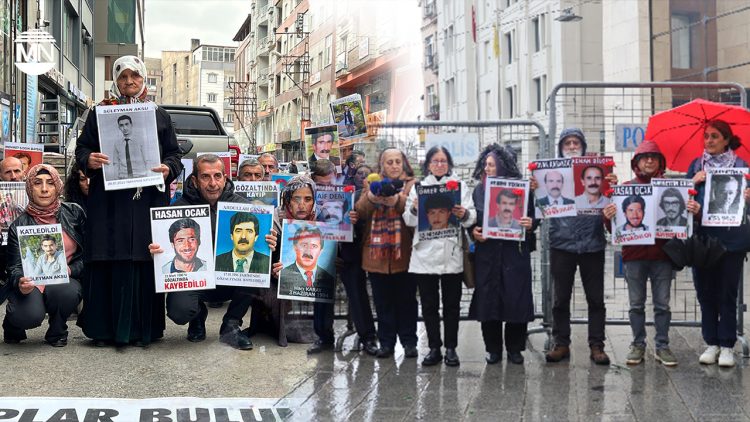
Families of Turkey’s disappeared gathered with human rights defenders in several cities on 12 April to demand accountability for those who vanished in state custody in the conflict in Kurdish-majority regions of the country in the 1990s. Demonstrators stressed that justice for these cases is key to addressing Turkey’s long-running Kurdish issue through democratic means.
The Saturday Mothers held their 1,046th weekly vigil at Galatasaray Square in İstanbul, this week focusing on demands for the prosecution of those responsible for the 1994 disappearance and death of Ömer Ölker in Silopi (Silopiya), a town in the Kurdish-majority province of Şırnak (Şirnex). Participants bore carnations and photographs of missing relatives.
Sebla Arcan, a member of the Commission Against Enforced Disappearances attached to the country’s independent Human Rights Association (İHD), read a statement recounting Ölker’s case. A 25-year-old barber also temporarily employed as a postal worker, Ölker vanished on 15 April 1994. Two days later, his body was discovered near Duru village in İdil, bearing a fatal bullet wound to the head.
Ölker’s ID card was not present on the body, but a state examination entry pass had been left there from which he was identified, but no proper autopsy was performed. Arcan cited contradictions in the investigation, noting that the body had been found in a location controlled by three military checkpoints, making any idea that it could have arrived there without the knowledge of the military implausible. She noted also the absence of an effective investigation, and that the case was eventually closed in 2014 due to the statute of limitations.
The family appealed the decision to close the case, naming then Gendarme Commander if Cizre (Cizîr) District, Cemal Temizöz, and six members of the gendarmerie’s counter-terriorism intelligence unit JİTEM as suspects. The appeal was rejected, and the family made an unsuccessful application in 2018 to Turkey’s Constitutional Court, which ruled the case inadmissible, also due to the passage of time. They then turned to the European Court of Human Rights (ECtHR), claiming that Turkey had failed to conduct an effective investigation.
A letter from Ölker’s brother Süleyman Ölker was read aloud by activist İrfan Bilgin, recounting the story of the family’s 31-year struggle for justice. “Like other families of the disappeared, we want to know the truth, to find justice, and to finally sleep in peace,” the letter stated.
Parallel demonstrations took place in Diyarbakır (Amed), Batman (Êlih), Hakkari (Colemêrg) and İzmir, coordinated by the İHD and local relatives of the disappeared. Diyarbakır’s 844th local vigil was held at the Right to Life Monument in Koşuyolu Park in the Bağlar (Rezan) district of the city, focusing on Ali İhsan Dağlı, who was forcibly disappeared in 1995.
The İHD’s Diyarbakır branch chair Ercan Yılmaz said these vigils expose how the lack of a democratic resolution to the Kurdish issue perpetuates state violence. He noted that confronting the past is one of the most important steps towards peace.
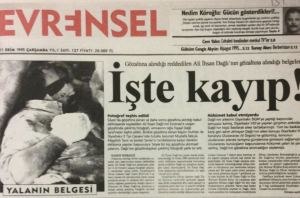
Lawyer Berfin Elçi related the story behind Dağlı’s case, noting that he was detained after a military operation in his village and was never seen again. Despite the presence of witnesses, officials denied any military involvement. In October 1995, the Evrensel newspaper published a photograph confirming Dağlı had been held in military custody, but no further information was uncovered. The family eventually pursued the case at the ECtHR, which ruled against Turkey.
The Batman branch of the İHD and families of the disappeared gathered on Gülistan Caddesi for the city’s 680th weekly protest. tbis week to raise the case of Ahmet Bulmuş, who disappeared in 1994 after being detained by men arriving in an unmarked vehicle. Witnesses, including a friend and fellow detainee, later testified to his havng been in state custody. His wife Fatıma reported harassment and violence by security forces following his disappearance.
The vigils ended with participants laying flowers and repeating calls for justice, with human rights defenders insisting that accountability for past abuses remains a precondition for a peaceful resolution to Turkey’s Kurdish conflict.


