

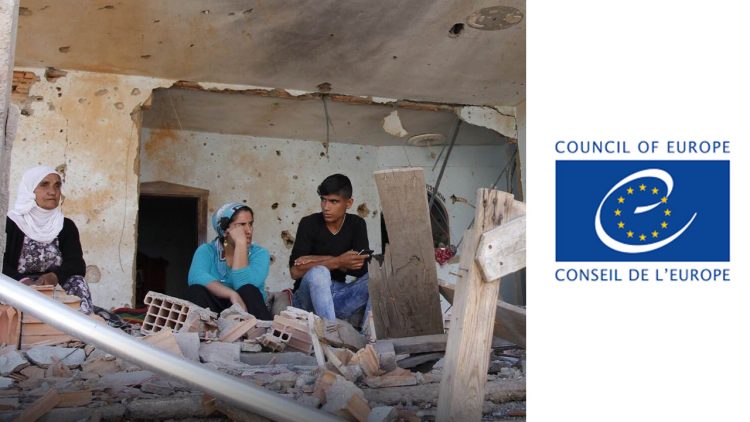
The European Court of Human Rights (ECtHR) has reignited a quest for justice by demanding that Turkey explain alleged human rights violations during the 2015-2016 curfews in Cizre (Cizîr), a predominantly Kurdish town in the country’s southeastern province of Şırnak (Şirnex). On 22 May, the court requested Turkey’s defence concerning the deaths of up to 288 people, many trapped in basements, during a 79-day military operation.
The curfews, imposed from 14 December 2015 to 2 March 2016, were part of Turkey’s response to clashes with the Kurdistan Workers’ Party (PKK), an armed group seeking greater Kurdish autonomy. In Cizre, residents faced severe restrictions on movement, food and medical access, with many seeking shelter in basements amid heavy fighting. Various reports claim 177–288 individuals died, with allegations of unlawful killings and burned bodies, as documented by NGOs such as Mazlumder and a 2018 Swiss forensic study.
“This request from the ECtHR offers hope for accountability after years of dismissal by Turkish courts,” said Ramazan Demir, a lawyer representing victims’ families. The significance of the ECtHR’s move lies in its potential to challenge Turkey’s judicial system, often criticised for lacking independence in politically sensitive cases involving Kurdish communities.
In 2018, lawyers filed 34 applications with the ECtHR, with cases like Ömer Elçi and Orhan Tunç highlighting curfew legality and basement deaths. The court held a hearing on 13 November 2018, but in February 2019, it ruled the applications inadmissible, citing the need to exhaust domestic remedies through Turkey’s Constitutional Court. That court’s 2022 rejection of the case, with the claim that there had been no rights violations, prompted renewed applications to the ECtHR, leading to the 2025 request.
Turkey’s Kurdish-majority southeast has faced repeated curfews and military operations since the collapse of peace talks with the PKK in July 2015. The Cizre curfews caused widespread destruction, displacing thousands and destroying over 10,000 homes, according to Mazlumder. Human rights groups, including Human Rights Watch, have accused Turkish forces of disproportionate force and collective punishment, allegations Ankara denies, asserting that their operations targeted PKK militants.
The ECtHR’s request comes amid Turkey’s strained relationship with the court, exemplified by its failure to implement rulings on cases like those of Osman Kavala and Selahattin Demirtaş, a former co-chair of the pro-Kurdish Peoples’ Democratic Party (HDP). In 2024, Turkey accounted for 35.8% of the ECtHR’s 60,350 pending applications, reflecting systemic human rights concerns.
“The curfews and Cizre basement files are back on the ECtHR agenda,” said Demir on X, noting the court’s shift to re-examine the case after the rejection by Turkey’s Constitutional Court. If the ECtHR finds violations, Turkey could face pressure from the Council of Europe, potentially escalating to infringement proceedings, as seen in Kavala’s case.


