

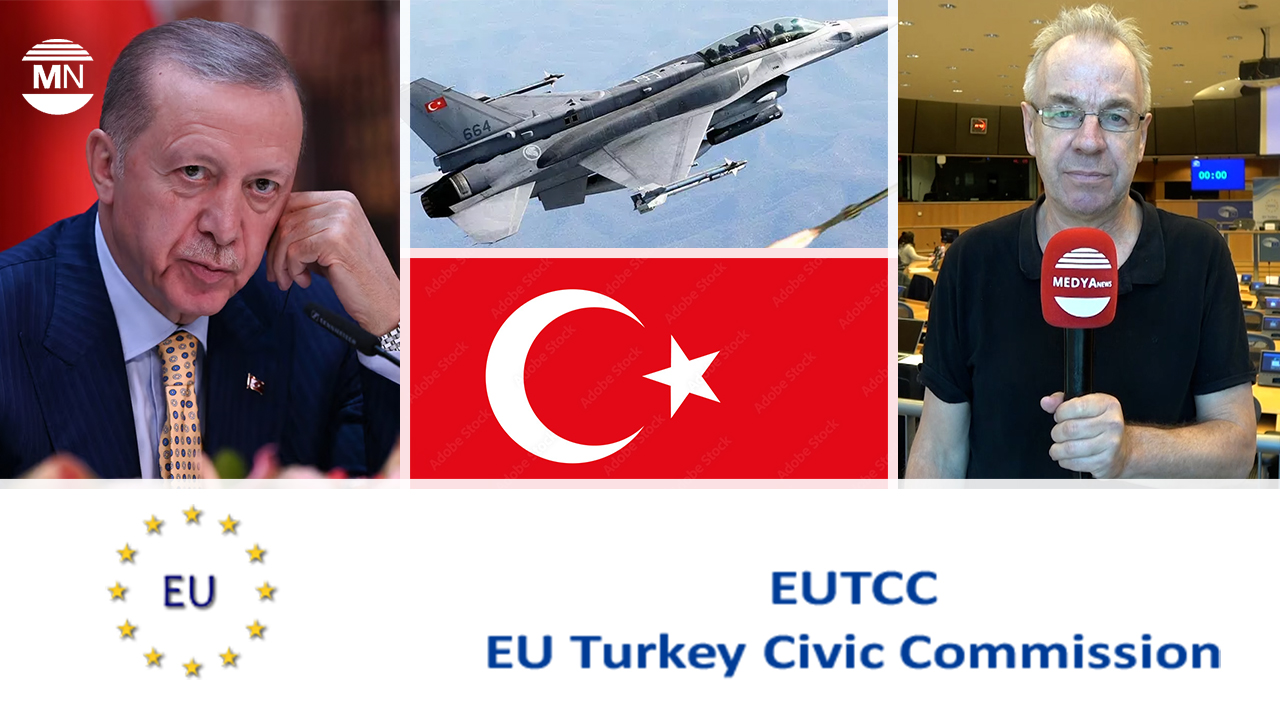
The 19th International Conference on the European Union, Turkey, the Middle East and the Kurds was held at the European Parliament, Brussels on 26-27 March. If Turkey wants to join the European Union, a long list of economic and political criteria must be fulfilled. Politicians, lawyers, researchers and journalists attended panels to discuss the issue of Turkish policy today.
Speaker Tuncer Bakırhan, co-chair of the pro-Kurdish Peoples’ Equality and Democracy (DEM) Party – the third largest party in Turkey – said that his party was ready to operate in favour of a peace process inside the National Assembly of Turkey. He also said that Devlet Bahçeli, the leader of the far-right Nationalist Movement Party (MHP), was taking initiatives, but that President Erdoğan himself must participate.
For Bakırhan, the peace process is at an early stage. “We want concrete steps,” he said. “We want all the political prisoners to be freed, and we do not want trustees to be appointed to replace our democratically elected mayors.”
Kurdish leader Abdullah Öcalans’ call for the laying down of arms was intensively discussed. Professor Joost Jongerden from the Netherlands declared that Öcalans’ step forward should be answered by the Turkish state:
"Öcalan's call actually refers to a parallel process: the disarmament of the PKK and the end of the armed struggle, and the democratisation of Turkey. Without a democratisation of Turkey it's unthinkable that the PKK will disarm."
Members of the European Parliament are in favour of Turkey joining the European Union, but only on the condition that the Turkish state is democratised. If not, the EU must take measures to put Turkey under pressure. Jonas Sjöstedt, MEP for the Left Party in Sweden said:
"The most important thing Turkey can do is to become a democracy, to accept freedom of speech, don't imprison mayors, to release all political prisoners. That's an absolute pre-condition. As long as that does not exist in Turkey, the accession to the EU is not on the table."
Sjöstedt added that political and economic pressure should be put on Turkey. “We have to speak about sanctions against those who are responsible,” he concluded.
Li Anderson, MEP for Finland said, “Turkey should not be allowed any new financial incentives by the EU. The EU should be ready to cut Turkish access to some of the programmes they have access to now. And the EU should also introduce sanctions as a way to put pressure on Erdoğan to release political prisoners. For Turkey to become an EU member – it will never happen in a situation where you see this level of autocracy in Turkey.”
Evin Incir, MEP for the Socialist Party in Sweden went in the same direction: “The EU member states and the Commission need to dare to use condemnation, which I haven’t heard until now. Secondly, if this continues, the EU needs to use its sanction mechanism against those who are behind the decisions on imprisonment of political prisoners.”
Finally, Leila Chaibi, MEP for the French La France Insoumise, said, “The European Union is making too many concessions to Erdoğan’s blackmail. Erdoğan is threatening to send many refugees to Europe if ‘you don’t listen to us’. On the contrary, the European Union is the first at every plenary session to denounce the violation on human rights all over the world,” and she stressed:
"There are very clear human rights abuses in Turkey, so the European Union should do the same as it's doing against Hungary of Victor Urban: to threaten to cut subventions."
The final resolution of the 19th EUTCC stated, among other points, that Turkey “must put an end on its attacks on Northern Syria and the Kurdistan Region of Iraq”. The final draft was very clear on “putting an end to the appointment of trustees by the Turkish Ministry of the Interior”. The EU Turkey Civic Commission also asked for Öcalan to be released, asserting that his freedom is “indispensable to be able to fulfil his role in the peace process adequately”.
The EUTCC called on the European Union and its institutions, particularly the Council of Europe (CoE), to “recognise the Autonomous Administration of North and East Syria and to lift the Kurdistan Workers’ Party (PKK) from the terror list”.
Turkey’s European Union membership is still on the table. But by putting opposition leaders, mayors and journalists in prison, the current Turkish government is itself closing the doors to the European Union – and this despite the peace efforts of Abdullah Öcalan.


