

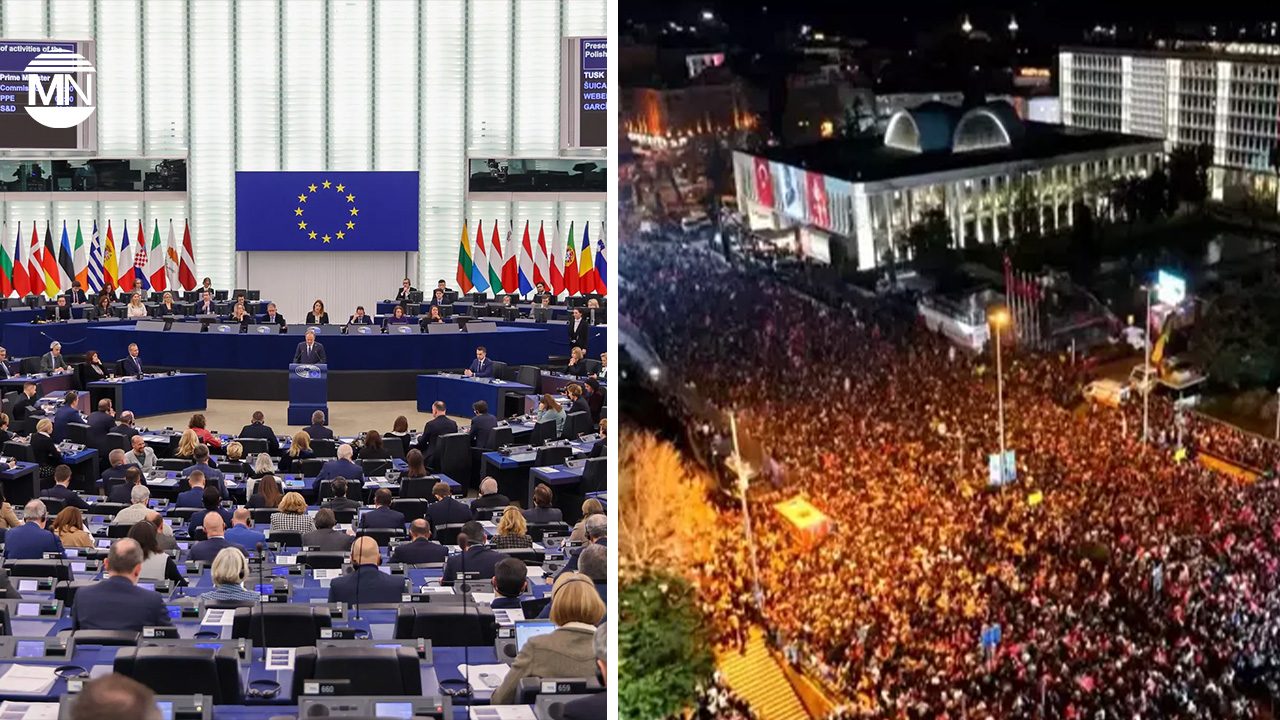
“I cancelled my participation at the forum in Antalya and I will not go to Ankara to meet the Turkish Minister of Foreign Affairs,” announced Marta Kos, the European Commissioner for Enlargement, on 1 April, as European Union officials strongly criticised Turkey’s recent political crackdown, including the arrest of İstanbul Mayor Ekrem İmamoğlu. The European Parliament called for a firm response and suspended joint meetings with Ankara, underscoring deep concerns over Turkey’s deteriorating political climate.
The EP’s condemnation follows the arrest of İmamoğlu, a leading opposition figure, alongside other public figures, journalists, and activists. His detention came after he announced his intention to run for president, raising questions about Turkey’s commitment to democracy. Mass protests have erupted across Istanbul and other cities, with demonstrators calling for his release.
Kos emphasised that these arrests “significantly reduce the space for exercising fundamental freedoms” and warned that Turkey was failing to uphold its commitments as a candidate for EU membership. She urged Turkish authorities to “listen to their people” and allow protests to continue without repression.
Emmanouil Kefalogiannis, Chair of the European Parliament’s Turkey delegation, reinforced the EU’s stance, stating: “Turkey is really on a dangerous path to autocracy. We unanimously agreed to suspend joint meetings with Turkey, starting with the one planned for April.”
He noted that over 150 mayors had been removed from office in recent years and replaced by government-appointed officials. “The European Union cannot remain silent,” he said, stressing the need for a strong message to Ankara.
Nacho Sánchez Amor, the European Parliament’s Turkey rapporteur, dismissed claims in pro-government media that Turkey’s military power could facilitate its accession to the EU. “If you are going to be a member of the EU, it’s about Kavala, it’s about İmamoğlu,” he said, referencing high-profile political prisoners in Turkey. “Membership is about democracy. Partnership could be a number of other things, but we are talking about an irreversible process.”
Malik Azmani, an MEP from the Renew Europe group, denounced the arrest as “politically motivated to silence the opposition” and criticised the EU’s delayed response. “Protests are facing brutal force, journalists are being arrested, and yet the EU remained silent until this evening,” he said. Azmani called for suspending all high-level political dialogue with Ankara unless Turkey releases İmamoğlu, warning that “Europe cannot be silent, or we will find ourselves on the wrong side of history.”
The EU’s latest stance marks an escalation in tensions with Turkey, an official candidate for membership but frequently criticised for backsliding on democratic principles. European officials have repeatedly called on Ankara to “effectively reverse the negative trend” in human rights and the rule of law, urging compliance with international commitments as a member of the Council of Europe.
With EU-Turkey relations at a crossroads, the European Parliament’s decision to suspend joint meetings signals mounting frustration with Ankara’s handling of political opposition and civil liberties. As protests continue in Turkey, the EU’s next moves could determine the future of its engagement with the country.


