

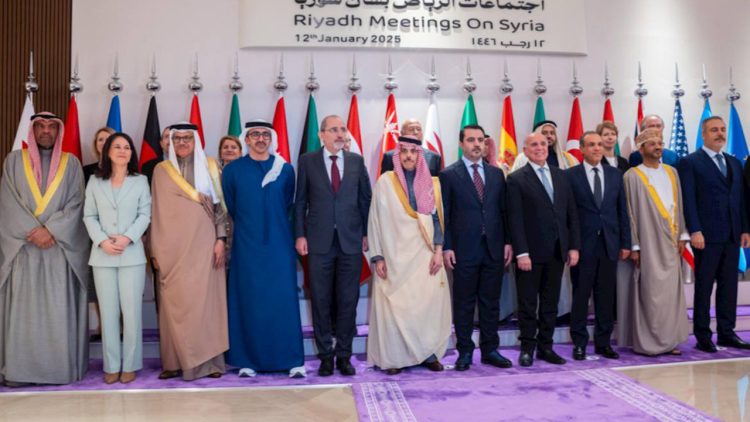
Representatives from 16 Arab and European states, along with officials from the US, EU, the Arab League, the Gulf Cooperation Council, and the UN, convened in Riyadh on Sunday to discuss Syria’s future. The meeting focused on key issues, including the potential lifting of sanctions and the support of the Hay’at Tahrir al-Sham (HTS) transitional government. However, despite discussions on territorial integrity, the meeting failed to address Turkey’s ongoing occupation of parts of northern Syria, which remains a major contributor to the country’s instability.
In a press release following the meeting, attendees expressed strong support for a Syrian-led political transition, emphasising the need for a process that includes a broad spectrum of political and social forces to ensure the protection of all Syrians’ rights. The statement also highlighted the importance of launching an inclusive political process that represents all components of Syrian society. Additionally, the participants praised the efforts of the government in Damascus to maintain the country’s political integrity.
While the meeting addressed the Israeli occupation of Syrian territory in southwest Syria and reiterated the need to respect Syria’s territorial integrity, it appears that the Turkish occupation of northern Syria was not raised. Turkey has been occupying parts of Syrian territory in Afrin (Efrîn) since 2018, and in Ras al-Ayn (Serêkaniyê) and Al-Qahtaniyah (Tirbespiyê) since 2019, with no indication of plans to withdraw from these areas.
Also on the agenda was the possibility of lifting economic sanctions against Syria—imposed by the US since 1979 and tightened after 2011—and the return of Syrian migrants to their country. British Foreign Secretary David Lammy reiterated his country’s support for the HTS transitional government while stressing the need for inclusive governance and humanitarian aid.
Syria’s current government, appointed by HTS, assumed office following the fall of the Assad regime on 8 December. Since then, the Kurdish-led Autonomous Administration of North and East Syria (AANES), which has controlled a significant portion of Syria’s northeast since 2012, has been calling for an inclusive process to rebuild Syria, one that involves all components of Syrian society. However, AANES was not invited to the Riyadh meeting.
Related article:
Salih Muslim: The social contract of the AANES can help to build a future Syria
The region under AANES control sees daily fighting due to ongoing Turkish Armed Forces bombings and attacks by Turkish-backed Syrian National Army (SNA) mercenaries. Turkey’s participation in the Riyadh meeting may have hindered discussions on its role as a key contributor to the conflict in northern Syria.


