

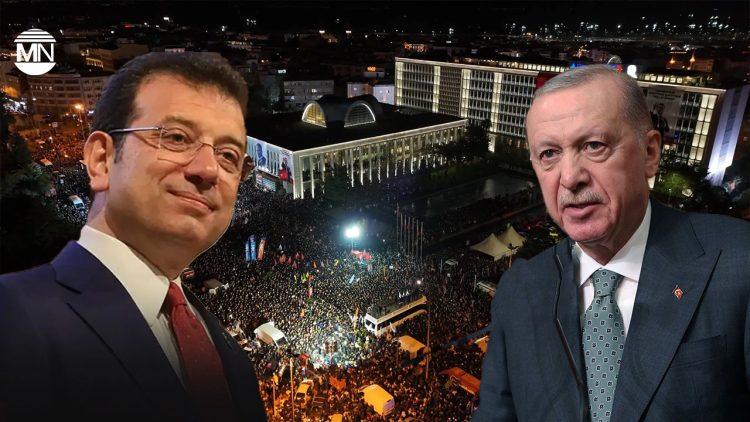
“[Turkish President Recep Tayyip] Erdoğan has long been successful in identifying his own survival with the survival of the state,” historian Professor Bülent Bilmez wrote for Artı Gerçek on Sunday, warning that this strategy now faces a critical rupture amid growing public unrest and internal political shifts.
Bilmez explains that the recent steps by Erdoğan — especially moves to criminalise cooperation between the pro-Kurdish People’s Equality and Democracy (DEM) Party and the main opposition Republican People’s Party (CHP) — risk derailing a delicate peace initiative and destabilising Turkey.
The ongoing, “unnamed process”, which Bilmez described as an effort to “end forty years of war” and prepare Turkey for a “new Middle East configuration”, has been jeopardised by Erdoğan’s apparent fear of İstanbul’s popular dismissed mayor Ekrem İmamoğlu.
The recent political climate, Bilmez suggested, may lead Turkey’s establishment to reassess its alignment with Erdoğan. “Even in the most totalitarian regimes… the state and the established order have never completely disappeared,” Bilmez asserted, despite what he described as a common belief that the state is synonymous with Erdoğan.
The stakes, he warned, are not limited to Turkey. “Iran will be the actor most likely to rejoice at this turn of events,” he said, while US and Israeli policymakers, who support the process for their own regional strategies, “will be the most angry”.
Bilmez’ article was originally published in Turkish by Artı Gerçek on 23 March. Below is an Medya News translation of the original column:
Tough choice: Erdoğan’s survival or the state’s? By Bülent Bilmez (Bilmez Hoca)
The (unnamed) process, which has been ongoing for some time and is expected to serve purposes such as “solving the century-old problem”, “ending the forty-year terror/war”, and “preparing for the new Middle East configuration,” is at risk of suffering a major accident due to the unreliable steps taken by Erdoğan in recent days due to his obvious fear of İmamoğlu
While he has been seeking reconciliation with the Kurdish movement, which he has accused of being a ‘terror organisation’ for years, his steps, which criminalise the politics of the ‘Urban Consensus’ between the CHP and DEM, are a great risk for the state that is carrying out the process.
I know, many people think that the state is now in Erdoğan’s hands, that there is no establishment independent of Erdoğan. However, at least in modern history (even in the most totalitarian regimes) the state and the established order have never completely disappeared; they never will.
Those with a bit of historical knowledge will know well that no Supreme Ruler, Savior, Founder, Duce, Great Leader, Führer, or Natural Leader and their regime have ever completely overlapped with the state and institutional structure, despite everything [their power].

It’s not possible for me to delve into this discussion today on a theoretical or historical level. At a later time in Tarih Tersleri, we may have the opportunity to explore the issue of “personality cults, regimes, the state, and institutional order” through examples from Turkey and the world. But in these extraordinary days following the 'March 19 Coup' [detention of İstanbul Mayor İmamoğlu and 105 others]. I want to say something about the current situation, based on a historical and theoretical analysis I cannot fully detail here for now:

Erdoğan, who has long been quite successful at merging/indexing/overlapping his personal political survival with that of the state through a personality cult and one-man regime, is now — due to his fear of İmamoğlu — taking steps that damage the process [Abdullah Öcalan's ‘Call for Peace and a Democratic Society’ and İmralı shuttle meetings] , and in doing so, may push the state and institutional powers to reconsider that overlap [with his policies].
In the absence of overlap, we can guess which of the two survivals will be decided, but the alternative roadmap is a complicated issue open to debate.
What may push the institutional order to a potential reassessment or search for alternatives is not only the growing economic, social, and global crisis, and the need — essential in a peace process — to move away from sharp polarisation and conflict, but primarily the risk of derailing plans for “peace/stability” in the country and a Kurdish-Turkish-Arab alliance in the region.
In short, this risk can be summarised as follows: Iran will be the actor most likely to rejoice at this turn of events!
And the one who would be most angered — given that it was the Erdoğan-[Devlet] Bahçeli-led government bloc that initiated the process in service of Iran-centered regional plans — would be the United States (perhaps not [US President Donald] Trump himself, but still) and the state and institutional establishment of Israel, both of which are said to have placed great value and support in it...

When one considers that the people who will be most saddened by the collapse of the peace and Kurdish-Turkish alliance process will, unfortunately, be the peoples of the region, it really makes one want to say: “To hell with the plans of these global, regional, and domestic powers!” But life doesn’t offer anyone the luxury of that kind of nihilism right now...
As a result, it is unknown whether Erdoğan can continue to align the survival of his own power with the survival of the state. However, we remain to see in the next few days how Erdoğan will be able to ‘convince’ or discipline the broad masses of the people who were decisive in the recent local elections.
On the other hand, we are now also facing a momentum in which, particularly the CHP and all opposition parties — as well as the angry masses beyond party lines — are becoming just as decisive a force in this process as Erdoğan himself, through both their actions and inaction.


