

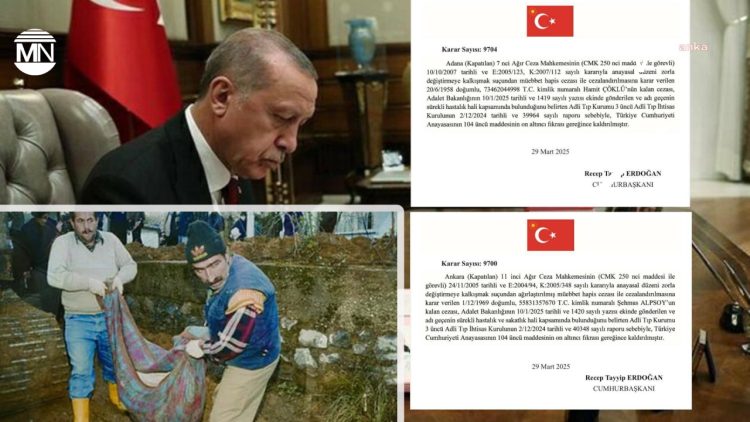
Turkish President Recep Tayyip Erdoğan has issued a pardon for 10 prisoners, including two convicts sentenced to life imprisonment for their involvement in the case of Turkey’s Hizbullah. The official decision, published in the Official Gazette, cited “terminal illness” as the reason for their release.
Among those pardoned is Şehmus Alpsoy, who was convicted in 2000 for “attempting to overthrow the constitutional order by force” and sentenced to aggravated life imprisonment. Alpsoy was found guilty of driving a truck that transported the bodies of individuals murdered by Hizbullah.
The Sunni extremist group, unrelated to the Shi’a Lebanese Hezbollah, became active in southeast Turkey around 1985, one year after the Kurdistan Workers’ Party (PKK) launched its insurgency in 1984. Its rise as a counter force to the secular Kurdish militant PKK marked its early years. Many believe the Turkish state orchestrated its formation to oppose the growing influence of the PKK. Notorious for causing widespread bloodshed in the Kurdish-majority region during the 1990s, it fought the PKK and targeted civilians.
“Belated police operations against Hizbullah often appeared to be carried out for show, rather than as a determined move against a dangerous illegal armed group. Initially, police did not move against the more ruthless Hizbullah Ilim group, which was the target of last month’s operations, but against their rival, the Menzil faction, which was reportedly opposed to attacks on suspected PKK members.”
16 February 2000, “What is Turkey’s Hizbullah?”, A Human Rights Watch backgrounder
Critics point out the contradiction in Turkey’s failure to address these 1990s atrocities, despite international law holding that crimes against humanity—like those attributed to Turkish Hizbullah—face no statute of limitations. The sheer weight of the group’s documented killings, disappearances and torture lingers as an open wound from that brutal decade.
Another convict, Hamit Çoklu, who was sentenced to life imprisonment in 2008 after being arrested in 1998 as part of the Hizbullah investigation, was also pardoned on medical grounds.
Erdoğan has previously granted similar pardons, including in 2023 when he commuted the sentences of Mehmet Emin Alpsoy—Şehmus Alpsoy’s father and a former Hizbullah member convicted of torturing and murdering three people.
Release of Hizbullah gunmen raises questions about Turkish government’s alleged rapprochement
Opposition politicians have strongly criticised these pardons. Main opposition Republican People’s Party (CHP) Deputy Group Leader Murat Emir denounced it as a “gift to Hizbullah” ahead of the Eid holiday, highlighting the ongoing imprisonment of hundreds of youth arrested during peaceful protests against the detention of Istanbul Mayor Ekrem İmamoğlu. Ali Mahir Başarır accused Erdoğan of hypocrisy, pointing out that while students are jailed for exercising their right to protest, members of Hizbullah walk free. Meanwhile, Murat Bakan questioned why convicted killers are being released while political prisoners, including scholars and journalists, remain in prison.


