

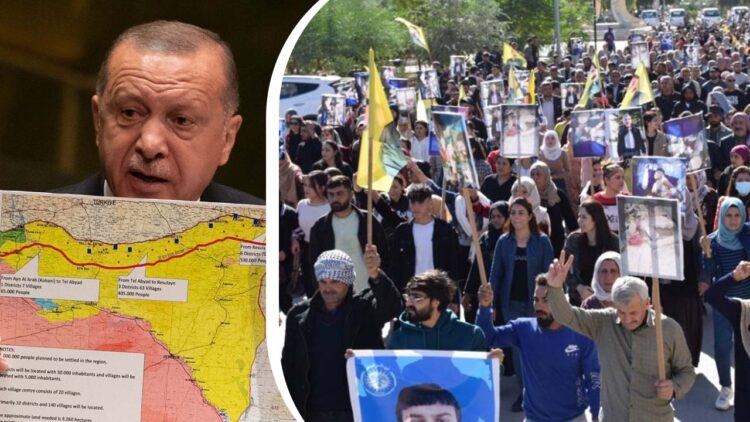
The recent Turkish airstrikes targeting areas under the Democratic Autonomous Administration of North and East Syria (DAANES) have killed at least 27 people, injured many more, and inflicted significant material losses. An analysis authored by Zeki Bedran argues that these attacks are part of a larger Turkish strategy in Syria, with Erdoğan’s government leveraging shifting regional dynamics to expand Turkish influence and military presence, specifically by targeting the Kurdish-led DAANES administration.
According to the analysis, Erdoğan’s primary objective is the eventual dismantling of DAANES authority, beginning with efforts to seize Tall Rifat (Til Rifat) and Shahba (Şehba). With Syria’s Assad government currently weakened and reliant on support from Russia, Iran and Hezbollah—each strained by their respective conflicts—Turkey appears intent on exploiting the situation to secure greater control over the region.
Turkey’s targeting of areas with Kurdish populations is viewed as part of a broader strategy of ethnic displacement. By seizing these territories, Erdoğan aims to displace Kurdish residents and reassert Turkish influence, potentially even threatening the strategic city of Aleppo.
RUSSIA’S LIMITED RESPONSE
Distracted by its ongoing involvement in Ukraine, Russia has taken a relatively passive stance regarding Turkey’s recent actions, focusing on sustaining Assad’s regime without directly challenging Turkish advances. While Russia maintains a strong interest in keeping Assad in power, it has been careful to manage Turkey’s demands to avoid escalating tensions further.
IDLIB AS A STRATEGIC BASE
In Idlib, Turkey aligns itself with Western powers, claiming its military presence is intended to prevent a refugee influx into Turkey should conflicts intensify. Critics argue, however, that Turkey’s presence in Idlib supports Sunni Islamist groups aligned with Erdoğan’s interests, while diminishing Kurdish and local opposition.
GEOPOLITICAL OPPORTUNITIES
The article highlights Erdoğan’s two-pronged strategy—offering ceasefire rhetoric for Palestine and Lebanon while escalating regional militarisation. As Turkey deepens its influence in Syrian Kurdish areas, analysts stress that such actions are part of Erdoğan’s efforts to consolidate domestic support and distract from Turkey’s internal issues, preparing the public for potential new conflicts.


