

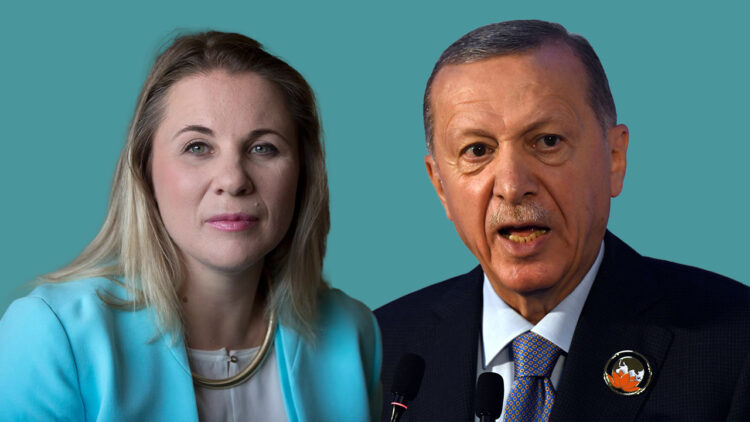
An agreement has been reached to release 50 of the more than 240 civilian hostages held in Gaza by militant Palestinian group Hamas under a temporary lull in Israel’s bombardment of the Strip. In return, Hamas has negotiated the release of at least 150 Palestinian prisoners from Israeli jails.
The main pretext for Hamas’ seizure of hostages, after its 7 October raid killing approximately 1,200 Israeli citizens, was to secure the release of Palestinian prisoners.
There are currently 7,200 Palestinian prisoners being held by Israel, among them women and children, according to the Palestinian Prisoners Society, with at least four in 10 Palestinian men spending some time in their life in Israeli prisons. UN data shows that at least 25 percent of these prisoners have been detained without charge or trial.
Turkish President Recep Tayyip Erdoğan has been vocal in his support of Hamas, hailing the group a “liberation organisation”.
As the tragedy in the region unfolds, Ksenia Svetlova, a former Israeli parliamentarian and non-resident fellow at the Atlantic Council, points out in her Jerusalem Post article the hypocrisy in Erdoğan’s ‘enthusiastic support’ for the release of Palestinian prisoners, considering Turkey’s record of incarcerating Kurdish political prisoners.
“Erdoğan has a soft spot for Palestinian prisoners,” Svetlova said. “Meanwhile, as [he] calls on Israel to release all Palestinian prisoners, there are over 38,000 Kurdish prisoners held in Turkish jails.”
“Many are detained without trial. Among them are a number of top political figures,” she added, naming incarcerated former Peoples’ Democratic Party (HDP) co-chairs Selahattin Demirtaş and Figen Yüksekdağ.
Svetlova highlighted the most controversial of Turkey’s detentions, Kurdistan Workers’ Party (PKK) leader Abdullah Öcalan.
“While Öcalan led a military insurgency against Turkey during the 80s and 90s, in 2013 he conveyed a message expressing the need for a transition from armed struggle to political struggle,” she explained.
“Öcalan is a key figure for peace in the Middle East. […His idea of] Democratic Confederalism offers a viable alternative to the current war.”
His vision led to the “birth of Rojava”, she continued. “An area in which co-existence among the diverse ancient peoples of the region is now possible.”
Svetlova pointed to Öcalan’s insightful interview on Greek TV during the 1990s, at the height of the Turkish-Kurdish conflict, when he said: “I’m against bombing civilian populations, it is against my approach to war to bomb innocent civilians. Also, Hamas’s political aims harm the Palestinians.”
Concluding, Svetlova said:
“Today, when world leaders discuss a possible deal between Israel and Hamas that might lead to the release of the hostages in return for the release of Palestinian prisoners, they should also keep in mind Kurdish political prisoners in Turkey and their leader Abdullah Öcalan, who will soon mark 25 years in his island prison.”


